

Ten artykuł jest w trakcie pracy. Będą nowe poprawki i nowe zdjęcia.
This article is not finished. There will be forthcoming textual edits and more images.
This article is not finished. There will be forthcoming textual edits and more images.
This document records the early formation of a cross-Atlantic geneological and ethnographic practice. What began as a fifth-generation return toward a world my family line no longer knew has become a structured effort to connect genealogy, archive work, field documentation, musical practice, and public dissemination.
The work remains in progress. What follows is not a finished project, but the first serious phase of one.
I. What Came Before Poland
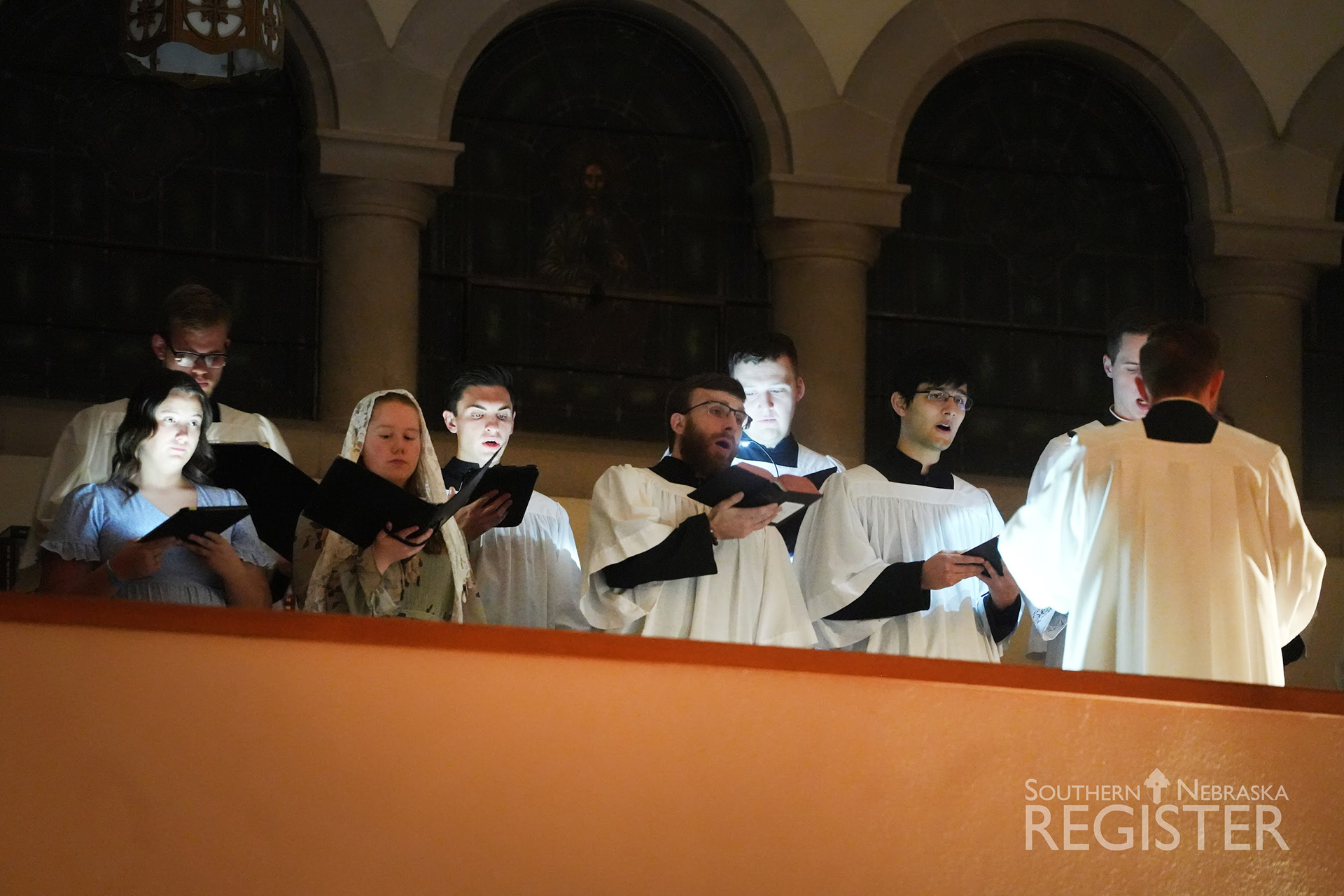
For over a decade, my professional life was graphic design. It taught discipline, clarity, sequencing, and how to build work meant to endure. Alongside that, I participated in personal research: history, family genealogy, religious tradition, Latin, and Gregorian chant. Through those forms, an older question began to press on me. If my ancestors prayed this way, how else did they live?
The absence was striking once I saw it. I had grown up without Polish language, without Polish folk music, and without much sense of the social world my family had left behind. Names had survived. A fuller inheritance had not.
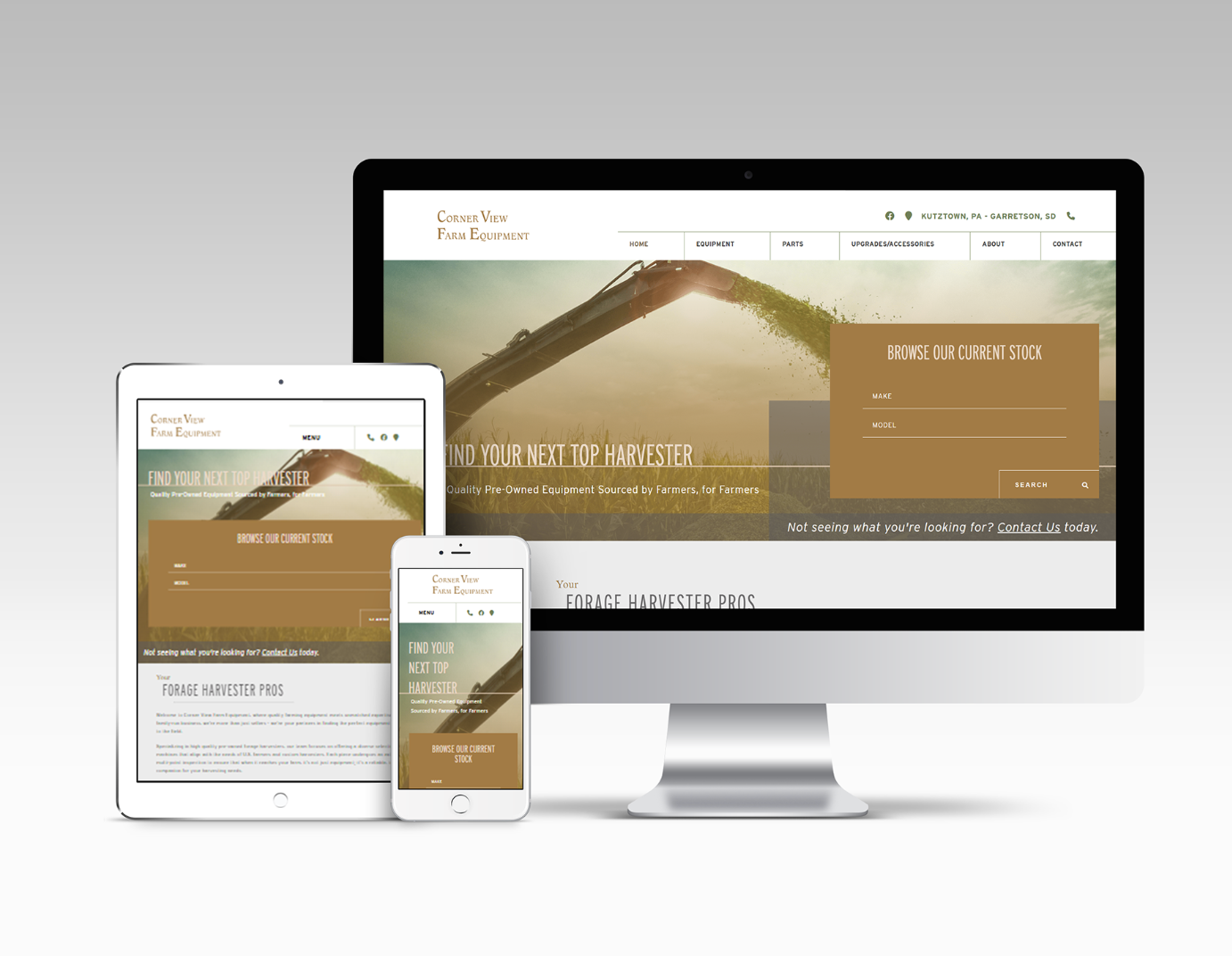
• Professional base: More than ten years of work in graphic design, web design, teaching, and public communication
• Transferable skills: Clarity, structure, documentation, visual presentation, audience awareness
• Early line of inquiry: Family history, religious practice, and the cultural world surrounding them
• Transferable skills: Clarity, structure, documentation, visual presentation, audience awareness
• Early line of inquiry: Family history, religious practice, and the cultural world surrounding them
• Skills in musical transmission: Country concert gigs, Gregorian Chant / polyphony at church
• Initial problem: Strong ancestral identity with weak cultural memory
• Initial problem: Strong ancestral identity with weak cultural memory
II. First Contact: Poland Answers
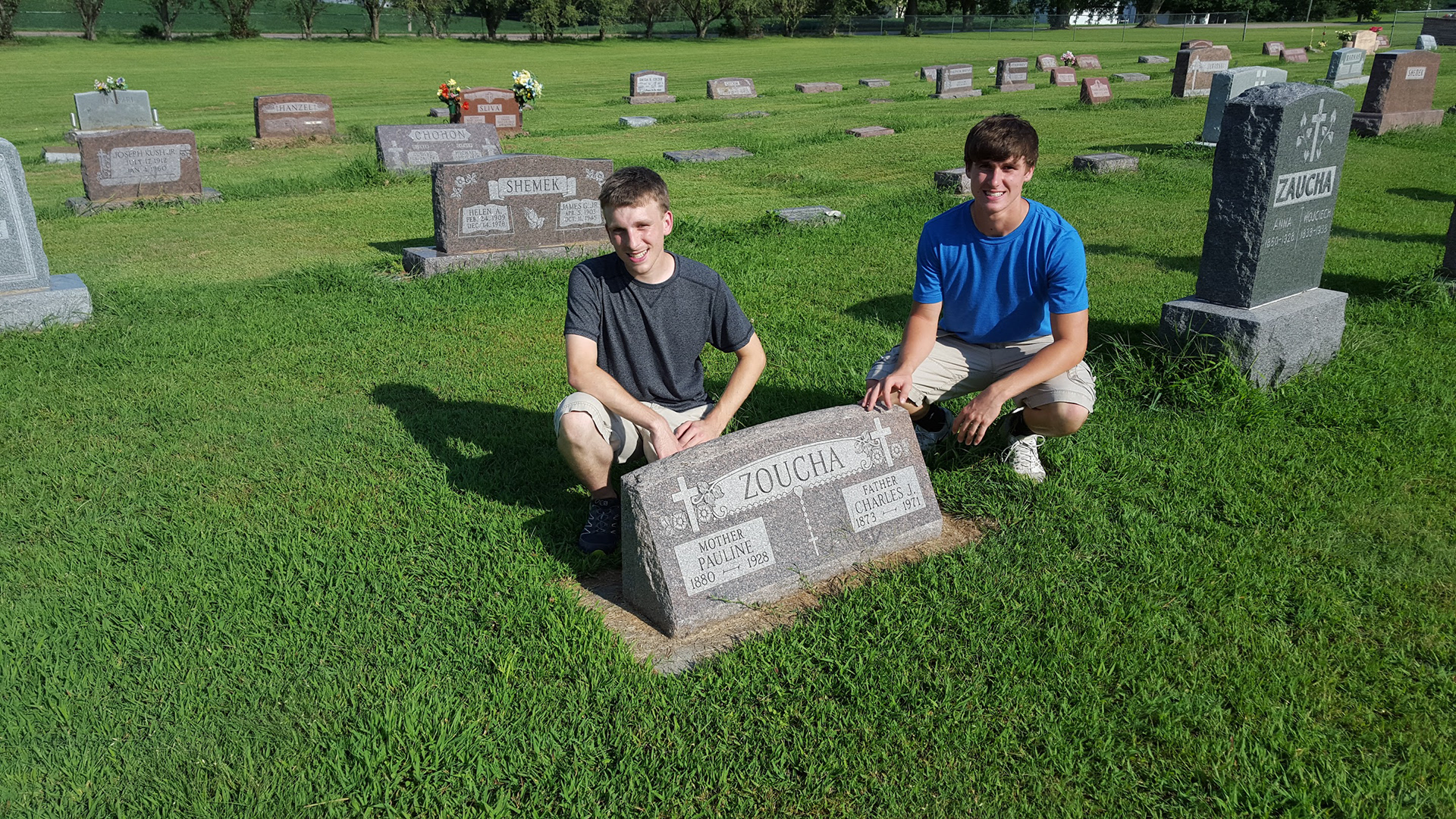
My first turn toward Poland came almost by accident. I had been planning a religious pilgrimage to France, with Poland treated as a brief stop at the end. At that point, my family knew very little. My great-great-grandfather was a name on a page. He had left, had children, and died. No one could name a village. No one could name a parish. What came before emigration was largely blank.
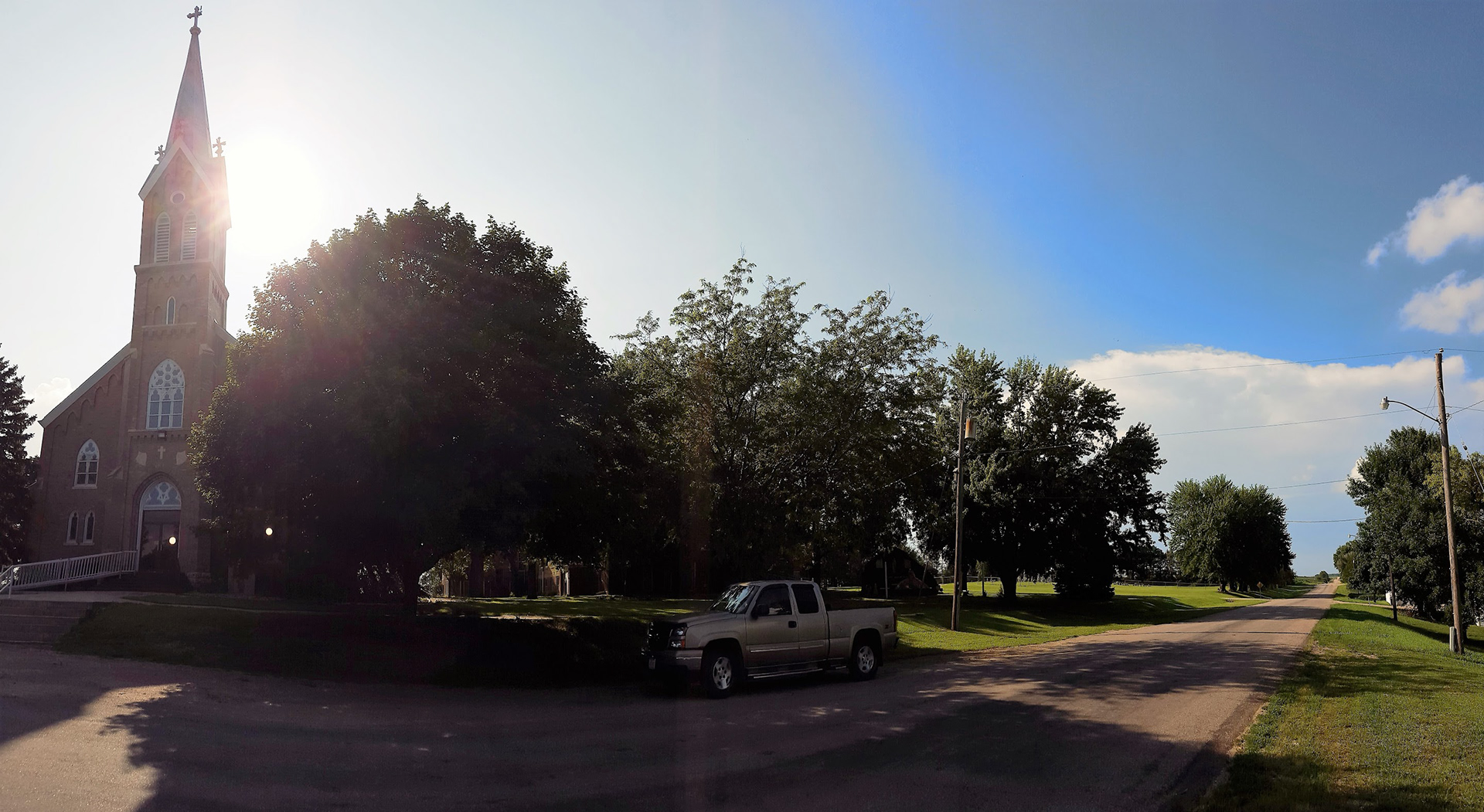
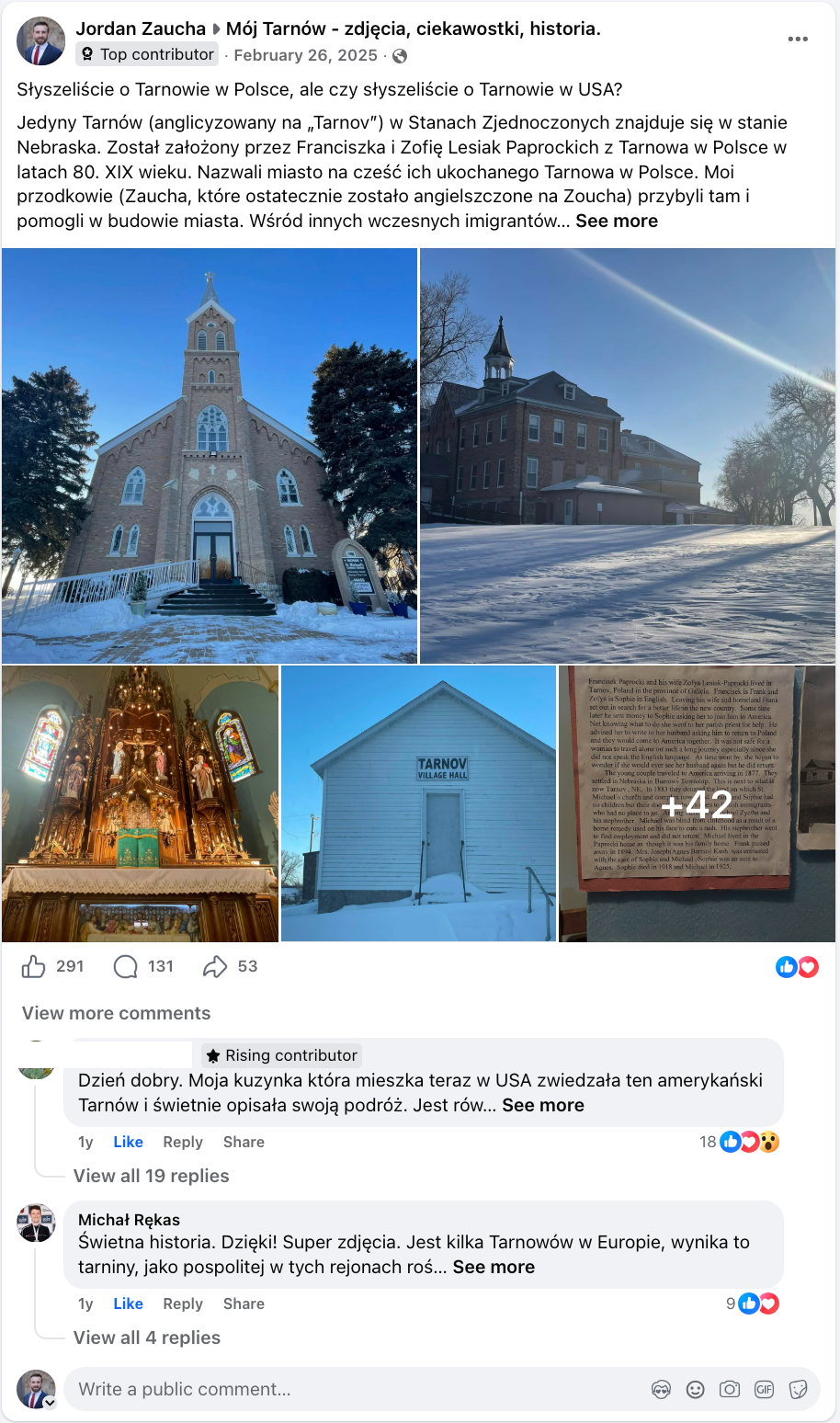
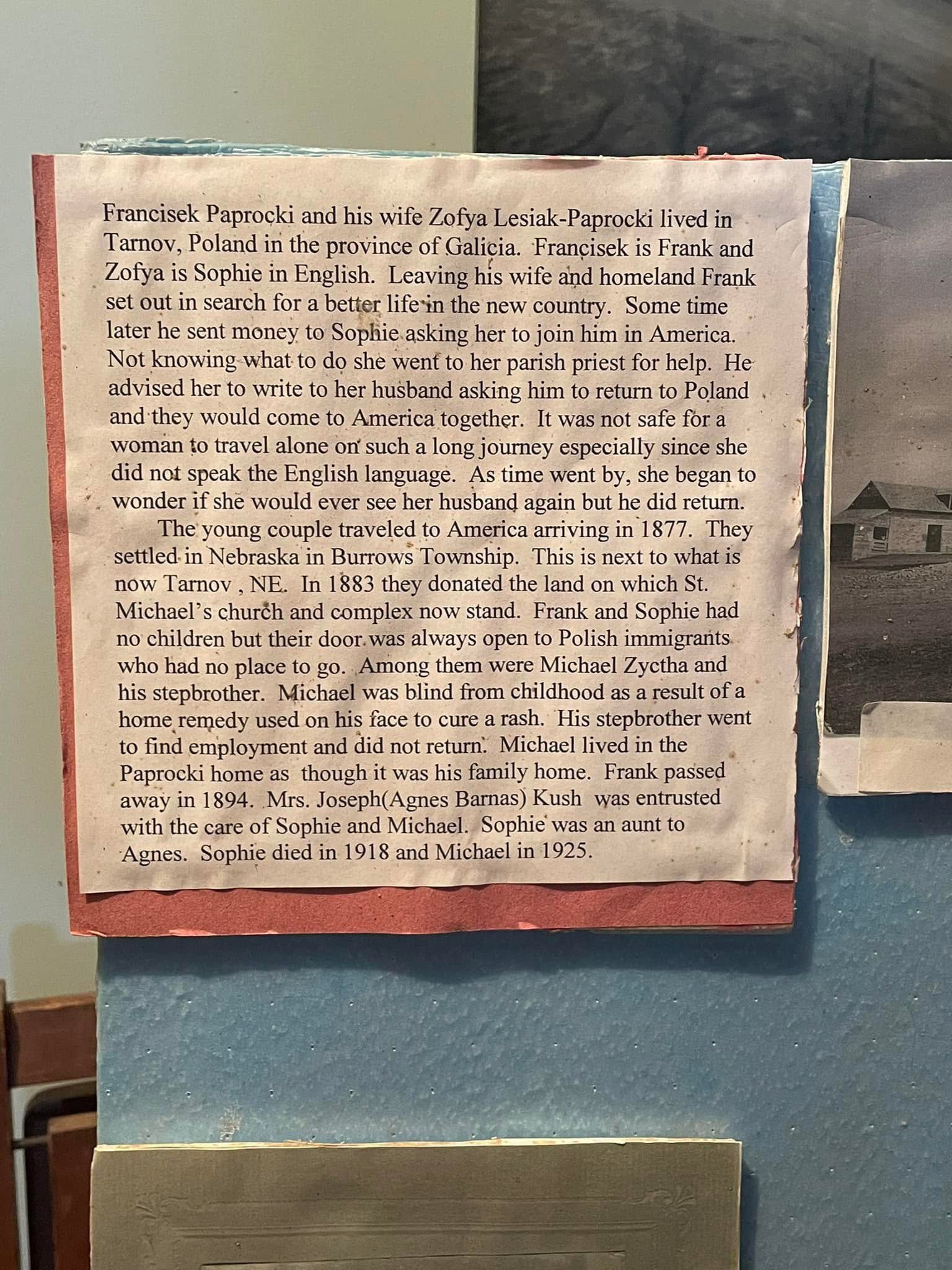
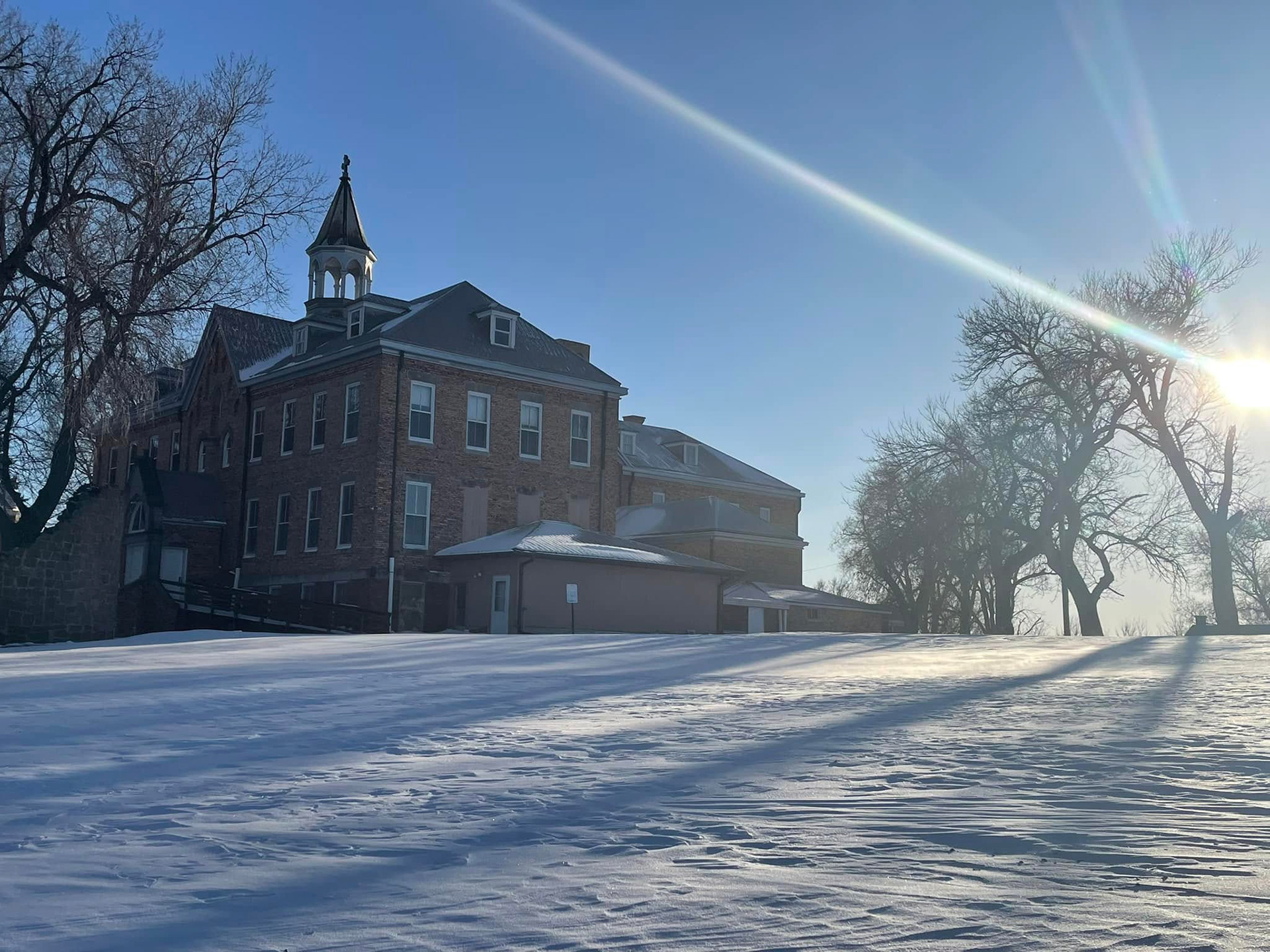
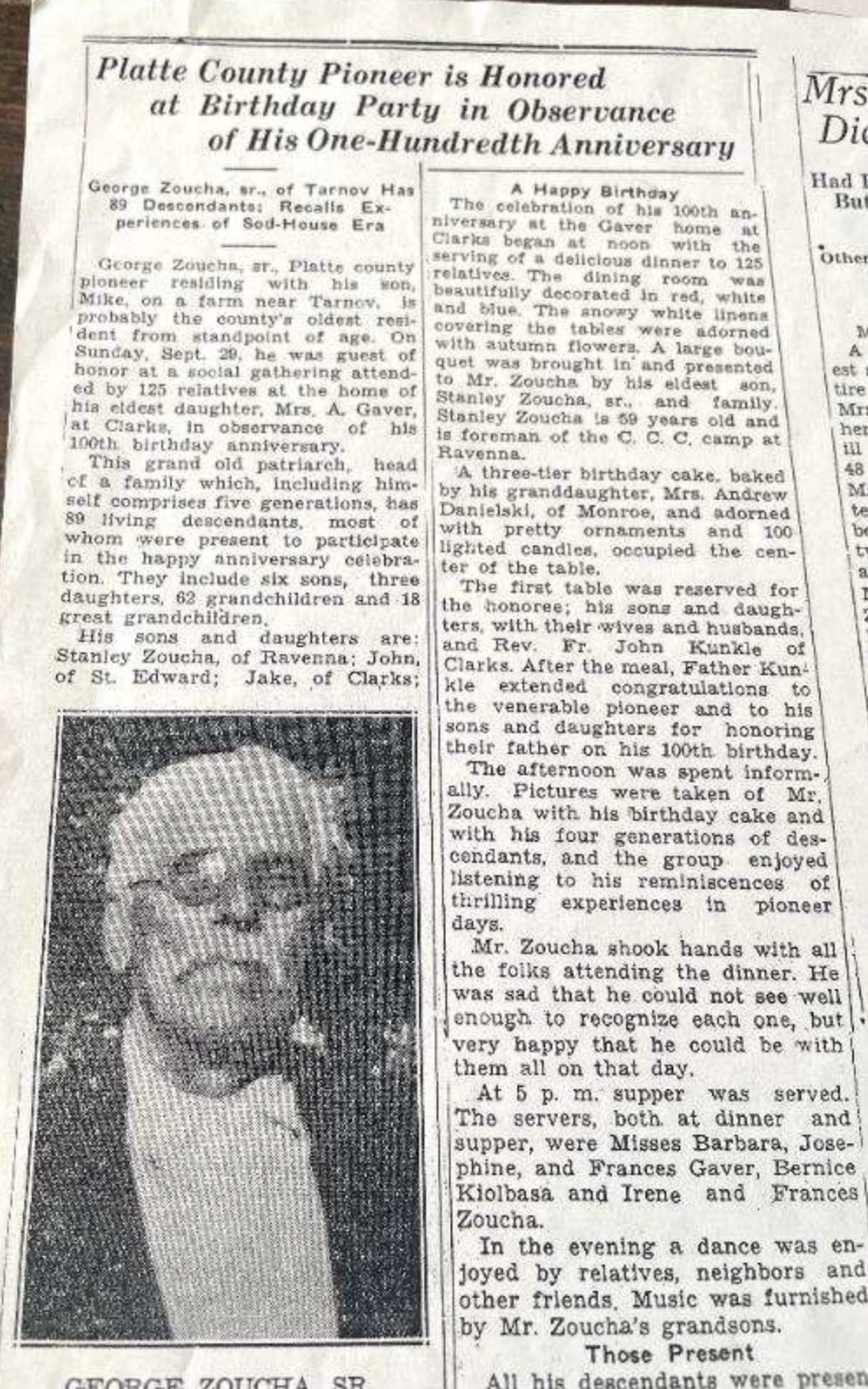
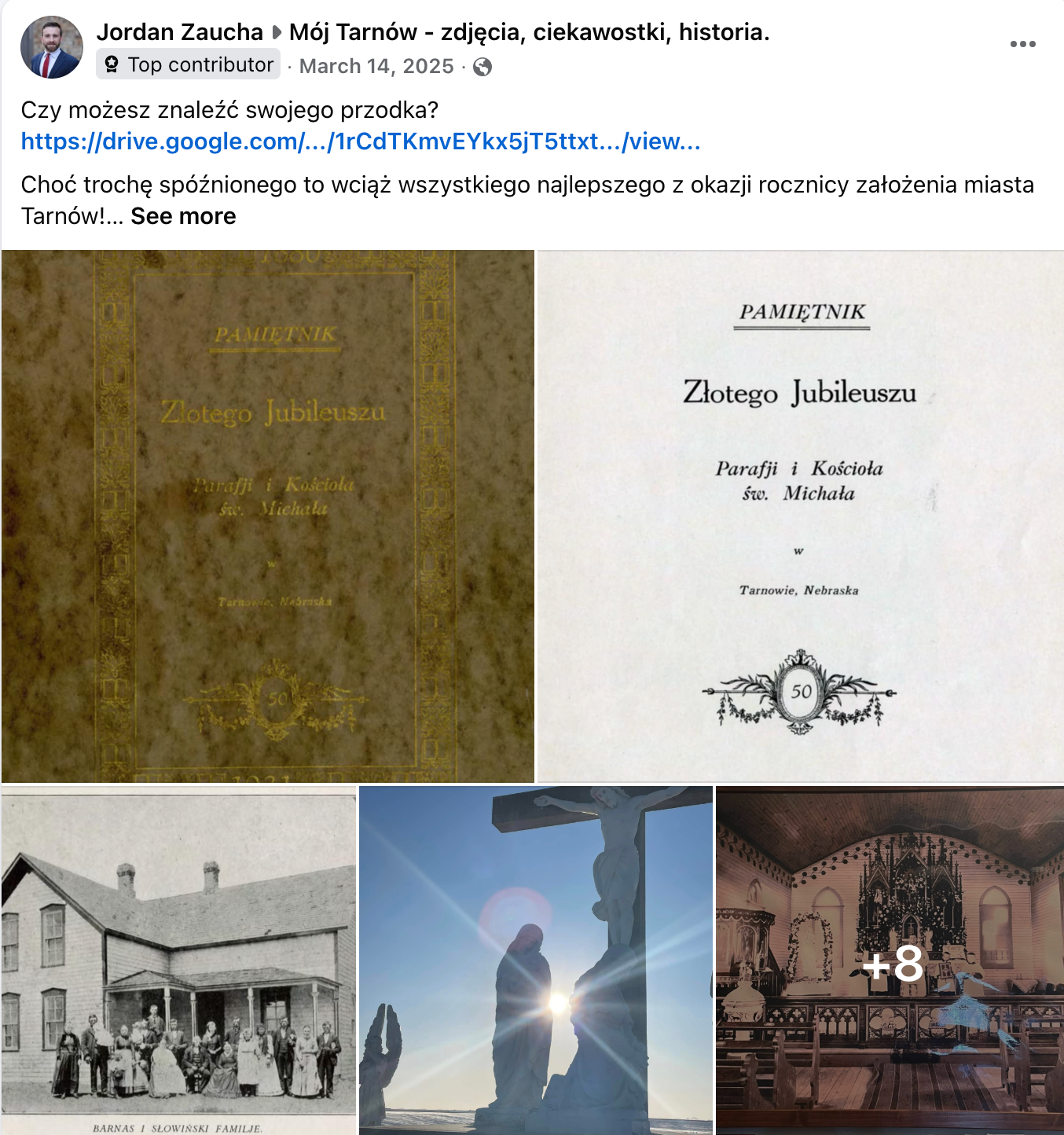
I started doing family research more seriously, joined a few relevant Facebook groups, and followed leads from the FamilySearch Center in Lincoln, Nebraska. During a winter visit to Tarnov, Nebraska, I photographed the parish grounds and museum, then wrote a short history post in careful, imperfect Polish for the Mój Tarnów group. By the next morning the post had drawn strong engagement, and messages began arriving from people in Poland who knew the names, the terrain, and the villages themselves.
For the first time in roughly 150 years, someone from my line was speaking back across the Atlantic to the place from which it had departed.
Poland stopped being an abstraction and became a live conversation.
Additionally, I began reaching folk musicians in Poland: Kapela Dusa, Guziowianka, and other bands. Surprisingly, many were very open to speaking, and some have since become friends.
These early connections eventually opened paths to higher institutional connections, such as the National Centrum Folkloru Polskiego Karolin, and connections to the National Ensemble Mazowsze.
• Catalyst: FamilySearch referral and focused diaspora research
• Public action: Polish-language post linking Tarnov, Nebraska and Tarnów, Poland
• Early reception: Strong response, new contacts, direct messages from residents of the home region
• Research shift: Travel curiosity became a targeted search for place, parish, and kin
• Significance: First documented re-entry of the family line into contact with the ancestral region in generations
• Public action: Polish-language post linking Tarnov, Nebraska and Tarnów, Poland
• Early reception: Strong response, new contacts, direct messages from residents of the home region
• Research shift: Travel curiosity became a targeted search for place, parish, and kin
• Significance: First documented re-entry of the family line into contact with the ancestral region in generations
III. The Turn Toward Poland
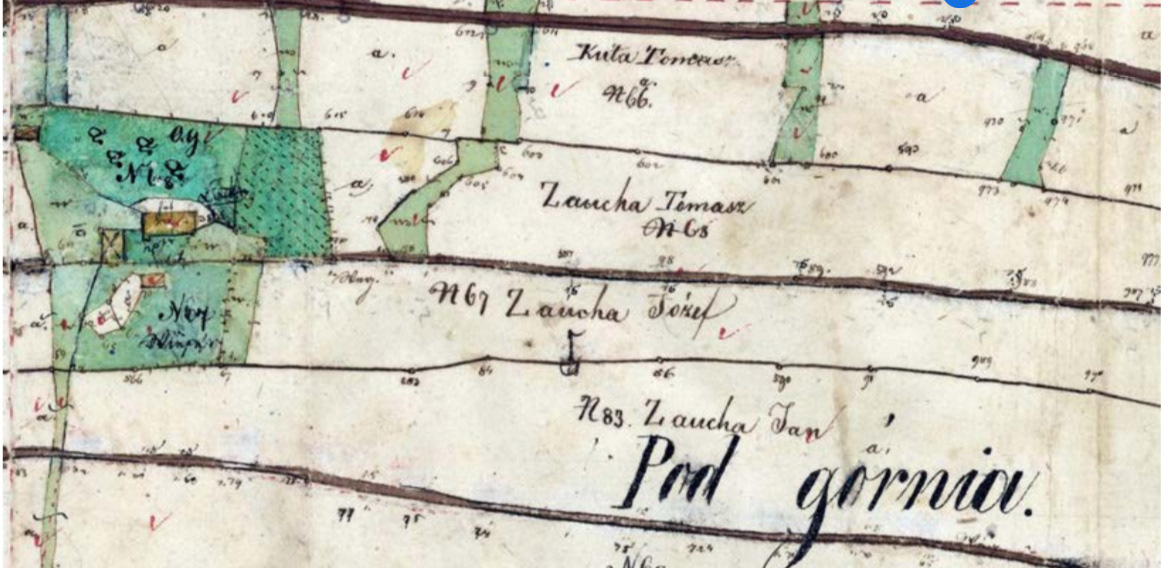
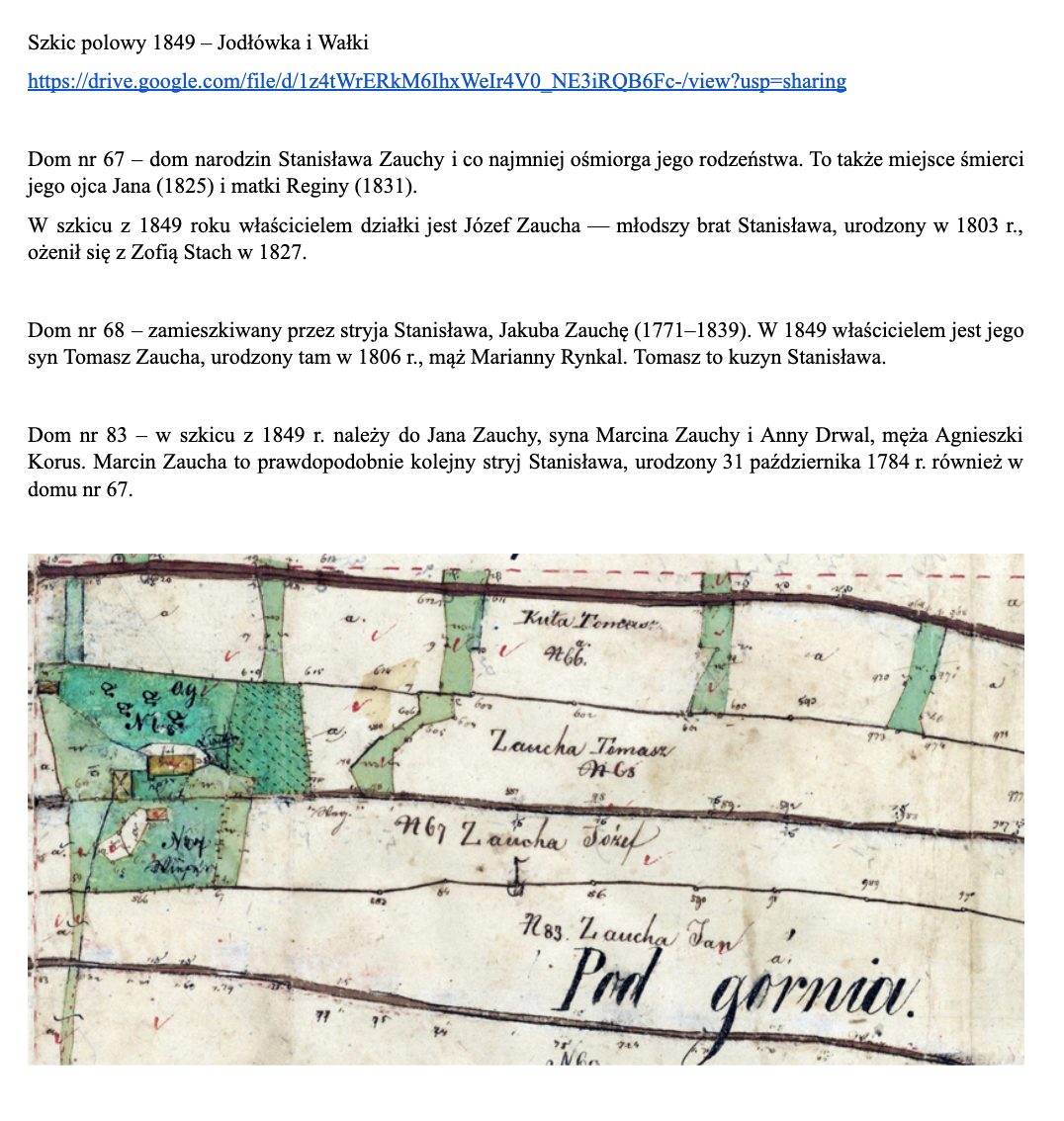
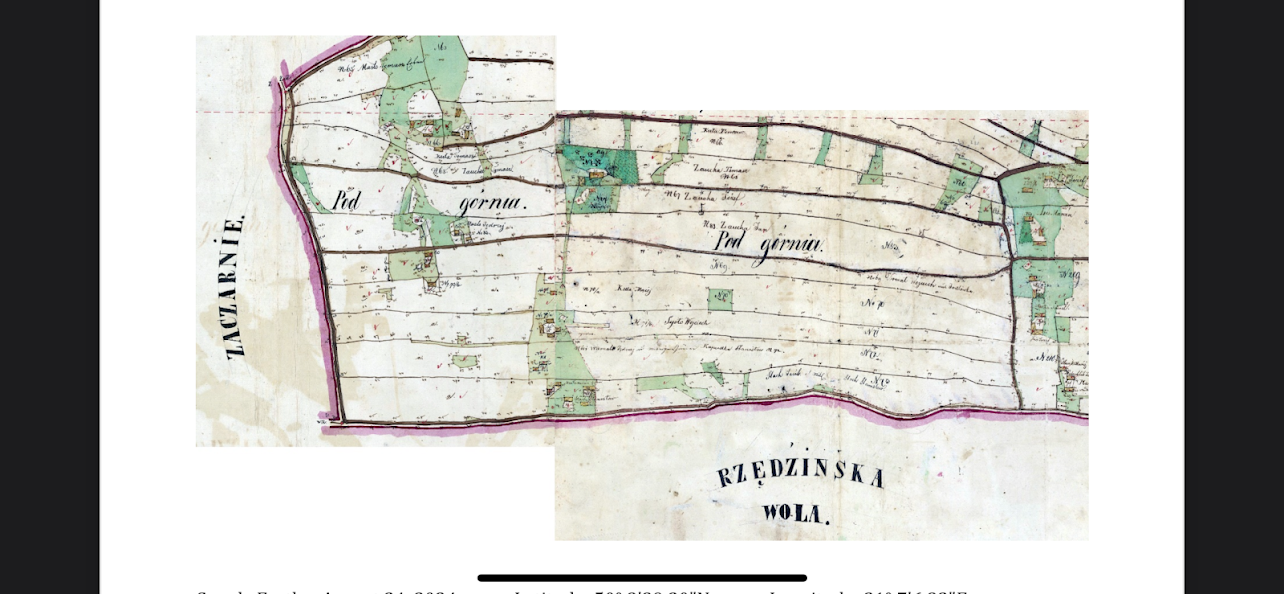
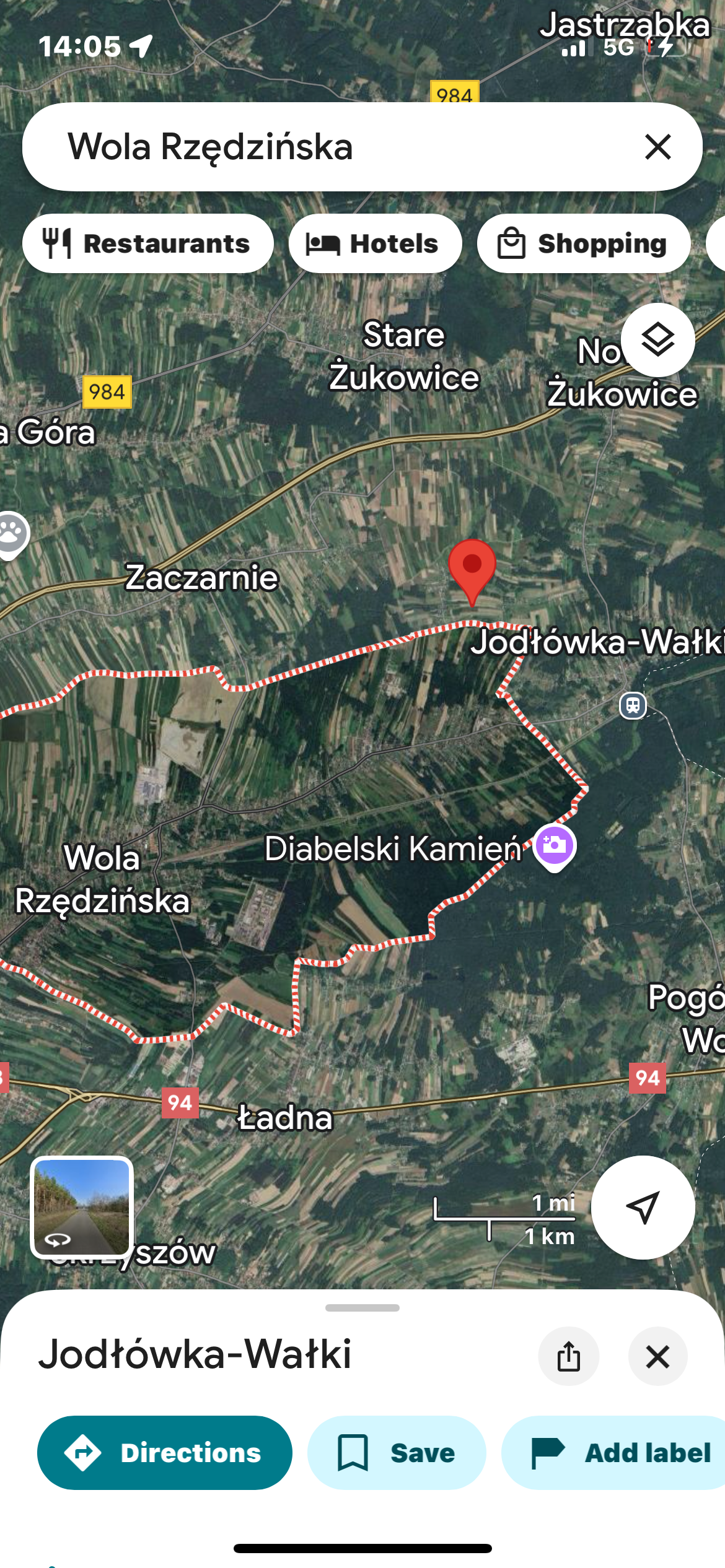
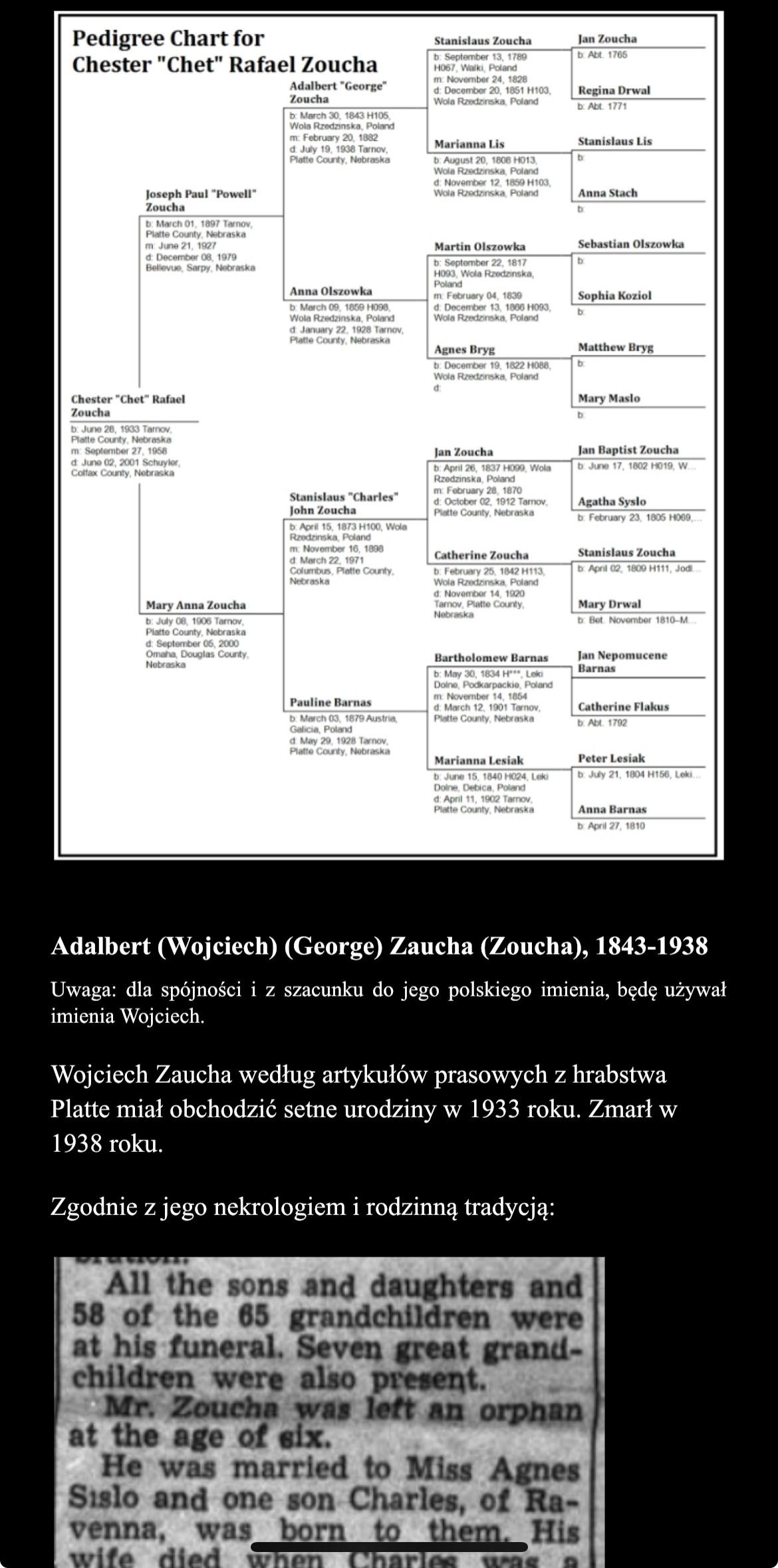
Once that contact was made, the work intensified. I sent hundreds of inquiries to archives, parishes, and institutions across Poland, Ukraine, and former Galicia. With help from the FamilySearch Center in Lincoln and sustained collaboration with my friend Mike Korgie, I traced the line past Tarnów and farther into the region until one name emerged with force: Wola Rzędzińska. For a family line that had lost its coordinates, the village was no longer rumor. It was locatable, documentable, and real.
Around the same time, another line of inheritance came into focus. My grandmother had once given me a Polish record album recorded by distant relatives in Nebraska in the 1970s. I had played it on feast days without really knowing what I was hearing. Later, after asking why other families still knew how their ancestors sang and danced while mine did not, I began listening seriously to Polish regional music. That search opened a different map: krakowiak, kujawiak, góralskie, village repertoire, and regional distinctions far older and more precise than the flattened Midwestern category of “polka.” I bought a violin, began studying Polish daily, and started building the tools for work I did not yet fully understand.
Genealogy and music stopped running as separate interests. They began to converge.
• Research scale: Hundreds of archive, parish, and institutional inquiries across borders
• Core discovery: Identification of Wola Rzędzińska and neighboring Tarnów-region lines
• Key collaborators: Mike Korgie; FamilySearch Center; Polish contacts including Nina Szczerbowska, a coworker I met with daily
• Skill-building response: Began Polish study and violin practice
• Emerging method: Genealogy, music, and regional history brought into one working frame
• Core discovery: Identification of Wola Rzędzińska and neighboring Tarnów-region lines
• Key collaborators: Mike Korgie; FamilySearch Center; Polish contacts including Nina Szczerbowska, a coworker I met with daily
• Skill-building response: Began Polish study and violin practice
• Emerging method: Genealogy, music, and regional history brought into one working frame
IV. Arrival and Immediate Immersion
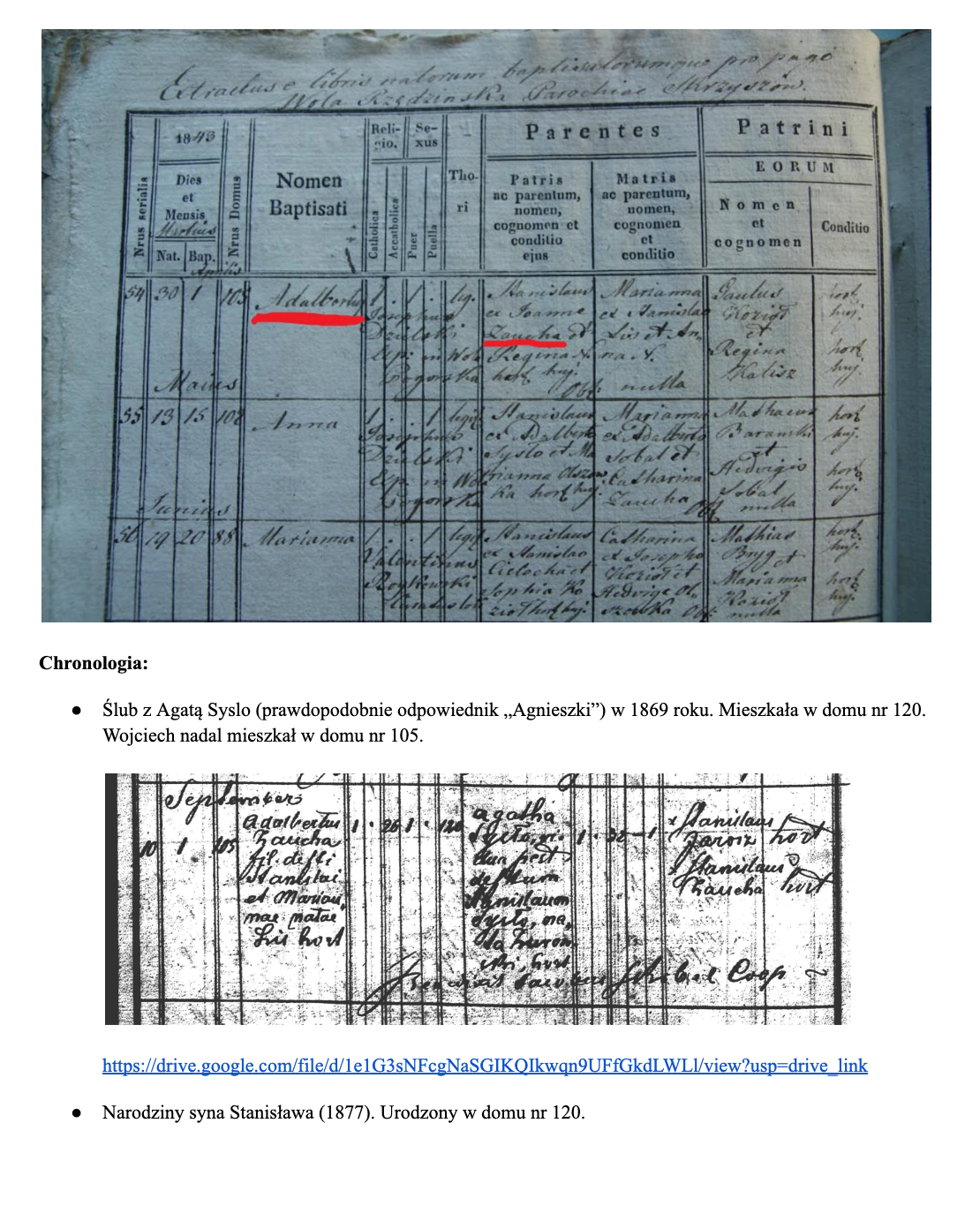
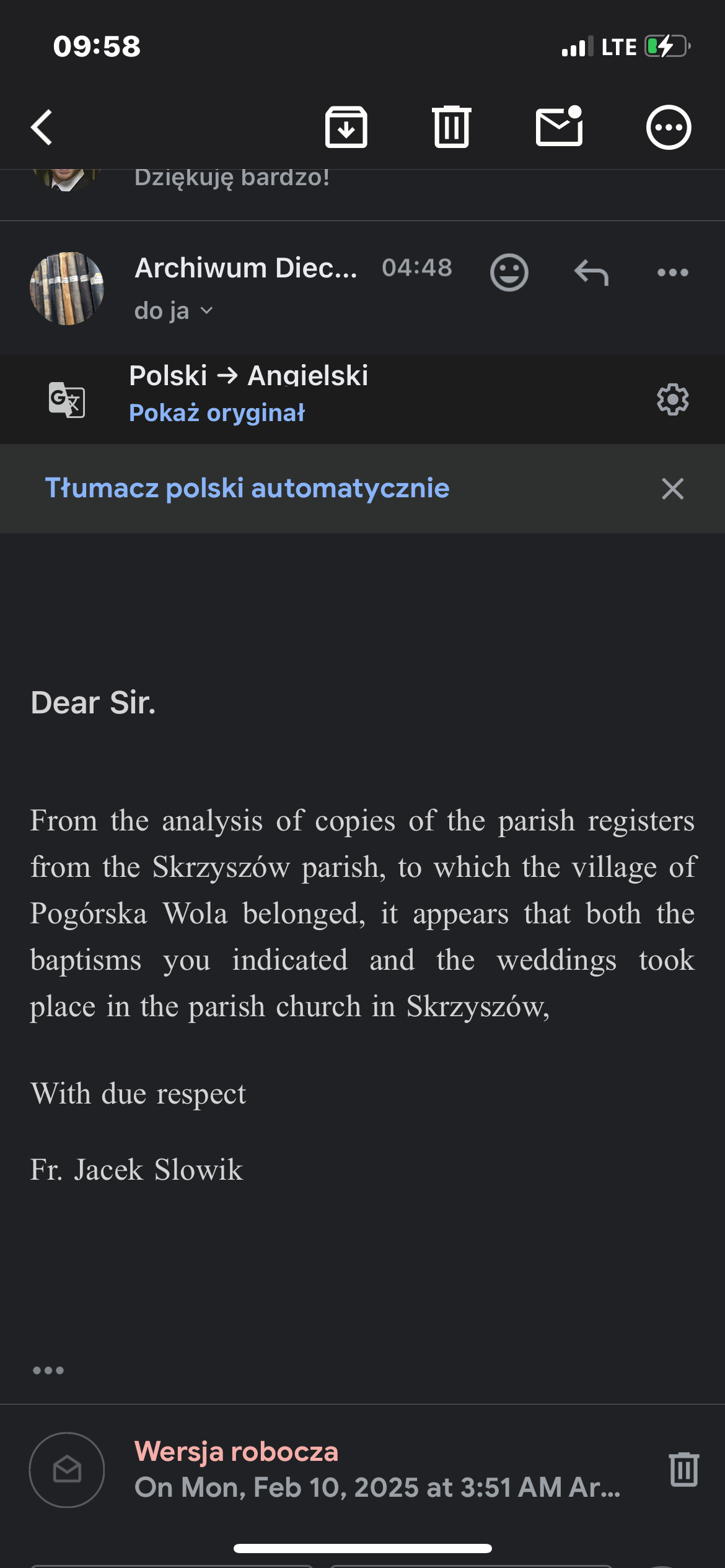
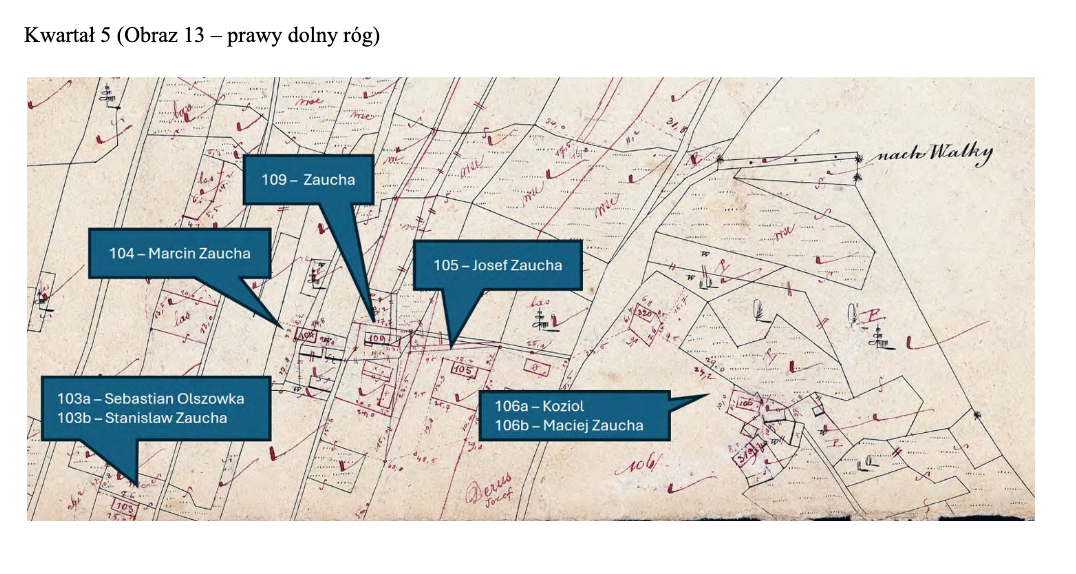
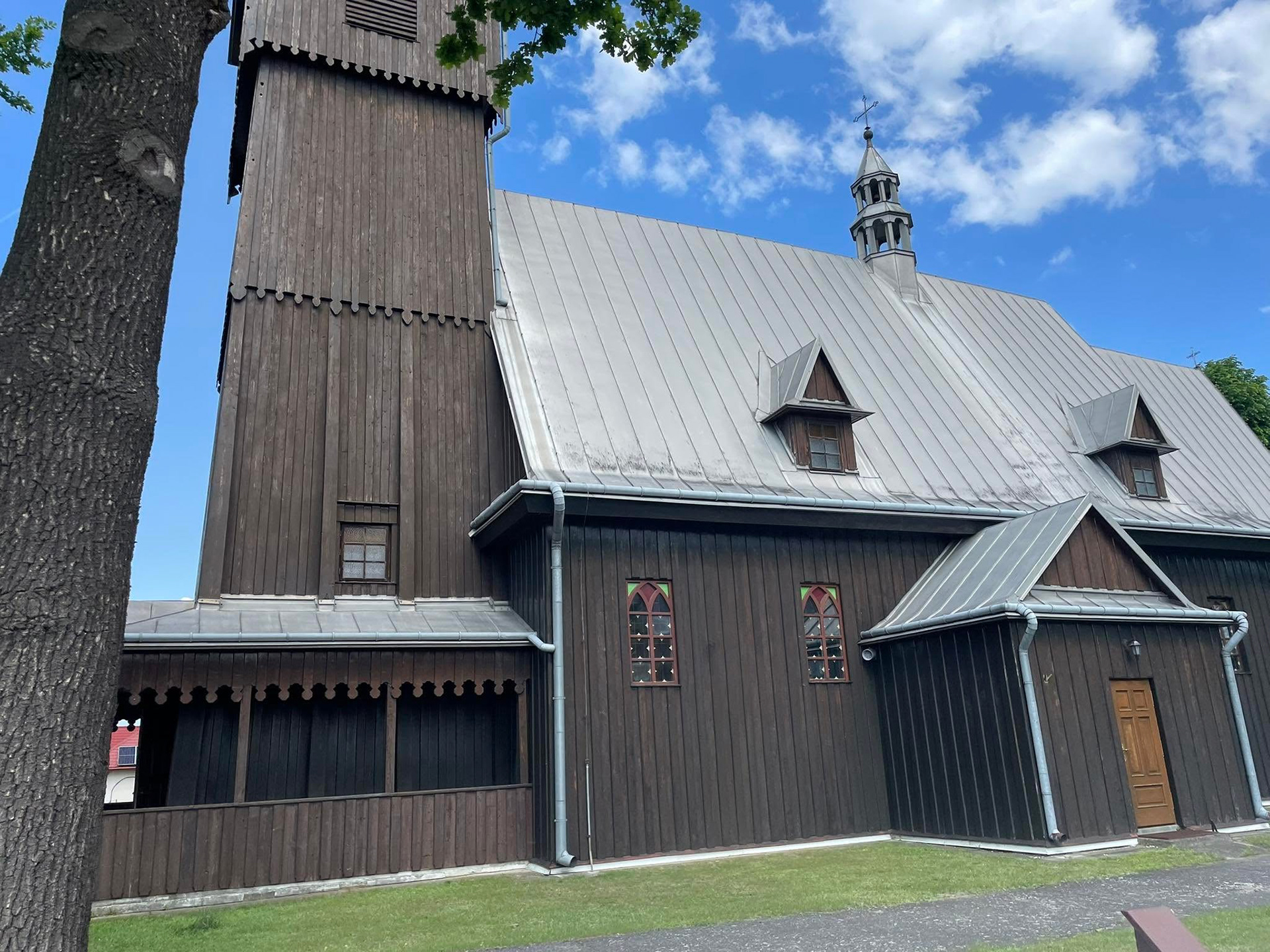
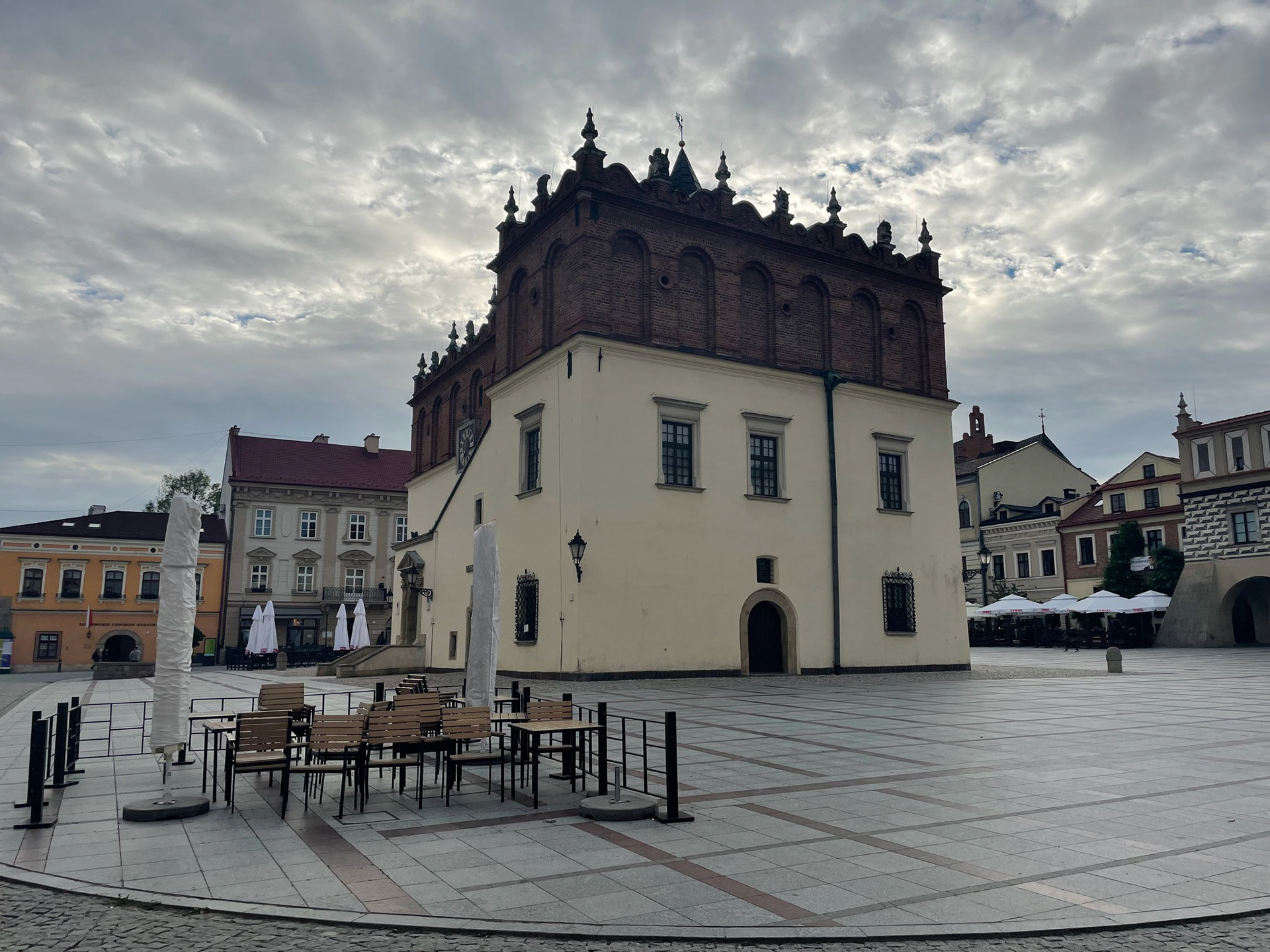
When I finally arrived in Poland, I did not arrive as a tourist. I went within the first hours to Mass at my ancestral parish in Skrzyszów (Parafia Rzymskokatolicka pw. Świętego Stanisława BM).
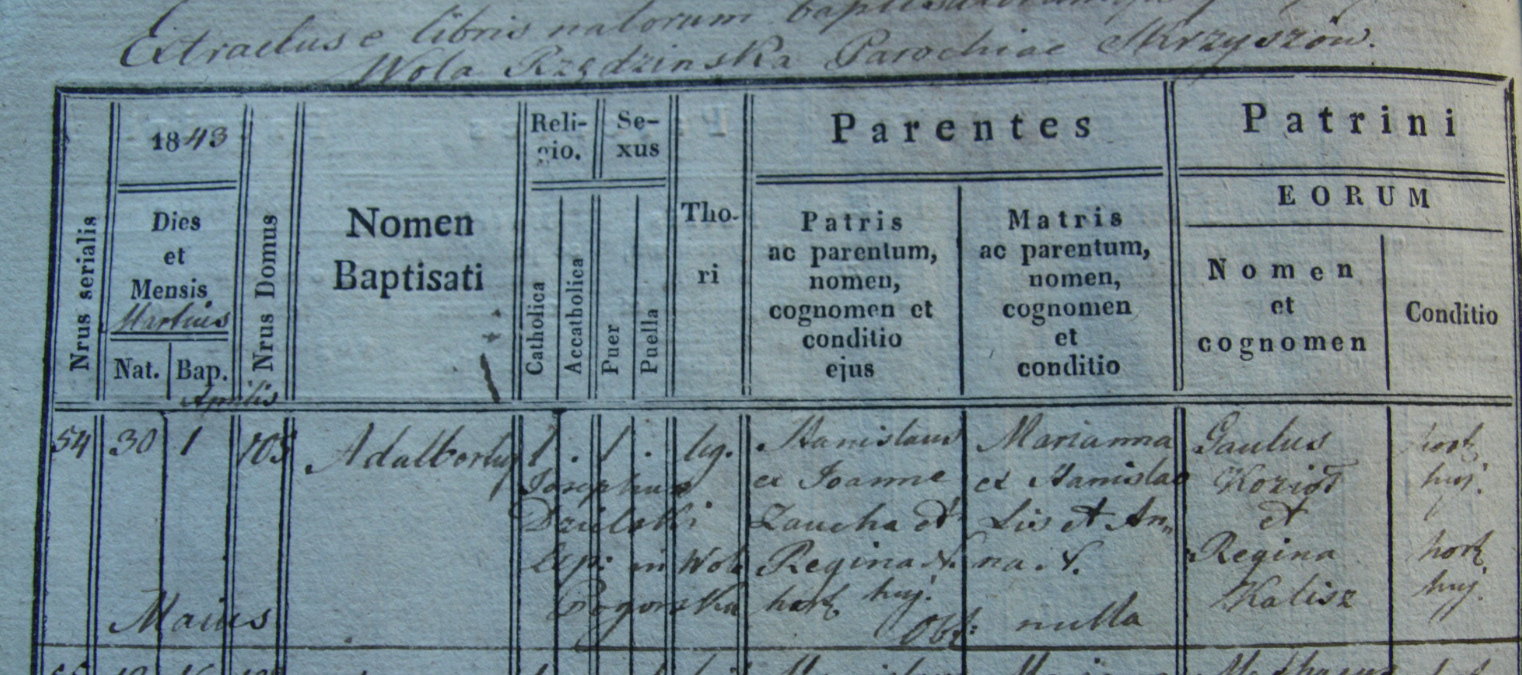
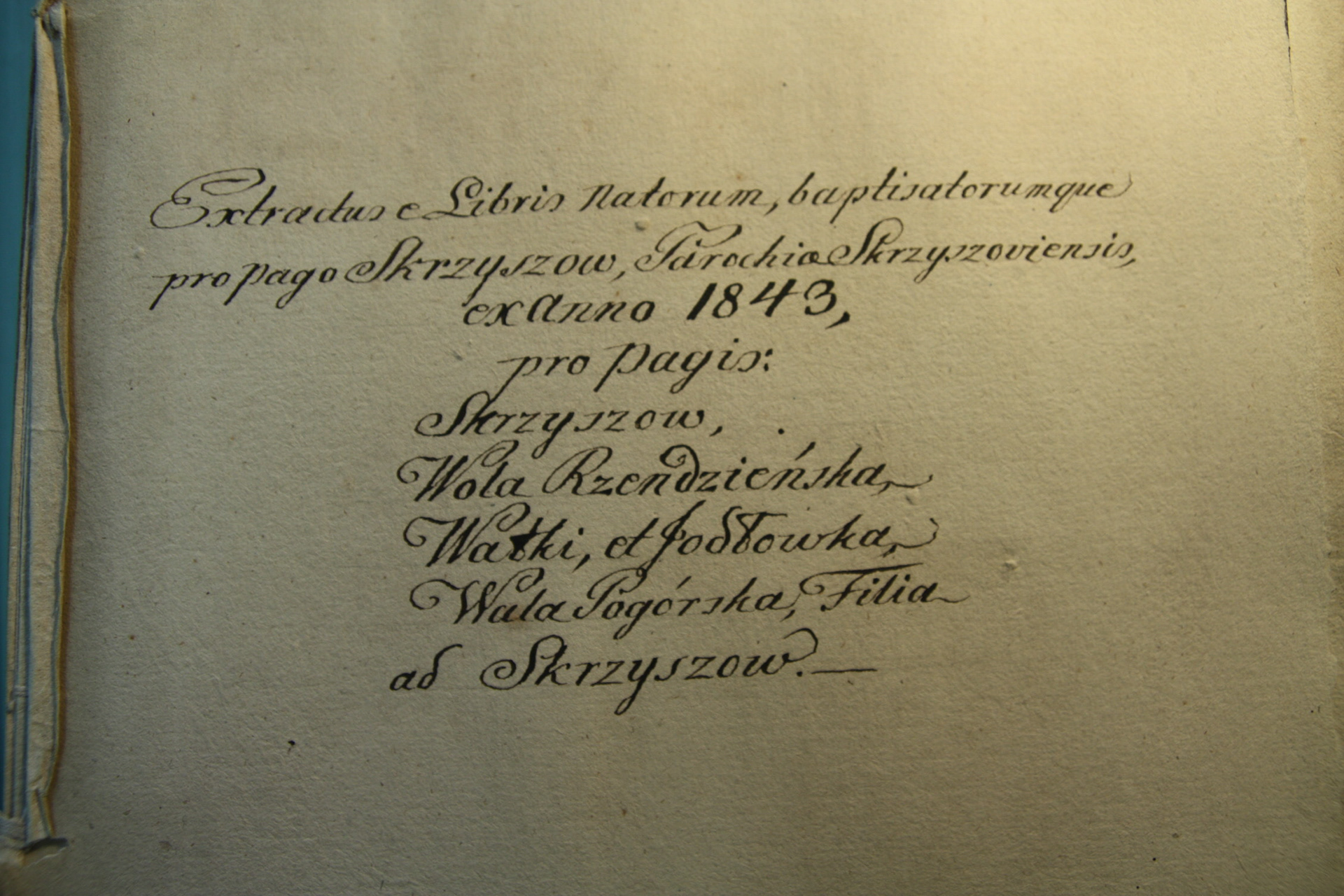
I approached a man sitting outside of the church. I pulled out the paper I had brought with me, a parish record, my finger resting under the date.
"Rok eighteen forty-three,"
I said, half in English, half in what could barely be called Polish. His eyes widened. The pause turned into something else: recognition, then excitement. He leaned closer, and suddenly
"Chodź, chodź,"
he said, and led me toward the back. Within minutes I was meeting a new friend Dominika Nowak and members of her family, all slightly stunned that someone had arrived from America holding proof of belonging from 1843, speaking in an accent they had only heard in films.
It felt surreal: standing in a foreign country, my ancestors’ church, explaining a document older than any living person in the room. In that instant, the abstraction that lived in America dissolved. Suddenly it was a place where the past could step forward into the room unannounced.
That scene remains important because it established the tone of the work to follow. Entry came through names, parish memory, documents, and live recognition. The research had crossed out of paper and back into place.
• First steps in Poland: Divine Mercy Sanctuary; ancestral parish Mass; direct introduction in the home region
• Proof in hand: Parish documentation used in live local encounters
• Language condition: Immediate use of imperfect Polish in real social and religious settings
• Outcome: Recognition and acceptance through surname, village connection, and documentary evidence
• Proof in hand: Parish documentation used in live local encounters
• Language condition: Immediate use of imperfect Polish in real social and religious settings
• Outcome: Recognition and acceptance through surname, village connection, and documentary evidence
V. Family
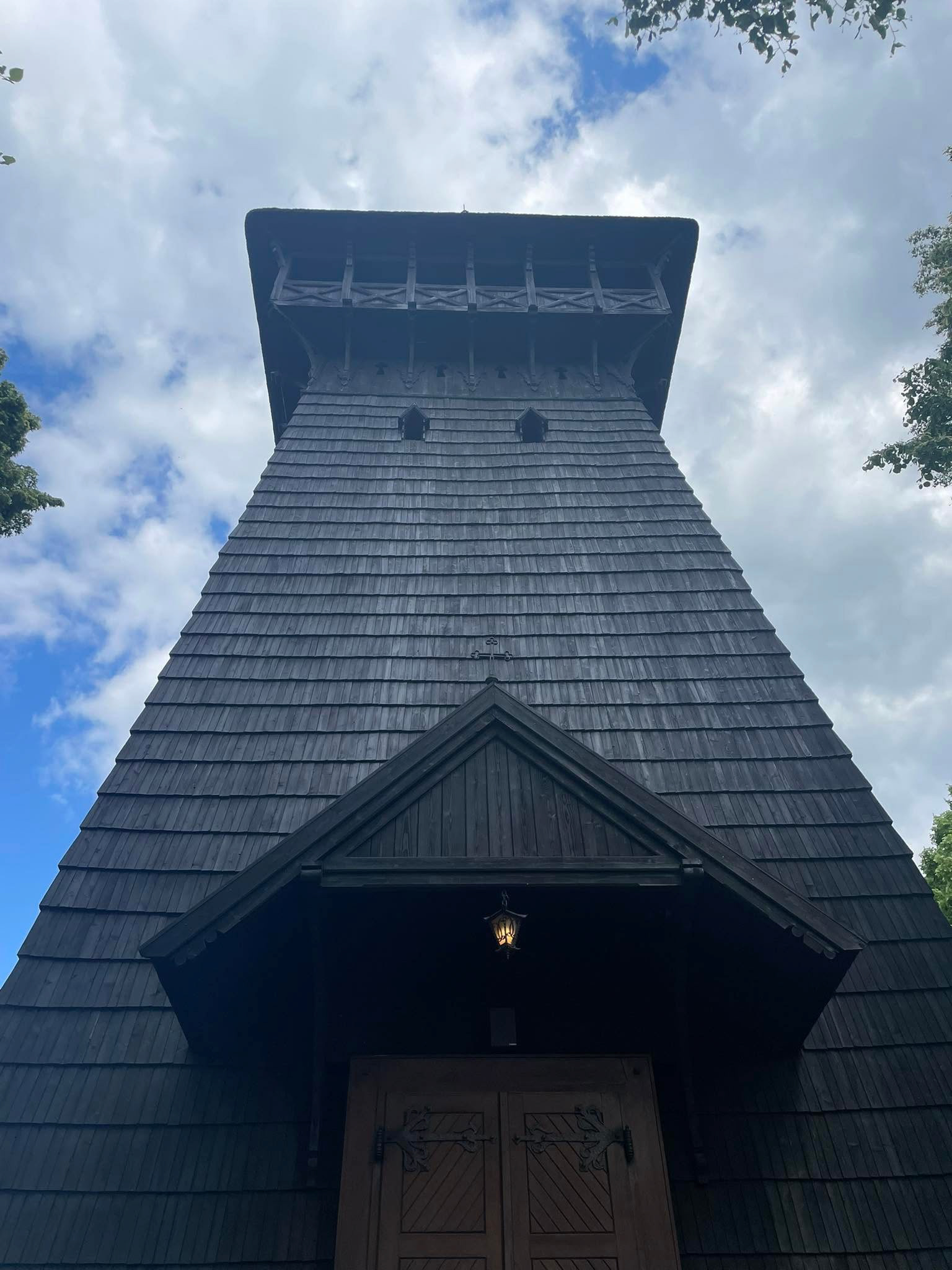
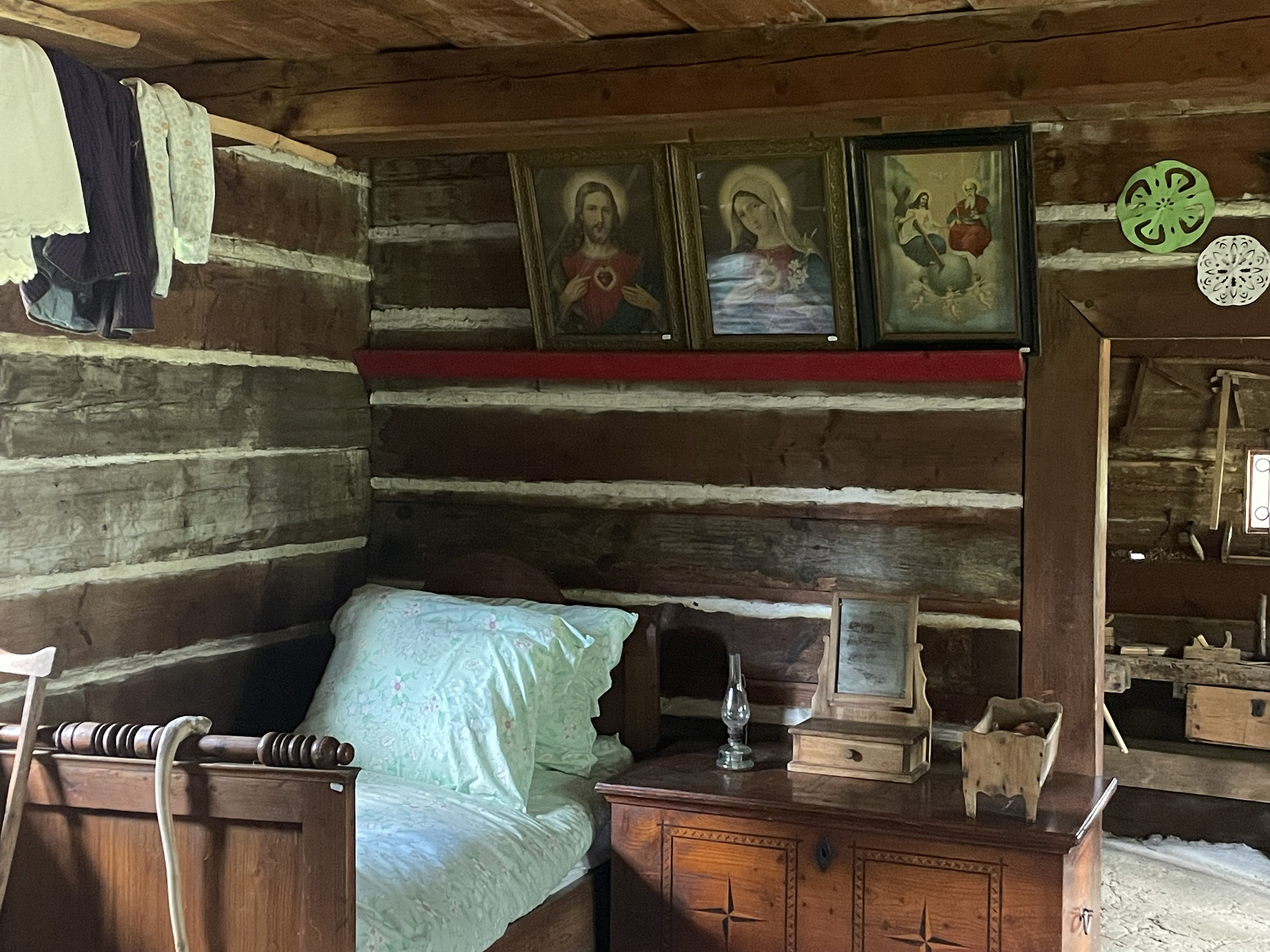
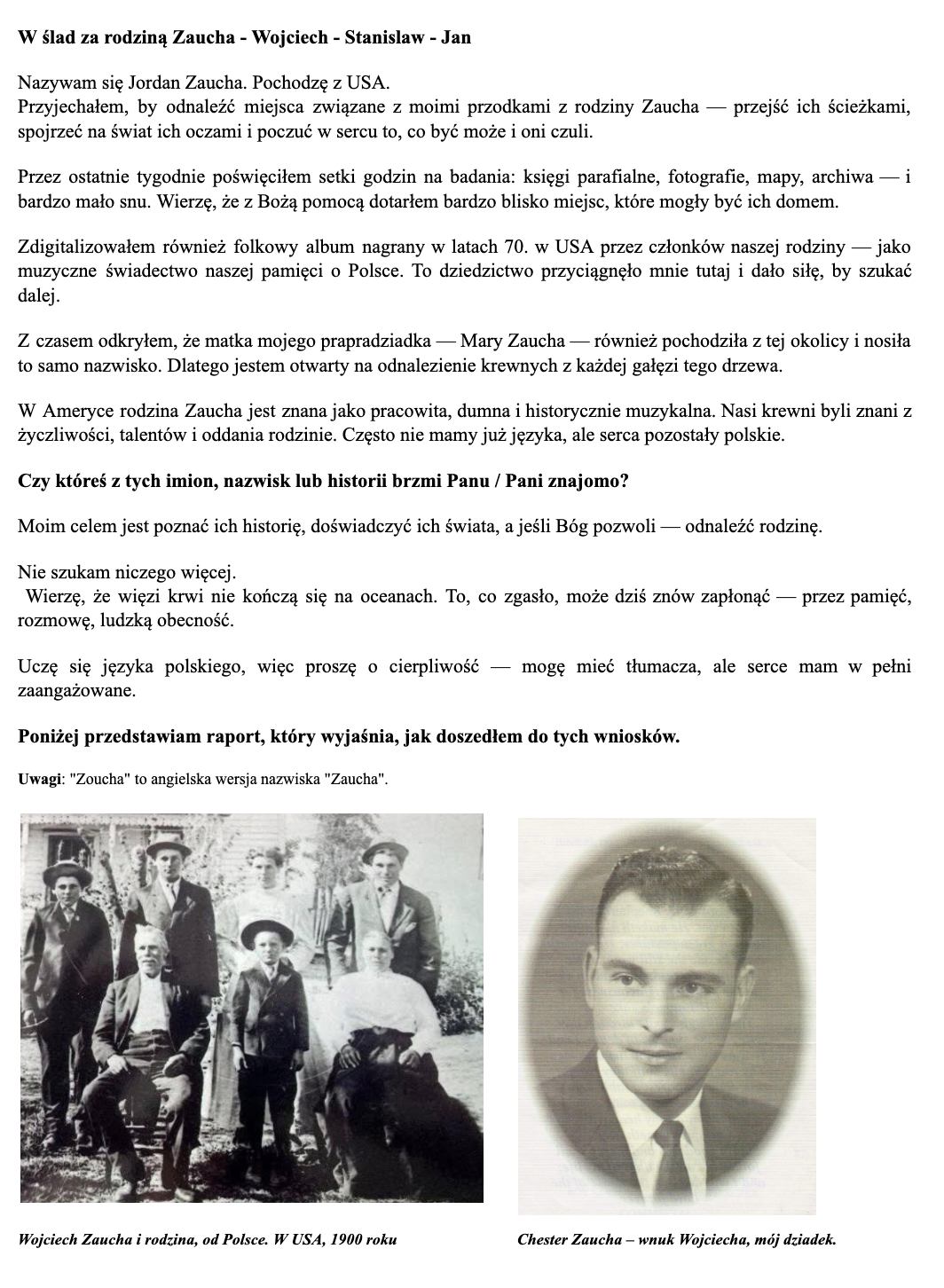
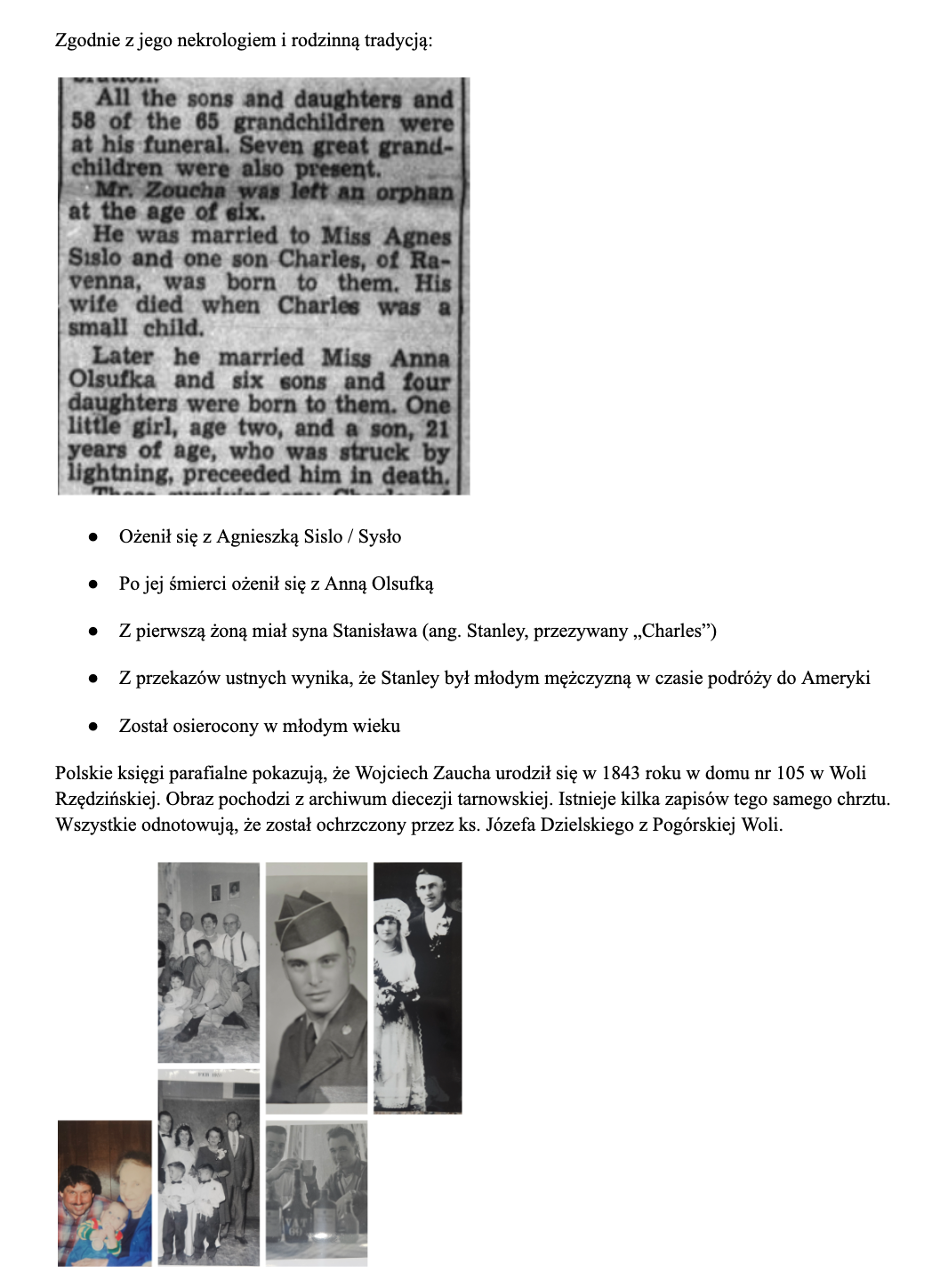
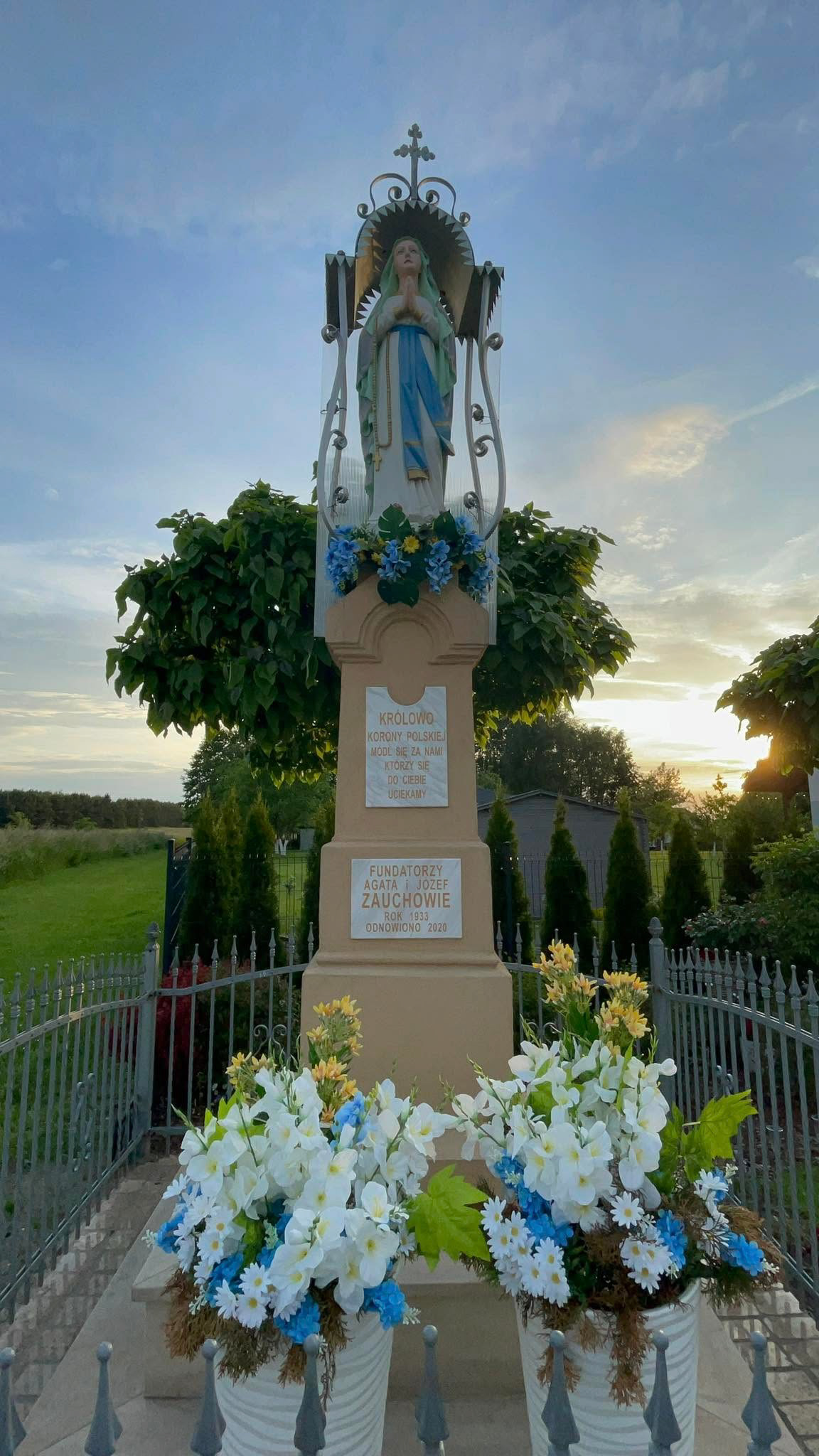
Finding family quickly became central. I knocked on doors in villages connected to my surname, met living relatives, compared photographs, shared music, and moved from lineage charts into kinship. One elderly cousin told me she would pray for me.
• Action: Direct contact with living relatives in ancestral villages
• Result: Family line further confirmed
• Result: Family line further confirmed
VI. Being Received
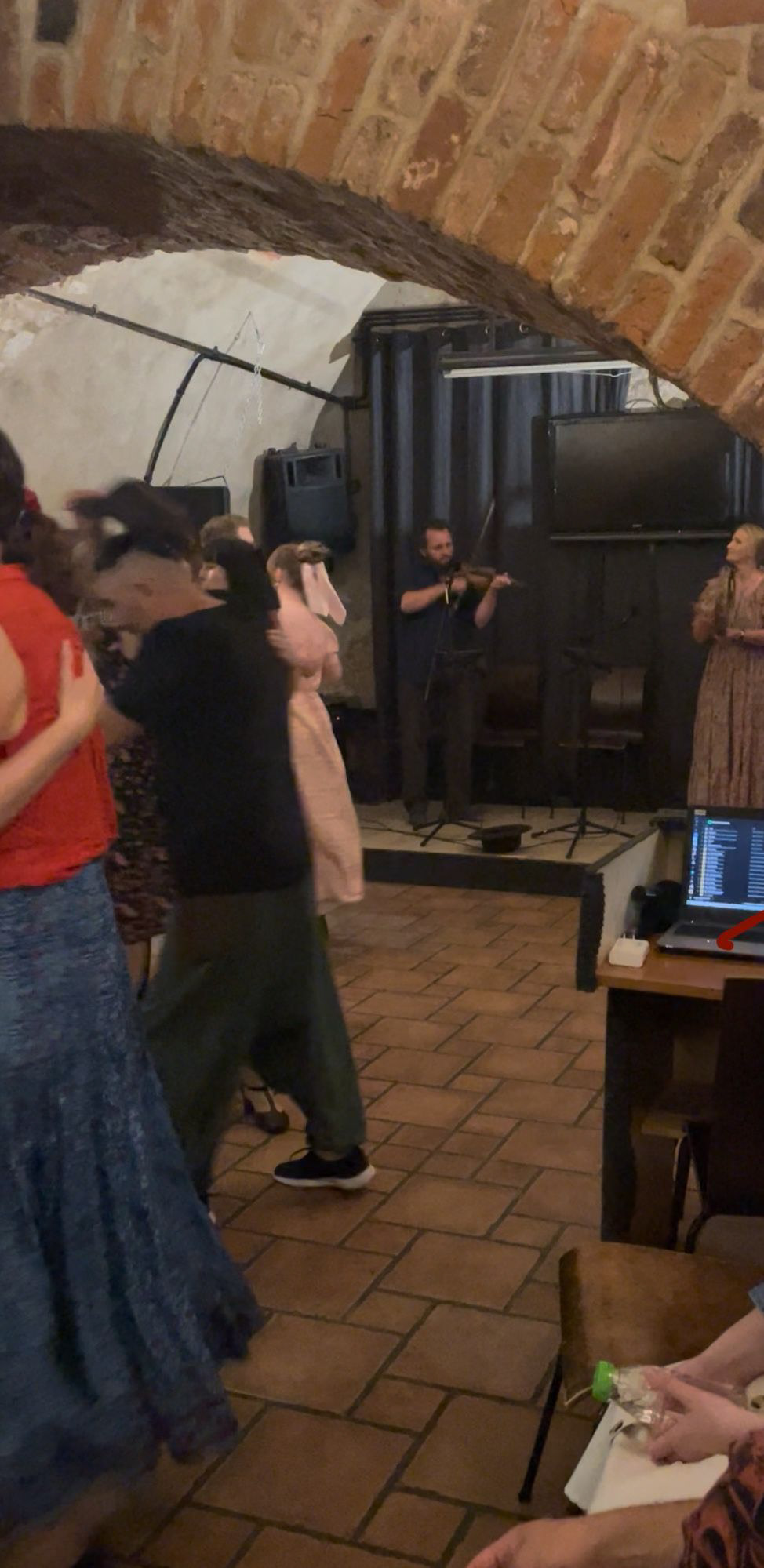
Alongside family, wider relationships formed quickly. I met Dominika Nowak, who helped guide my early days. I met another friend, Dorota, who taught me the Polish method of polka dancing, as well as mazurka, and oberek. These are generally characterised by smaller steps than what is seen in the midwest.
This difference exemplified for the first time to myself how social transmission changes across generations and continents.
I attended rehearsals with Świerczkowiacy, a long-standing ensemble from the Tarnów area preserving regional dance and music. I was welcomed into rehearsal rooms and conversations.
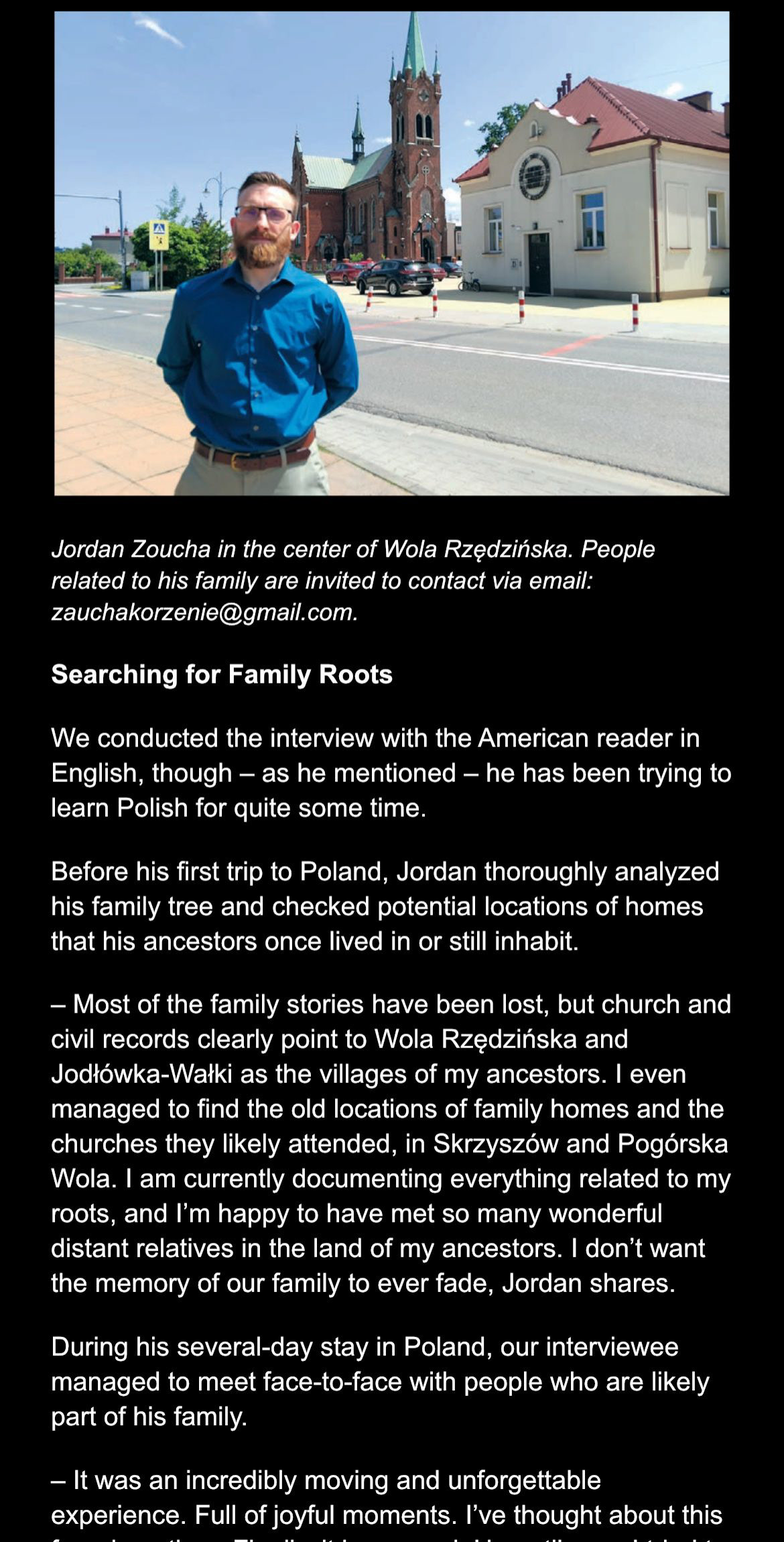
A similar pattern unfolded in Wola Rzędzińska. After asking at the parish about village history, I met Pani Kozioł, the librarian, and spent three hours speaking about surnames, records, and why someone from America had arrived with documents in hand.
She had mentioned I had reached out to a few individuals already in the village, and they were skeptical of myself. When I showed her recordings of singing with my choir in the USA, she listened and said, with quiet humor, “You are clearly a real person.” She then invited me to a Chór Cantus rehearsal.
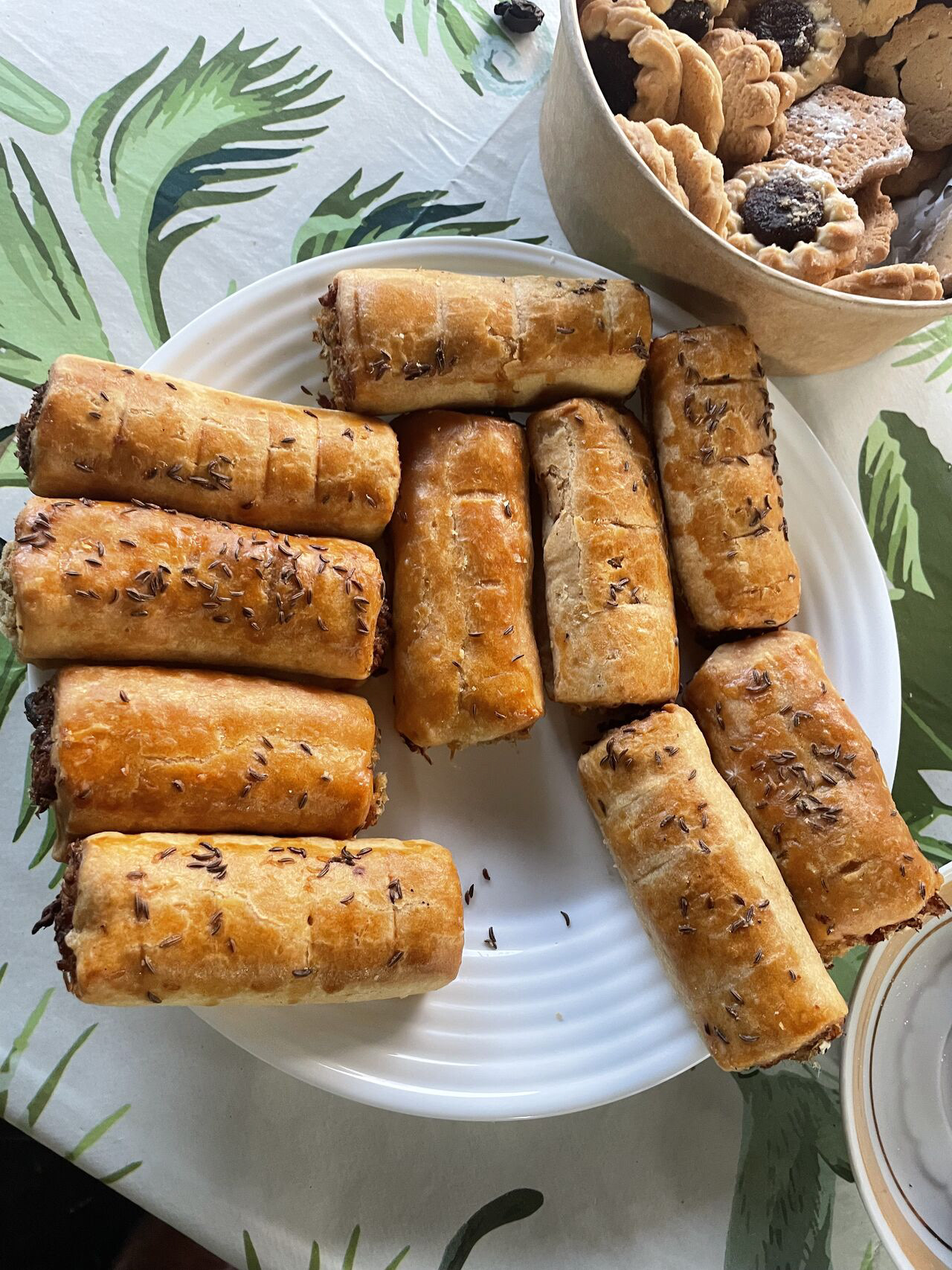
I attended, and was met with my first instance of Polish hospitality. Afterwards, we feasted, and I was able to play some music from America for them.
Ks. Tomasz, pastor of św. Stanisława in Skrzyszów, whom I had reached over the phone in January before my trip, showed me my ancestral parish, and invited me to a Polish wedding.
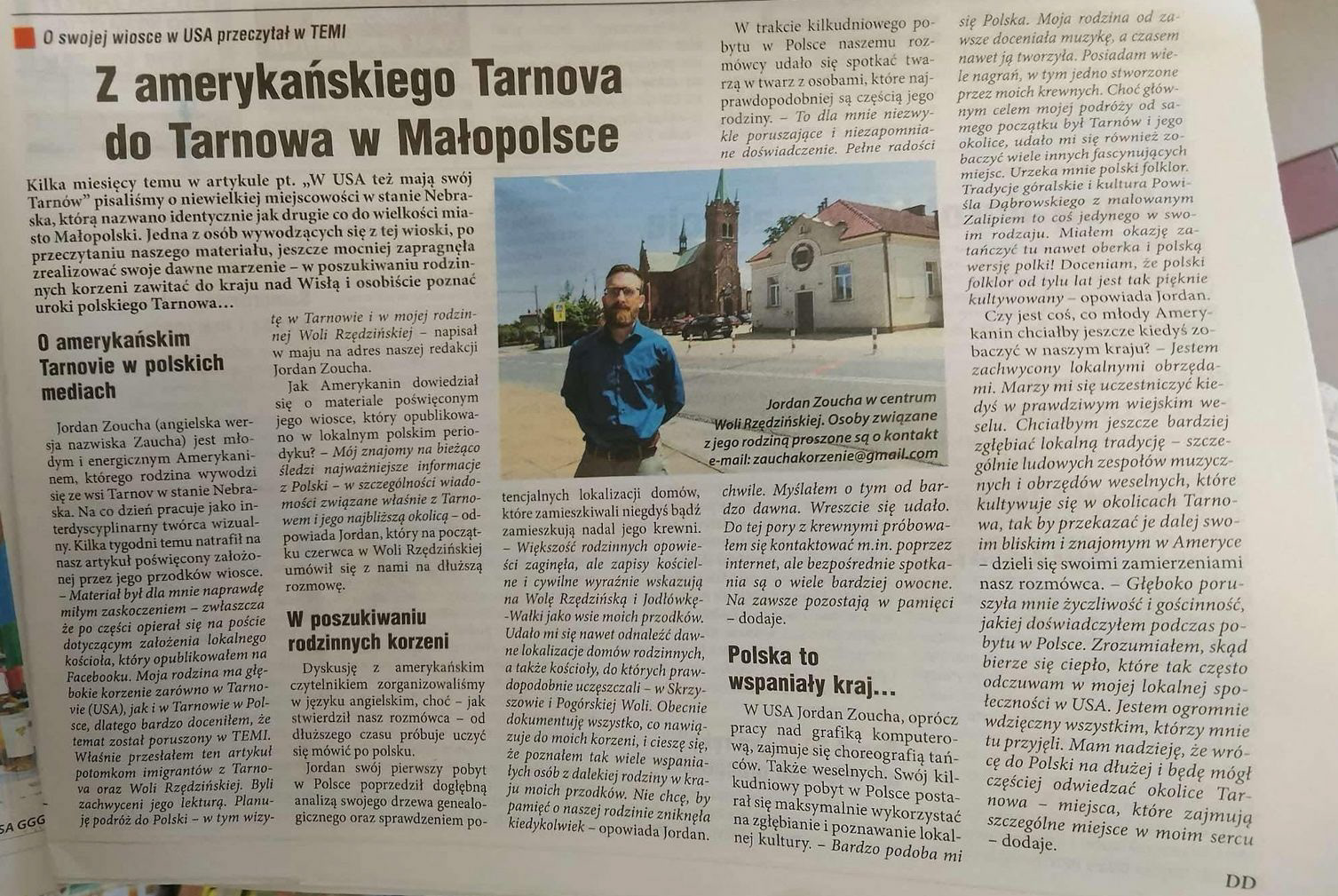
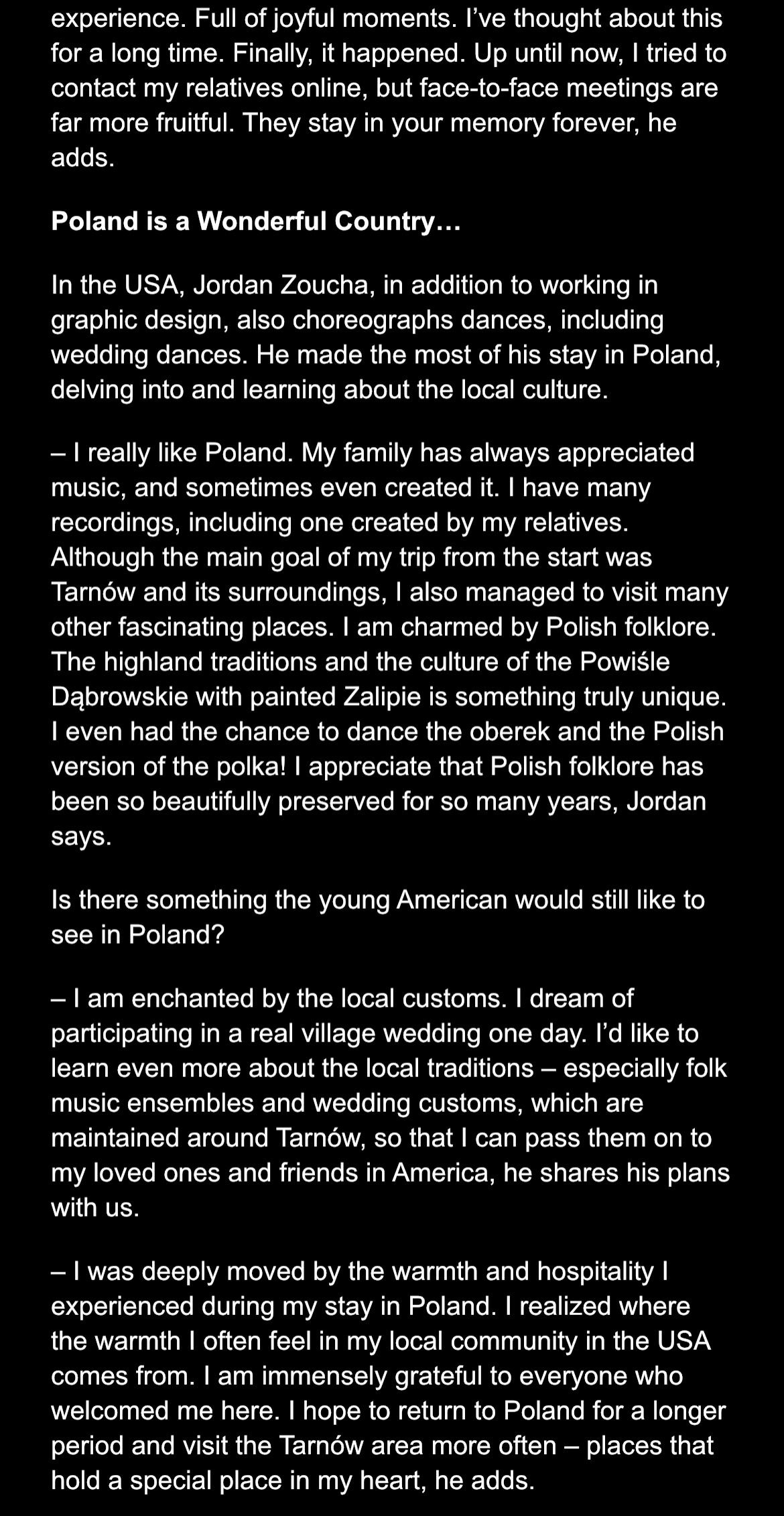
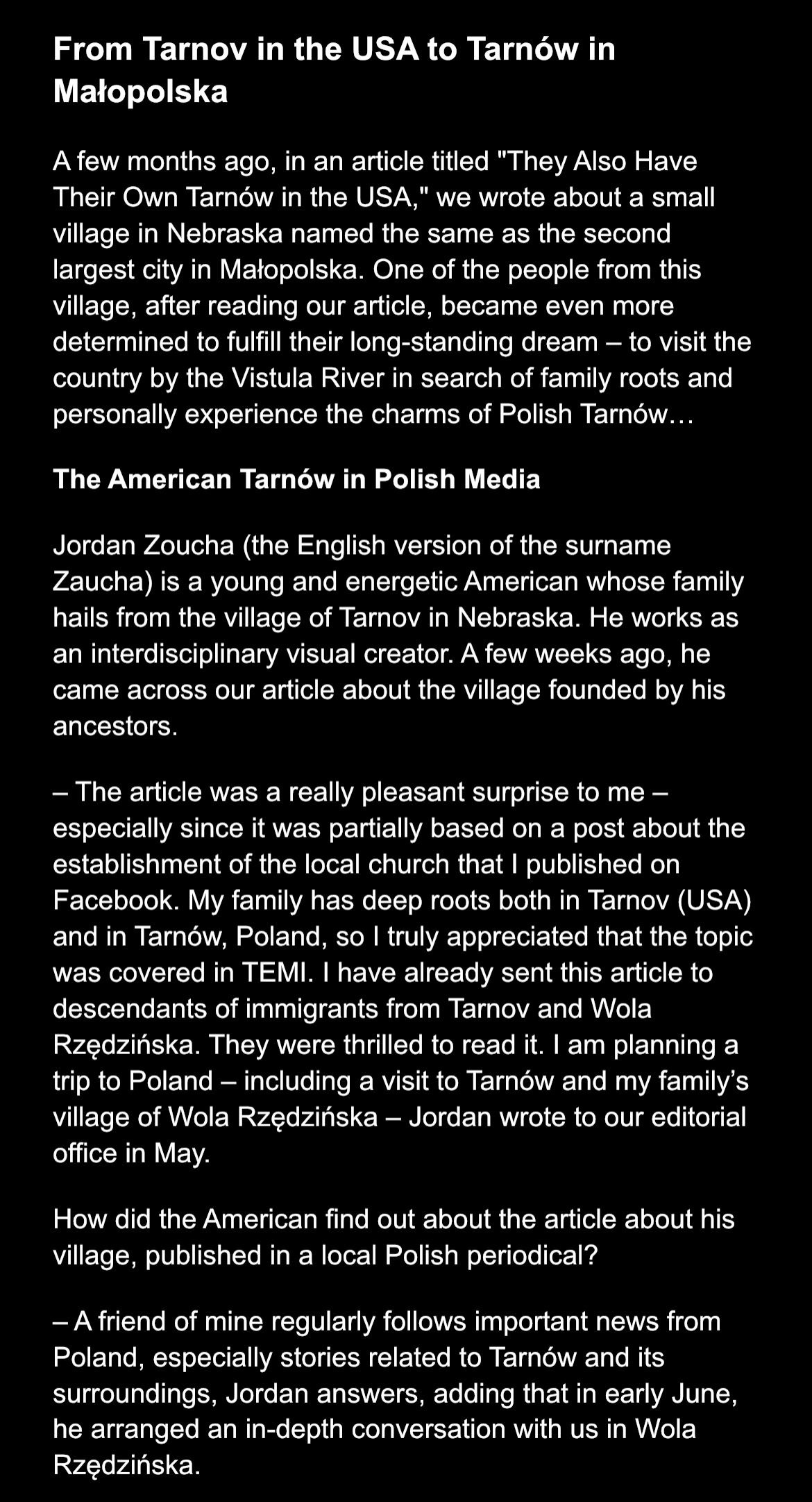
This period also brought media and collaborative openings. I was interviewed by TEMI in Tarnów, and began conversations with Michał, a Tarnów-based collaborator tied to future radio and recording work.
• Key local relationships: Ks. Tomasz, Dominika Nowak; Dorota; Barbara Kozioł; Michał, Dawid
• Regional access: Świerczkowiacy rehearsal participation and Chór Cantus invitation
• Publi-facing Output: Interview in TEMI Tarnów
• Cultural integration: Parish life, village contacts, choir rehearsal, dance study
• Forward direction: Early Tarnów-region network began to form around real people
• Regional access: Świerczkowiacy rehearsal participation and Chór Cantus invitation
• Publi-facing Output: Interview in TEMI Tarnów
• Cultural integration: Parish life, village contacts, choir rehearsal, dance study
• Forward direction: Early Tarnów-region network began to form around real people
VII. The Question That Remained - Museums, Dances, Deeper Polonia Involvement
After just two weeks in Poland, I returned to Nebraska. I continued my studies between my professional work, community initiatives, and dance and music instruction classes.
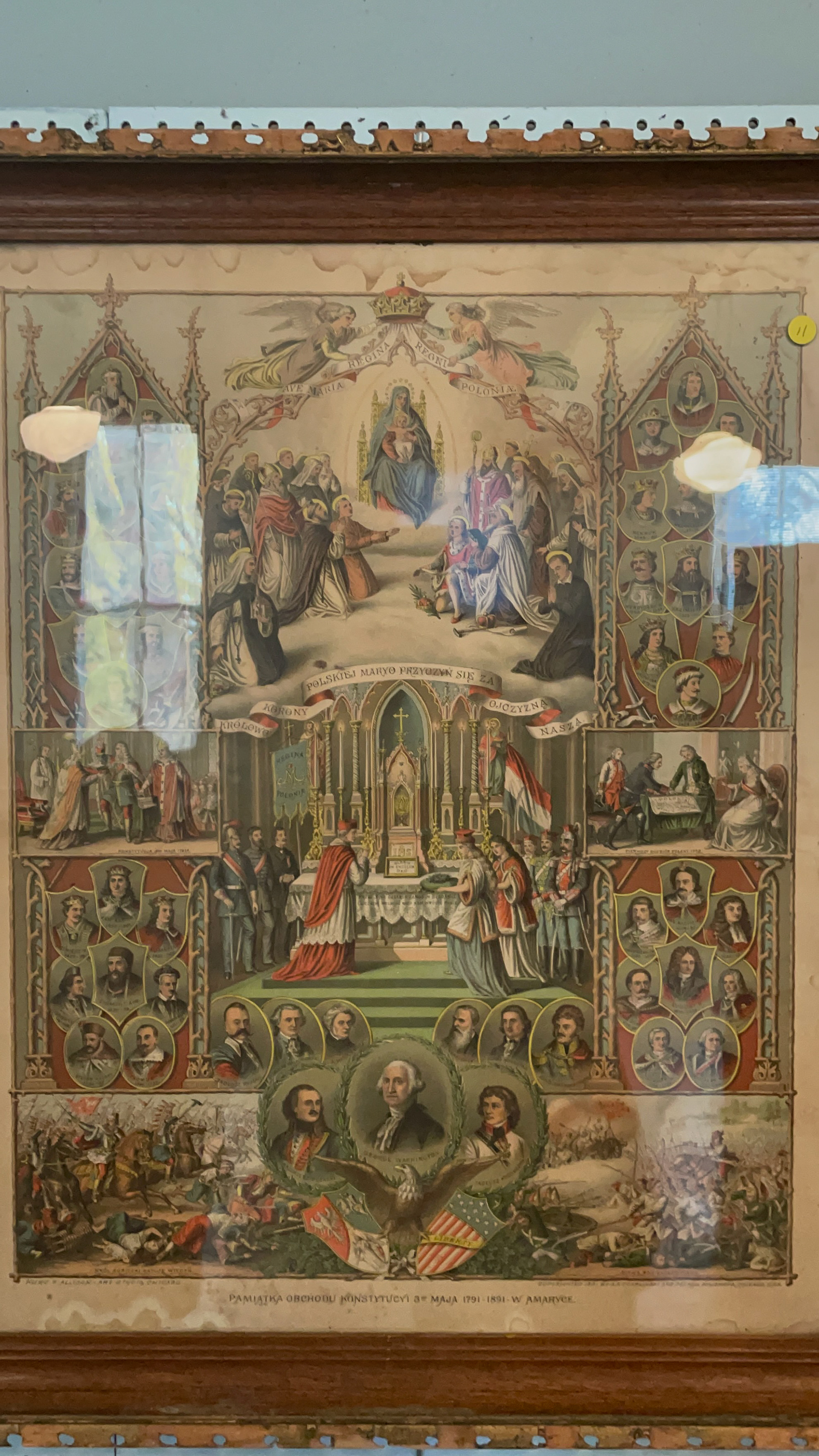
The deeper I entered Poland, the sharper the unanswered question became. In Nebraska, the museums held artifacts, but their timelines nearly always began at the same point: departure. Labels started after emigration. Glass cases preserved what survived the crossing. What came before was assumed, compressed, or left unspoken.
That absence followed me.
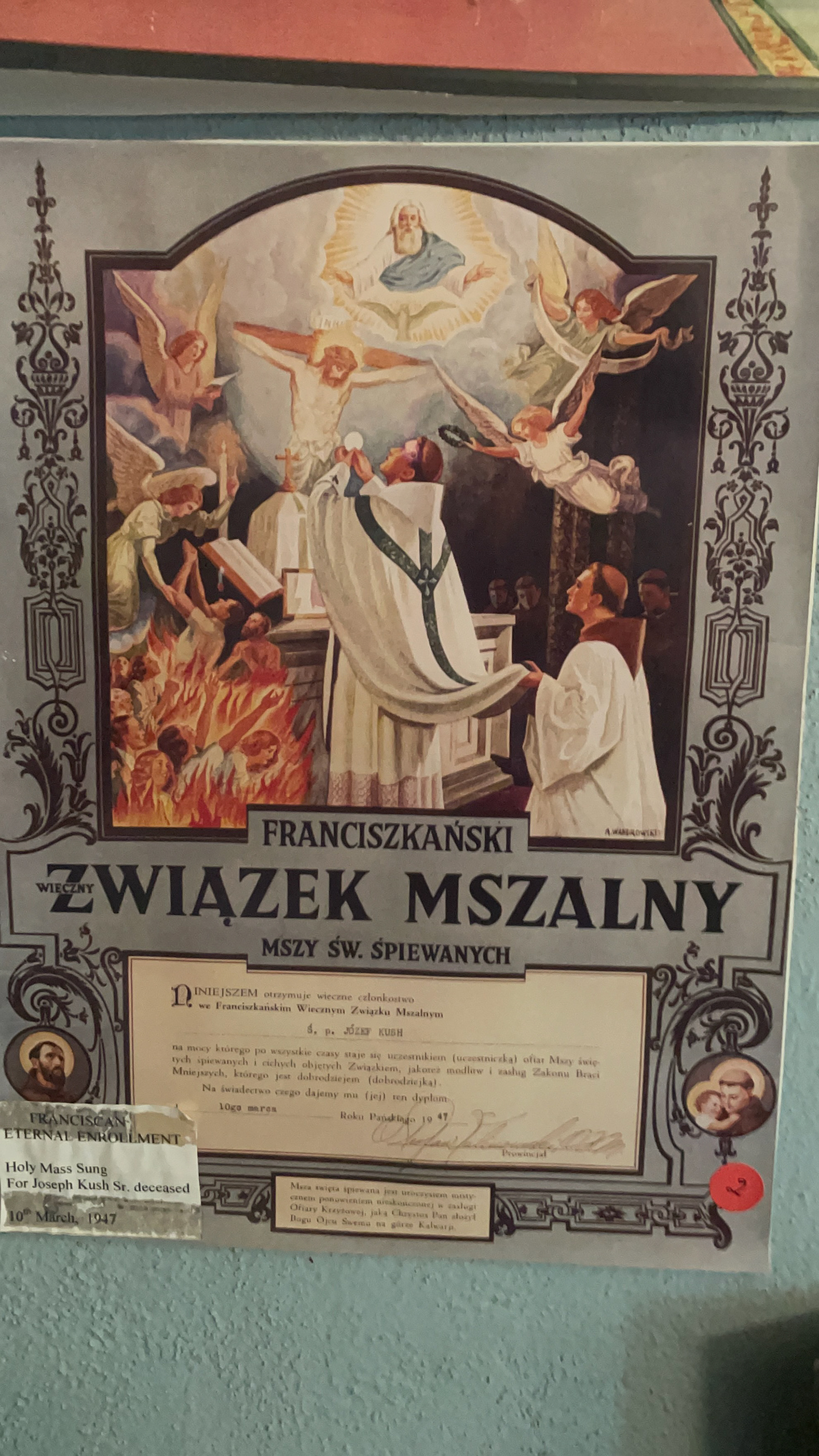
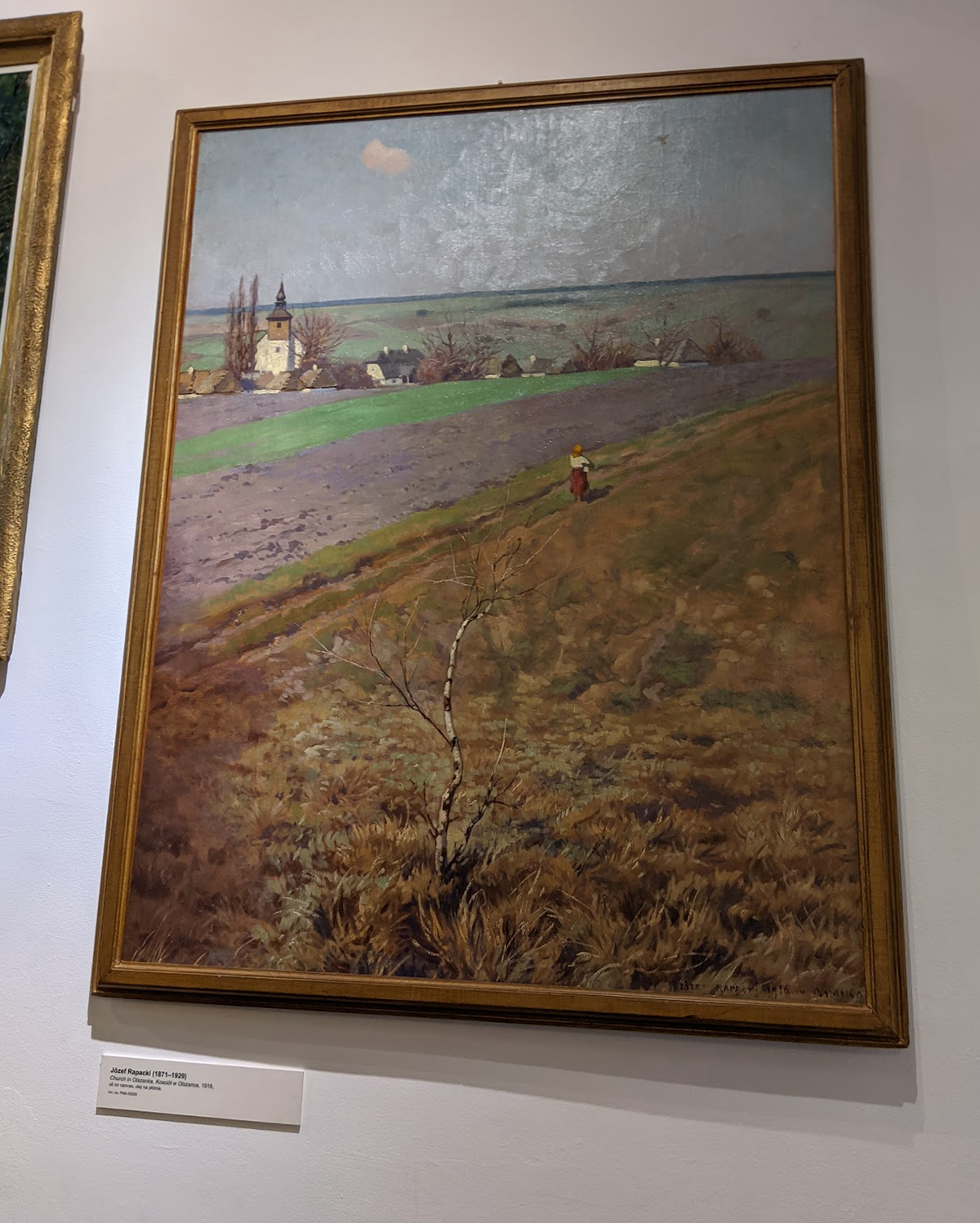
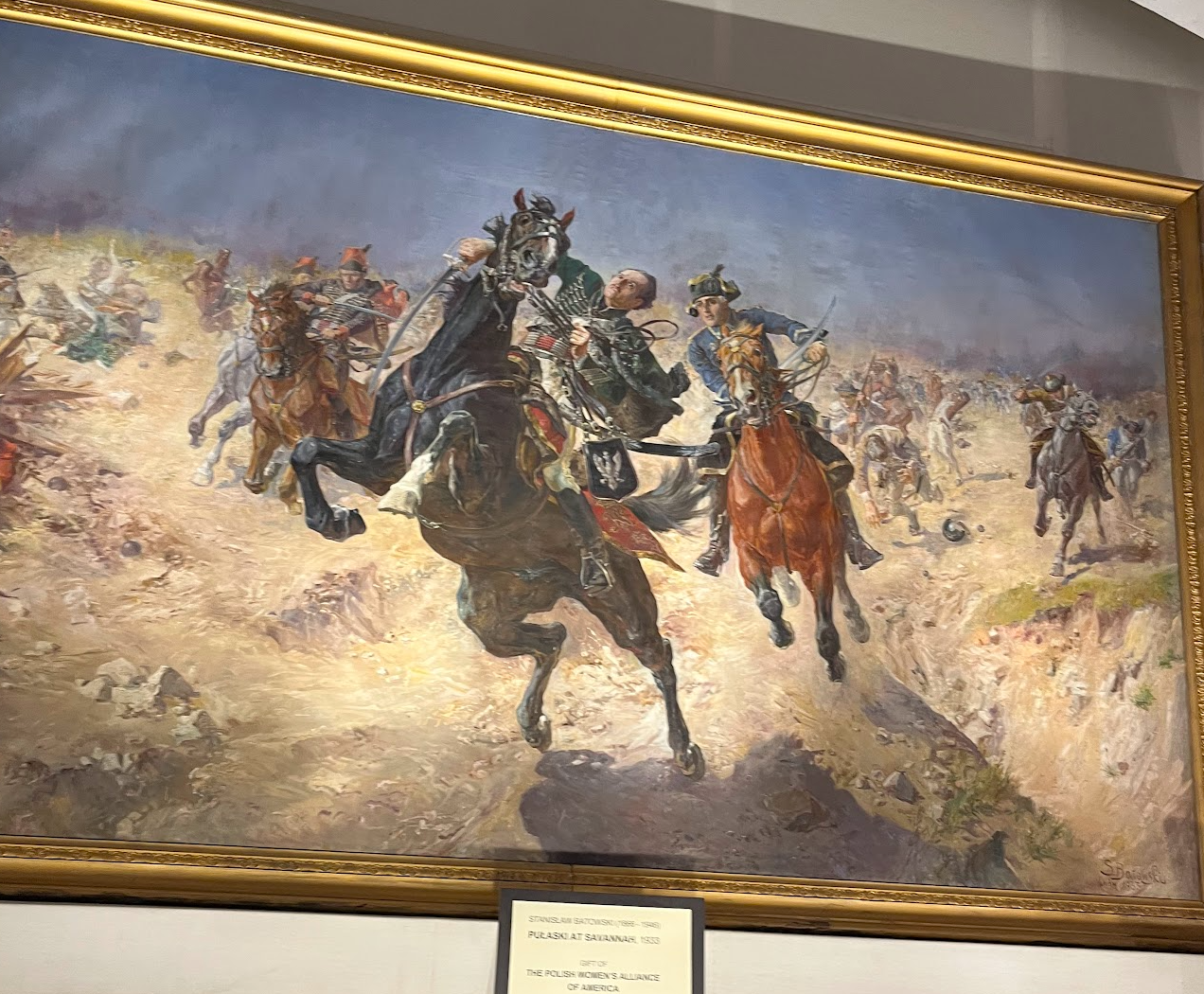
In museums and parish halls, Polish records and devotional images still hung on the walls, but often like relics without a living key. I began asking simple questions.
Why don’t we know Polish anymore?
“Father preached from the pulpit that it was bad to speak Polish at home.”
Did you learn your ancestor's language growing up?
“No. Grandma had it beat out of her.”
What does this painting say?
“I... don’t know, really.”
Then silence.
The kind that settles like dust on old wood.
A slight shrug. No eye contact. Almost an apology.
“Someone used to be able to read this painting.”
Another pause.
Longer this time.
“Someone used to know...”
And then nothing.
No name.
No date.
Nothing.
Nie.
Only the faint recognition that there had once been a voice here, confident and fluent, and that it had gone quiet without anyone noticing the day it fell silent. Language thinned first. Then memory. The script remained, but the voice behind it had withdrawn.
Polish art had become decoration without language. Memory without grammar.
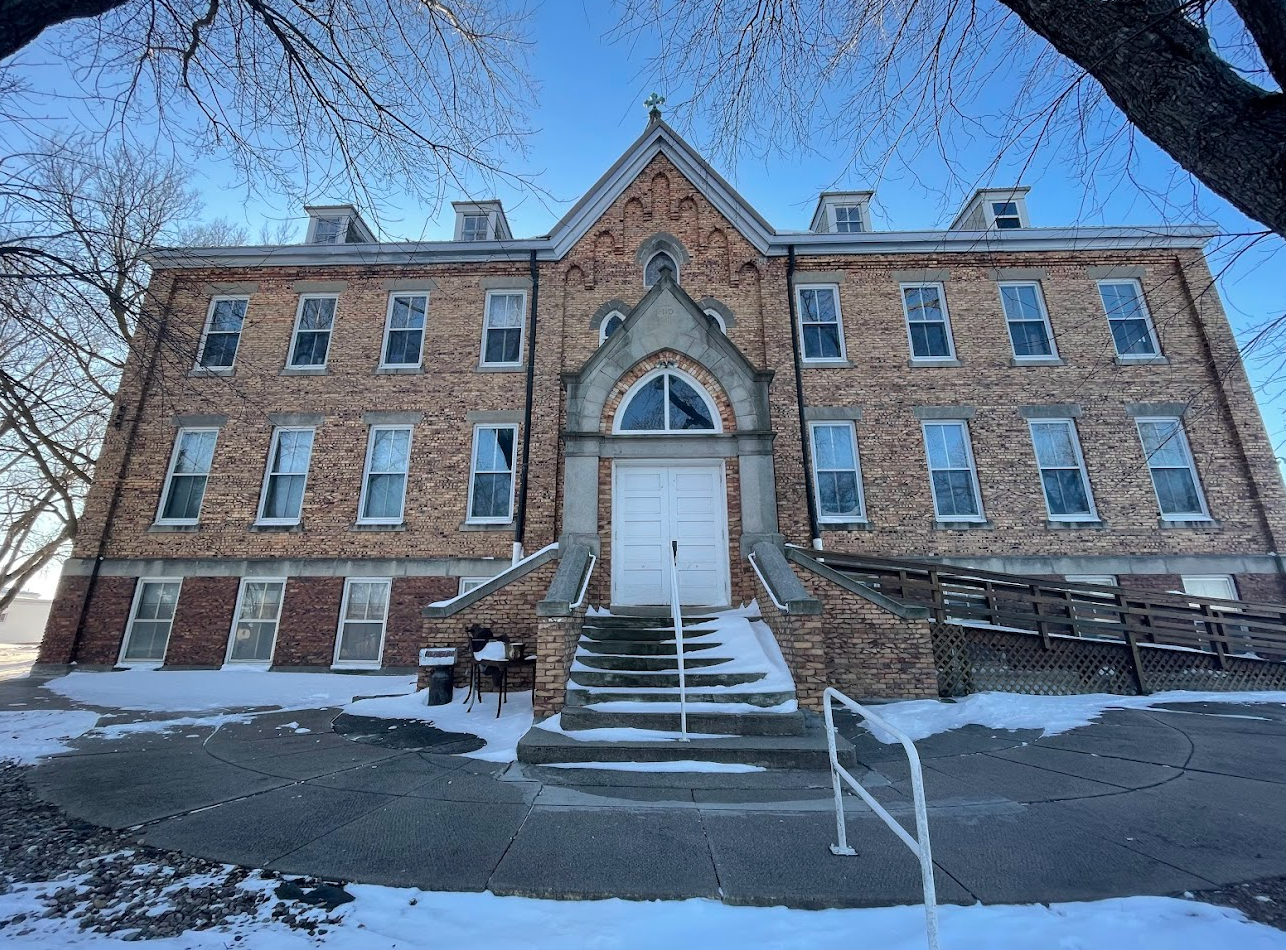
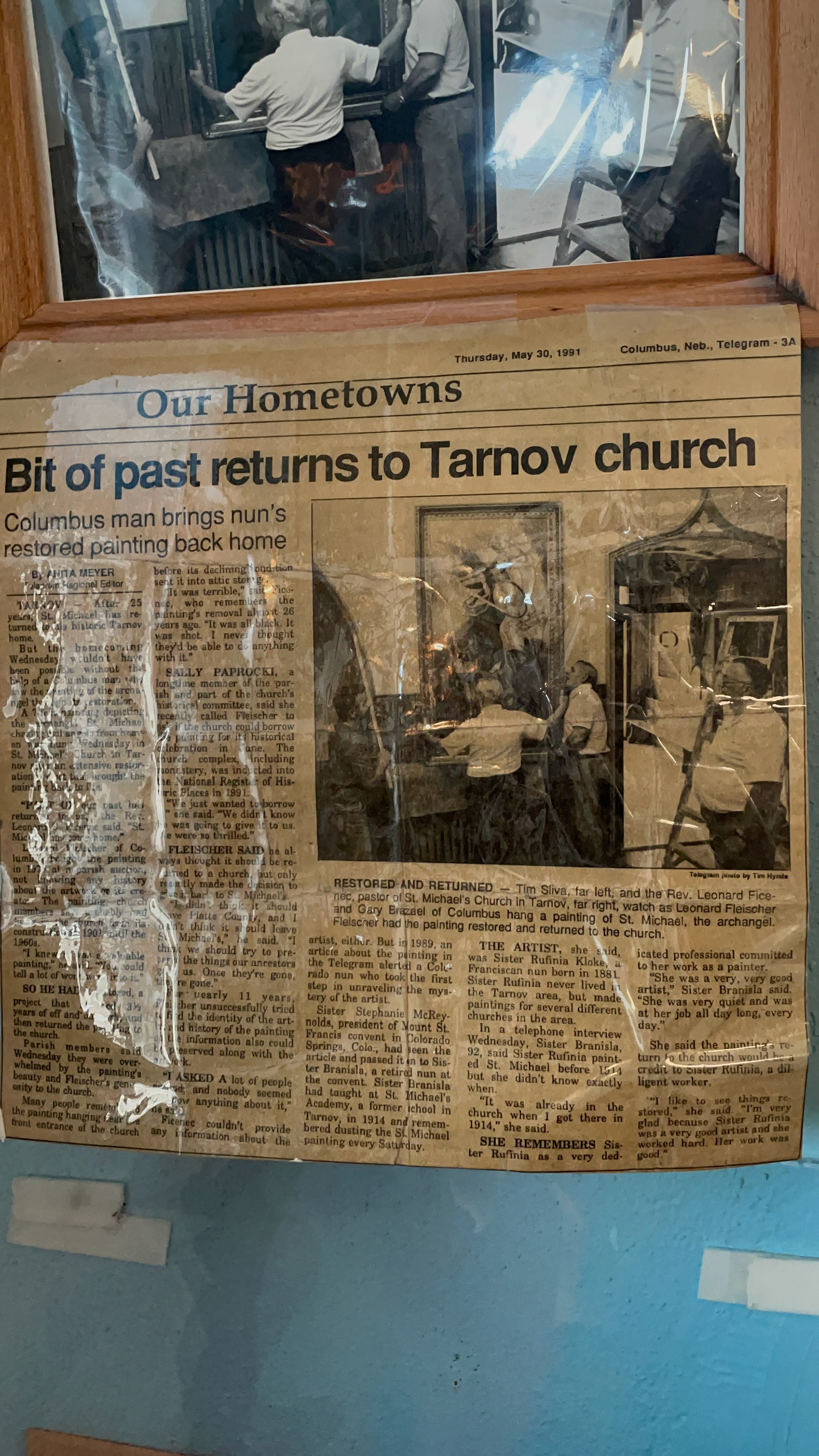
I traveled across Nebraska, speaking with the Tarnov Museum and with Tim Sliva, photographing the church, the museum, the grounds. Each image felt like documentation without a key. Preservation without transmission.
Someone had to learn this.
At the Polish Home in Omaha, I spoke at length with Tom, its director, about music, memory, and the things institutions quietly lose while still appearing intact. Through him I met Lonnie Urkoski, who leads one of Nebraska’s last remnants of Polish music, the Lonnie Urkoski Orchestra polka band. We spoke for hours about Polish music, about who still remembered, and about who was gone.
“Can anyone still teach me Polish folk violin in Nebraska?”
“They’re all about ninety.”
Death had already done its work.
That was the moment the question stopped being theoretical. If I wanted to understand what came before emigration, I would have to learn it where it was still alive. I would have to do what my family had once done in reverse.
I said a prayer that I would return, though at the time I could hardly believe it myself.
• Core problem: Diaspora memory often preserves departure more clearly than origin
• Field impression: Museums, parish halls, and family settings repeatedly revealed memory without language
• Nebraska sites: Tarnov Museum, church grounds, Polish Home Omaha, local carriers of musical memory
• Key contact: Lonnie Urkoski and the surviving Nebraska polka milieu
• Consequence: Poland-side study became necessary for responsibly reading diaspora fragments
• Urgency: Remaining carriers of older repertoire are elderly, making the work time-sensitive
• Field impression: Museums, parish halls, and family settings repeatedly revealed memory without language
• Nebraska sites: Tarnov Museum, church grounds, Polish Home Omaha, local carriers of musical memory
• Key contact: Lonnie Urkoski and the surviving Nebraska polka milieu
• Consequence: Poland-side study became necessary for responsibly reading diaspora fragments
• Urgency: Remaining carriers of older repertoire are elderly, making the work time-sensitive
VIII. The Bridge
After returning briefly to the United States, I found that my professional life no longer sat at the center of gravity it once had. Design work remained useful and real, but it now felt preparatory. Folk music displaced other listening. Polish entered the day in disciplined hours. The violin sat close at hand. Names, regions, and maps accumulated. A different line of work was assembling itself.
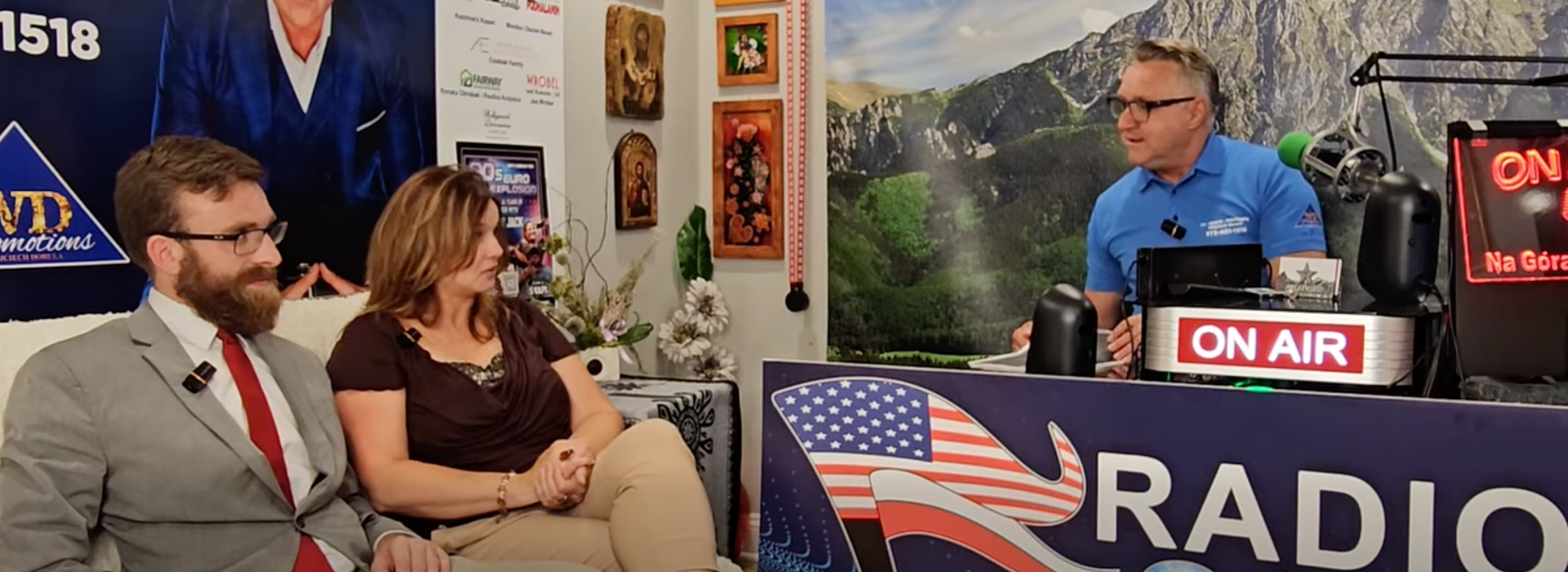
I wrote to Jagiellonian University, flew to Chicago for my visa. While there, I sat down with Wojciech Dorula of the Chicago Góral community, whom I had first contacted during the initial research phase before my first trip to Poland. We recorded my first radio interview where I discussed genealogy, return, and my ancestor's Polonia album.
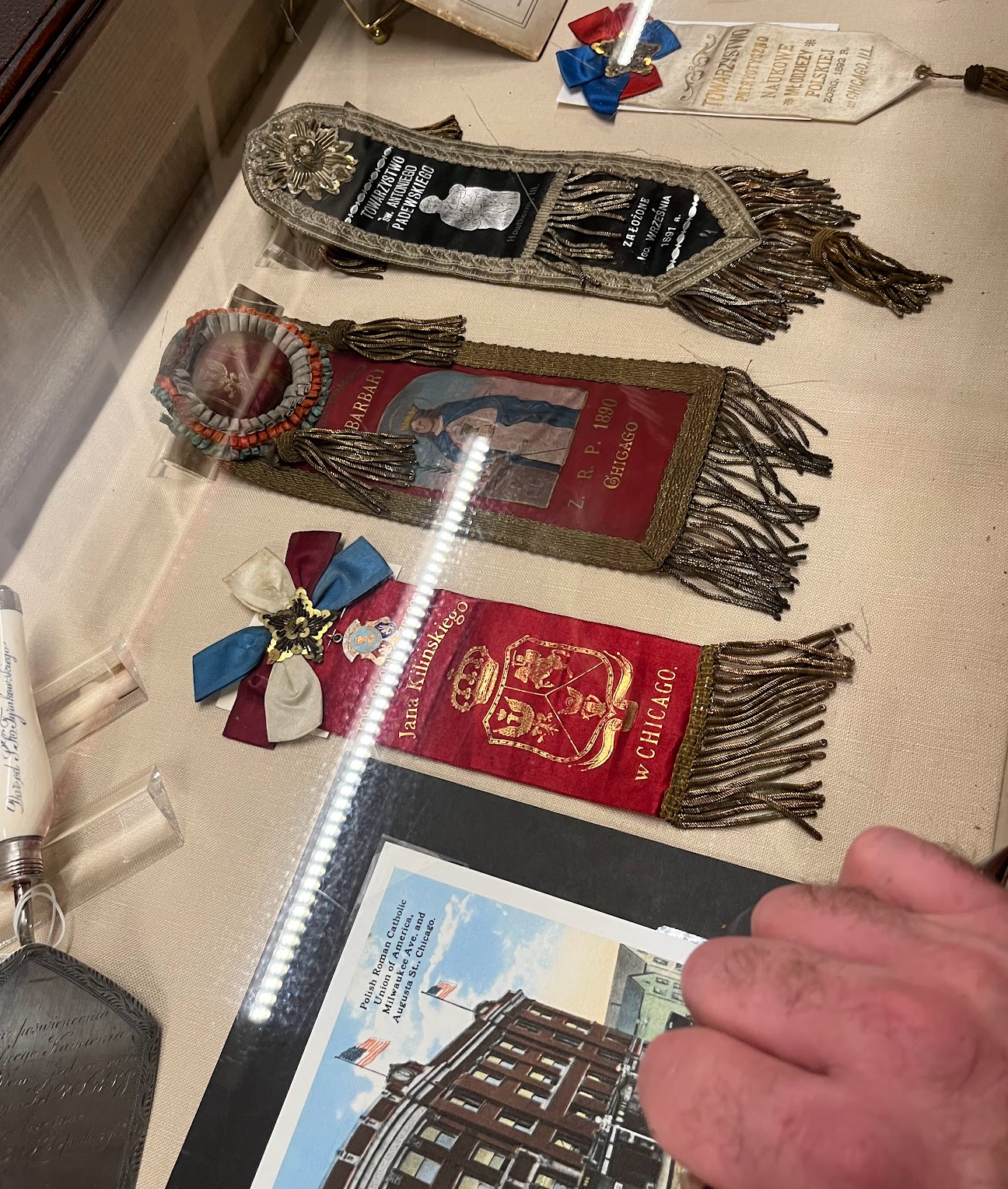
I visited the Polish Museum in America, where I met more important connections, and contributed a book, on their request, about historical Tarnov, Nebraska, for their expanding Polonia communities library.
Through the Mój Tarnów network, online names became faces. Through Chicago, Poland and American Polonia ceased to feel like separate worlds. They became linked fields of one emerging project.
No single decision created that shift.
It accumulated until staying where I was no longer was honest.
I bought the ticket, enrolled, resigned from the job I had held for ten years, and boarded the plane.
• Bridge: Nebraska, Chicago, Kraków, and the Tarnów region began functioning as one comparative field
• Institutional step: Application and entry into the Jagiellonian Polish-language program
• Media/network step: Chicago interview and contact with Wojciech Dorula
• Strategic shift: Professional research skills were reallocated toward language, archive, and field formation
• Institutional step: Application and entry into the Jagiellonian Polish-language program
• Media/network step: Chicago interview and contact with Wojciech Dorula
• Strategic shift: Professional research skills were reallocated toward language, archive, and field formation
IX. October: Entry Into Practice
October imposed structure.
Intensive Polish study at Jagiellonian University established the first real discipline of the new phase: grammar, listening, oral correction, fatigue, and daily public use of a language I did not control well enough.
• Institutional weight: Intensive study within the Jagiellonian academic tradition
• Practice: Daily public use of Polish beyond the classroom
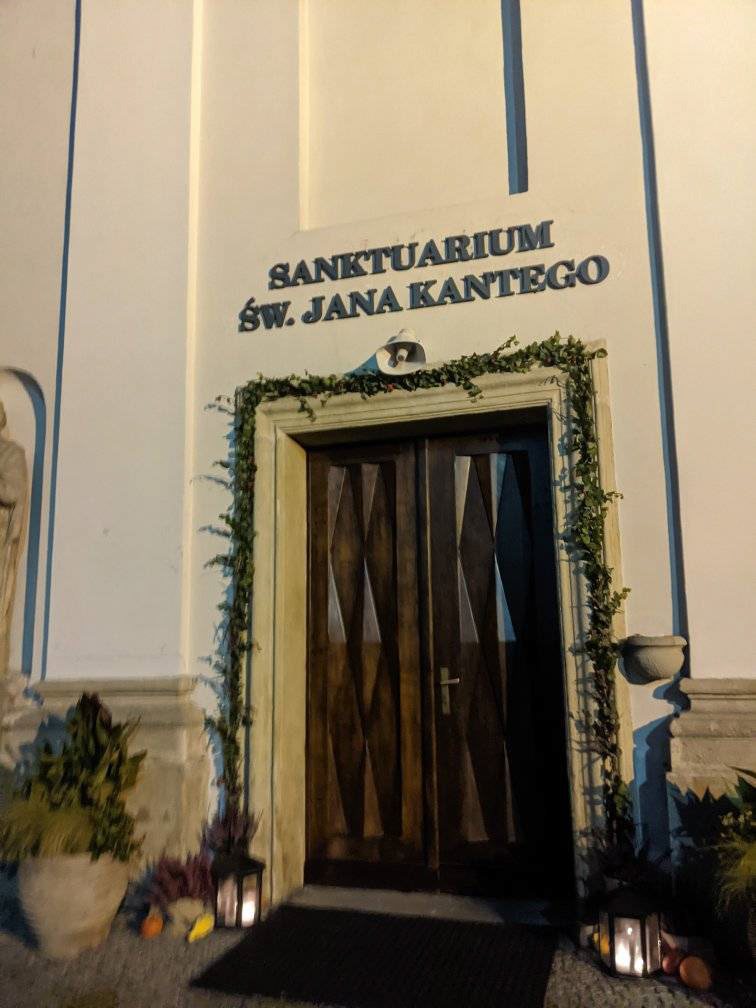
• Field test: While on a pilgrimage to honor sw. Jan Kęty in thanksgiving for my acceptance to UJ, participated in a two real conversations in Kęty in imperfect Polish, applying what I learned in class. The women particularly on the bus was excited to engage with my story
• Lesson: Reinforced language proficiency is prerequisite to serious ethnomusicological research
• Formation: Early shift from interest to disciplined study
• Practice: Daily public use of Polish beyond the classroom
• Field test: While on a pilgrimage to honor sw. Jan Kęty in thanksgiving for my acceptance to UJ, participated in a two real conversations in Kęty in imperfect Polish, applying what I learned in class. The women particularly on the bus was excited to engage with my story
• Lesson: Reinforced language proficiency is prerequisite to serious ethnomusicological research
• Formation: Early shift from interest to disciplined study
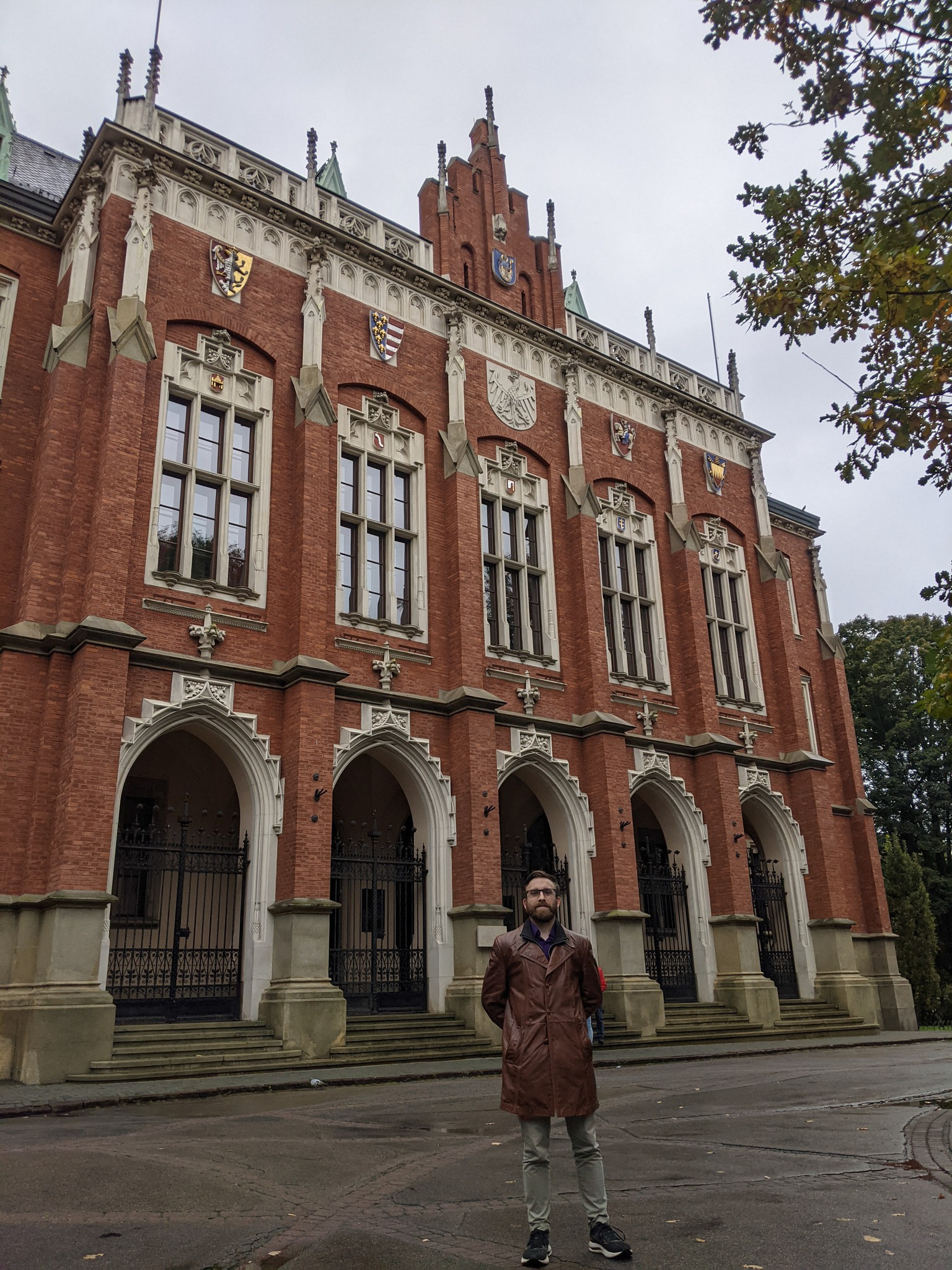
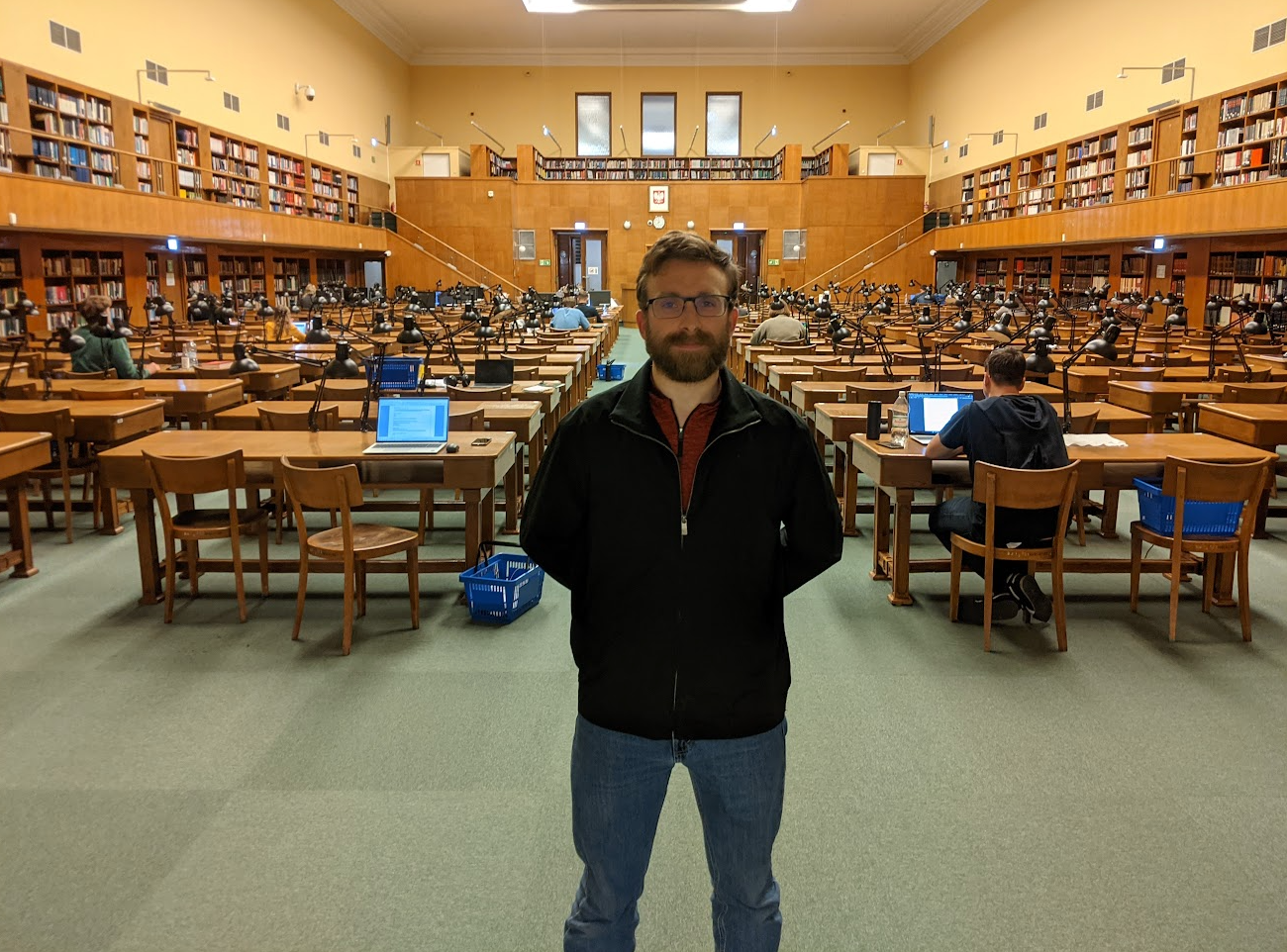
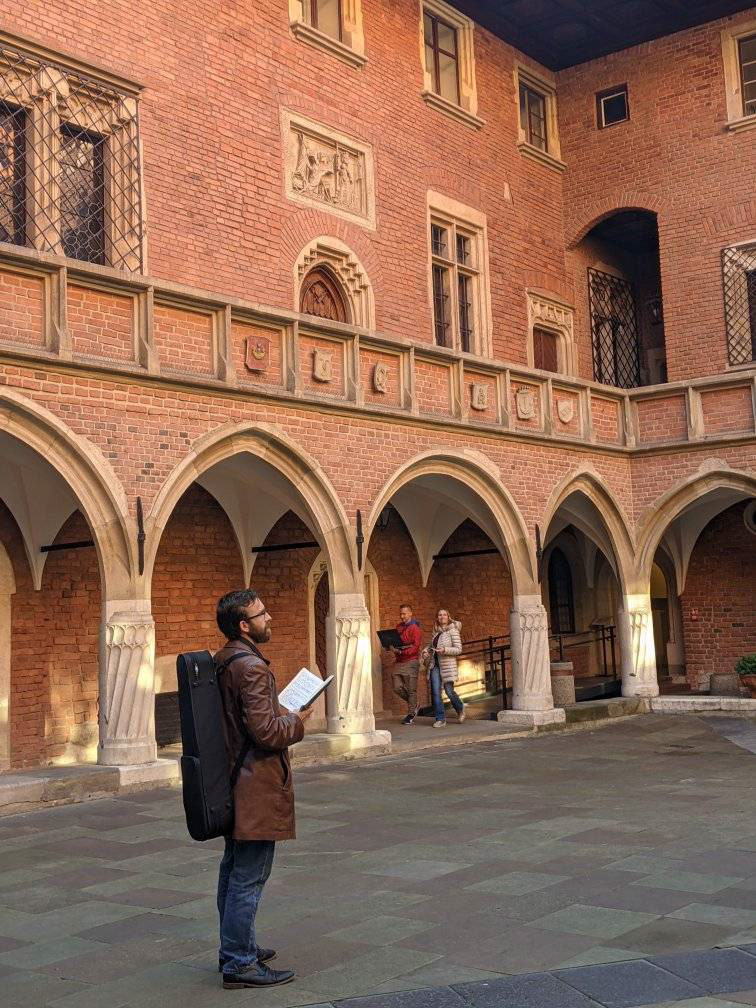
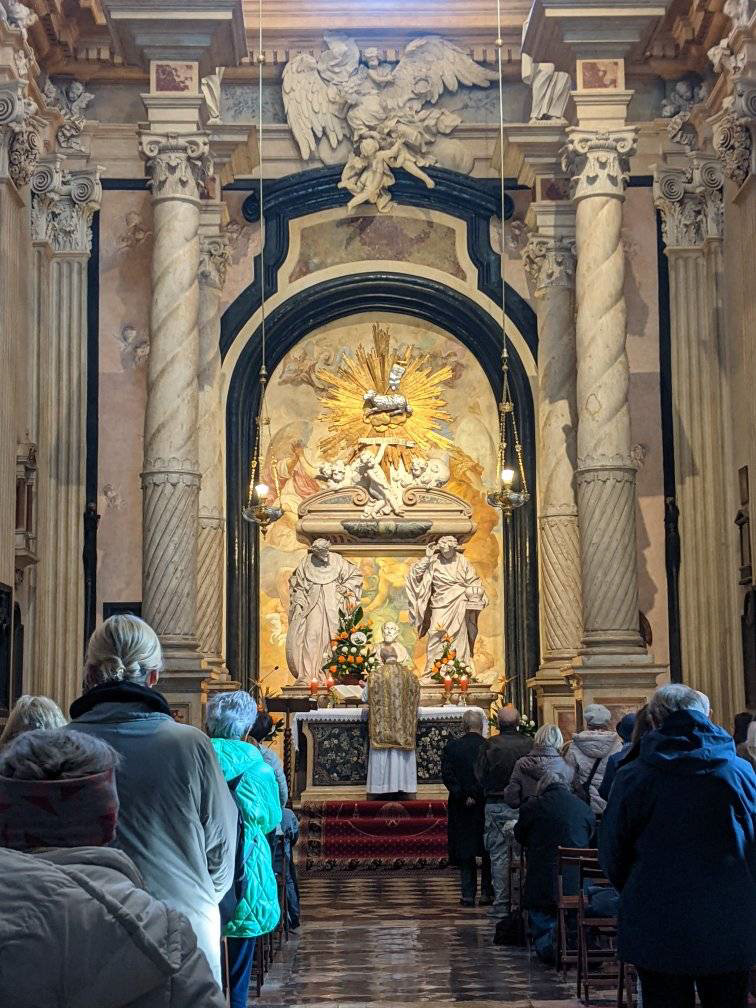
Workshops and Musical Formation
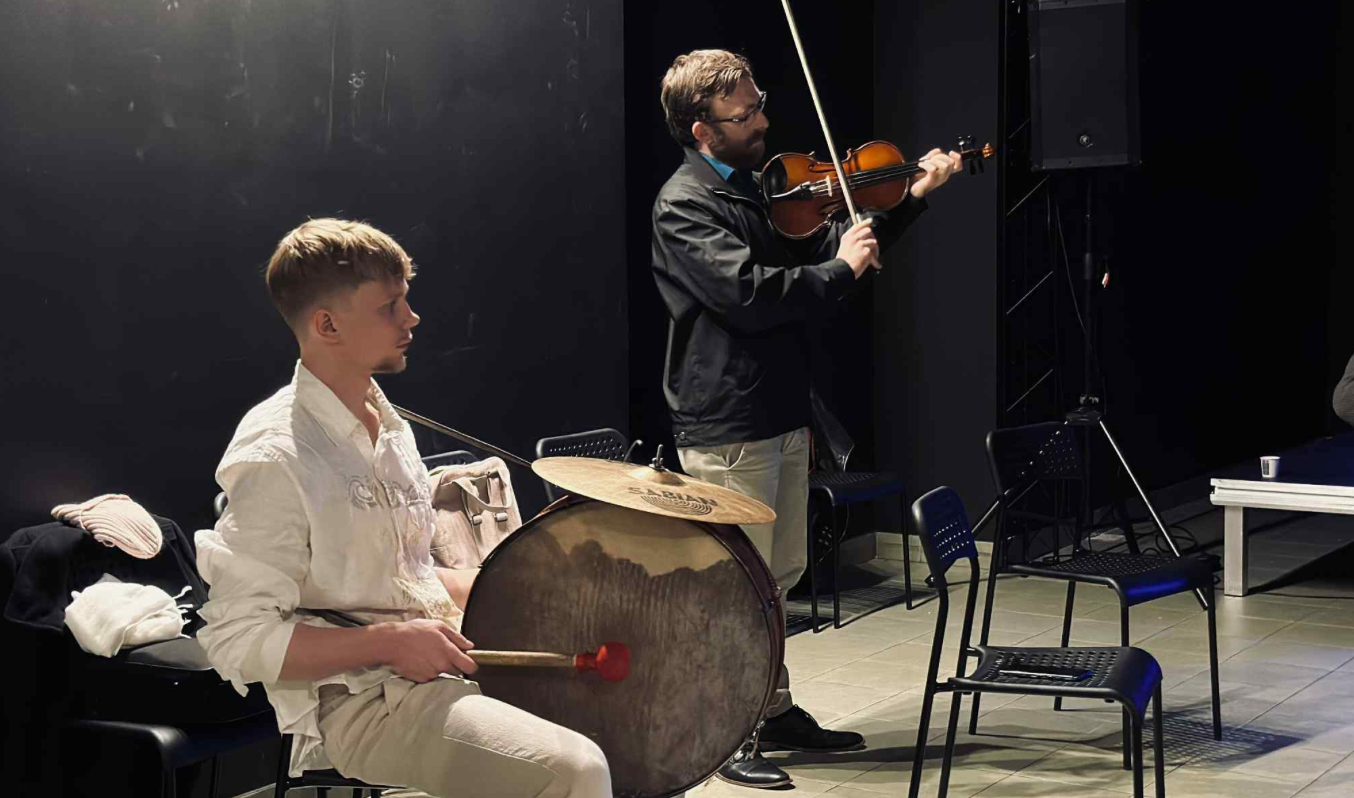
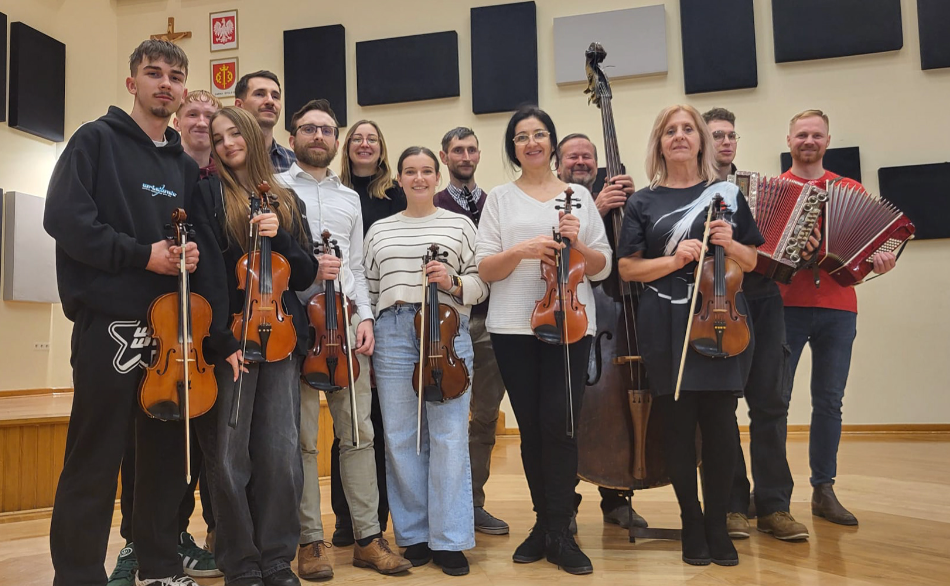
Workshops have become a key aspect of my formation in Poland. The first was a workshop and concert with Nierodzinna Kapela Ostrowskich at Strefa Nowa in Kraków, a space committed to preserving traditional sound and practice.
There I observed their pedagogy and began my first serious violin training. Learning through another language demanded humility and precision. It marked the shift from listening to doing, from appreciation to disciplined study.
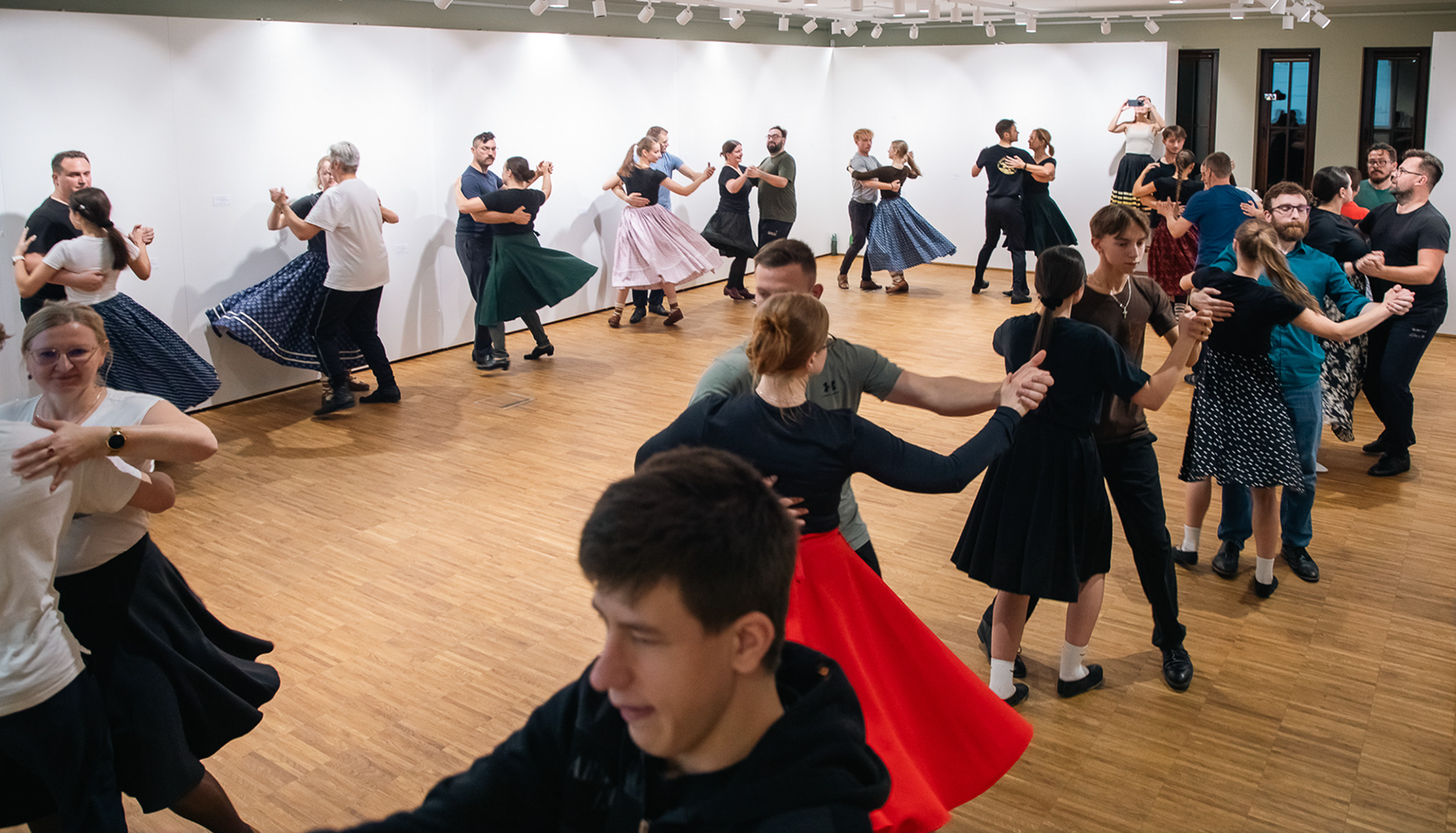
The second workshop was V Podhalańskie Spotkanie z Folklorem Tradycyjnym Karpat, a Carpathian-focused workshop led by Mateusz Etynkowski and Agnieszka, rooted in long-term engagement with Hungarian, Slovak, and regional village traditions.
I attended as a dancer after violin places filled, the experience was formative.
Music and dance were reunited through shared evenings and late-night potańcówki that functioned as informal ethnographical classrooms.
And further than that, they functioned as language classrooms. I won't forget the singing of Sto Lat on multiple occasions at this workshop, where what I had learned in the classroom slowly starting to mold the formerly random sounds into comprehensible song.
Through this workshop, recommended by my friends in the band Kapela Dusa, Piotr and Kasia Kret, who I had messaged a few months before, I networked with some of my most important initial contacts: former Masowsze dancers, individuals working at the National Centrum Folkloru Polskiego Karolin, and the first links to the Góralskie ensemble Skalni, which I would later test into.
A third formative workshop followed at Festiwal Wszystkie Mazurki Świata in Warsaw, where I studied violin and attended a psalms workshop on seventeenth-century Podlasie chant led by Janusz Prusinowski. Though outside my region, the encounter clarified what serious restoration of village repertoire requires in practice. Because of prior Gregorian chant training, I could follow and participate immediately. After introducing myself, we began exchanging substantive emails on ethnography and transmission; he recommended Tarnów-area contacts, and I have since reached out. The experience deepened both my network and my understanding of social tradition.
Additionally, I signed up for traditional folk violin lessons with Jan Niegazoda, who has become a mentor and a friend. I find the violin easy to learn given my past musical experience.
• Primary settings: Strefa Nowa; Podhalańskie Spotkanie; Wszystkie Mazurki Świata
• Skills developed: Violin study, dance practice, listening, embodied repetition
• Network growth: Contact with Janusz Prusinowski and broader ethnographic circles
• Interpretive gain: Began distinguishing how repertoire is preserved and taught in live settings
• Skills developed: Violin study, dance practice, listening, embodied repetition
• Network growth: Contact with Janusz Prusinowski and broader ethnographic circles
• Interpretive gain: Began distinguishing how repertoire is preserved and taught in live settings
October also brought encounters that grounded this work in community and belonging.
I returned regularly to the ancestral village and neighboring parishes for evening prayer, rosary, and ordinary contact with relatives and neighbors. I asked simple questions about ritual origin, local history, and the oldest remaining carriers of village memory.
The answers were often blunt:
people no longer knew, history books began too late, and the oldest living witnesses required better Polish than I yet possessed.
This frustration gave shape to the next stage of work. The question was no longer whether language mattered, but how fast it had to be strengthened.
• Village practice: Repeated return to ancestral-region parish life
• Method: Simple questions, patient listening, repeated local contact
• Academic effect: Ethnography and ethnomusicology emerged as the proper direction of study
• Method: Simple questions, patient listening, repeated local contact
• Academic effect: Ethnography and ethnomusicology emerged as the proper direction of study
X. November
By November, my path became increasingly solidified.
I determined I want to study Ethnography or Ethnomusicology, and both teach it and perform research at an official level. Particularly, Ethnography and Ethnomusicology as related to Tarnów, Poland, as well as Nebraska's old Polonia, with Podhale as a comparative model of successful transmission.
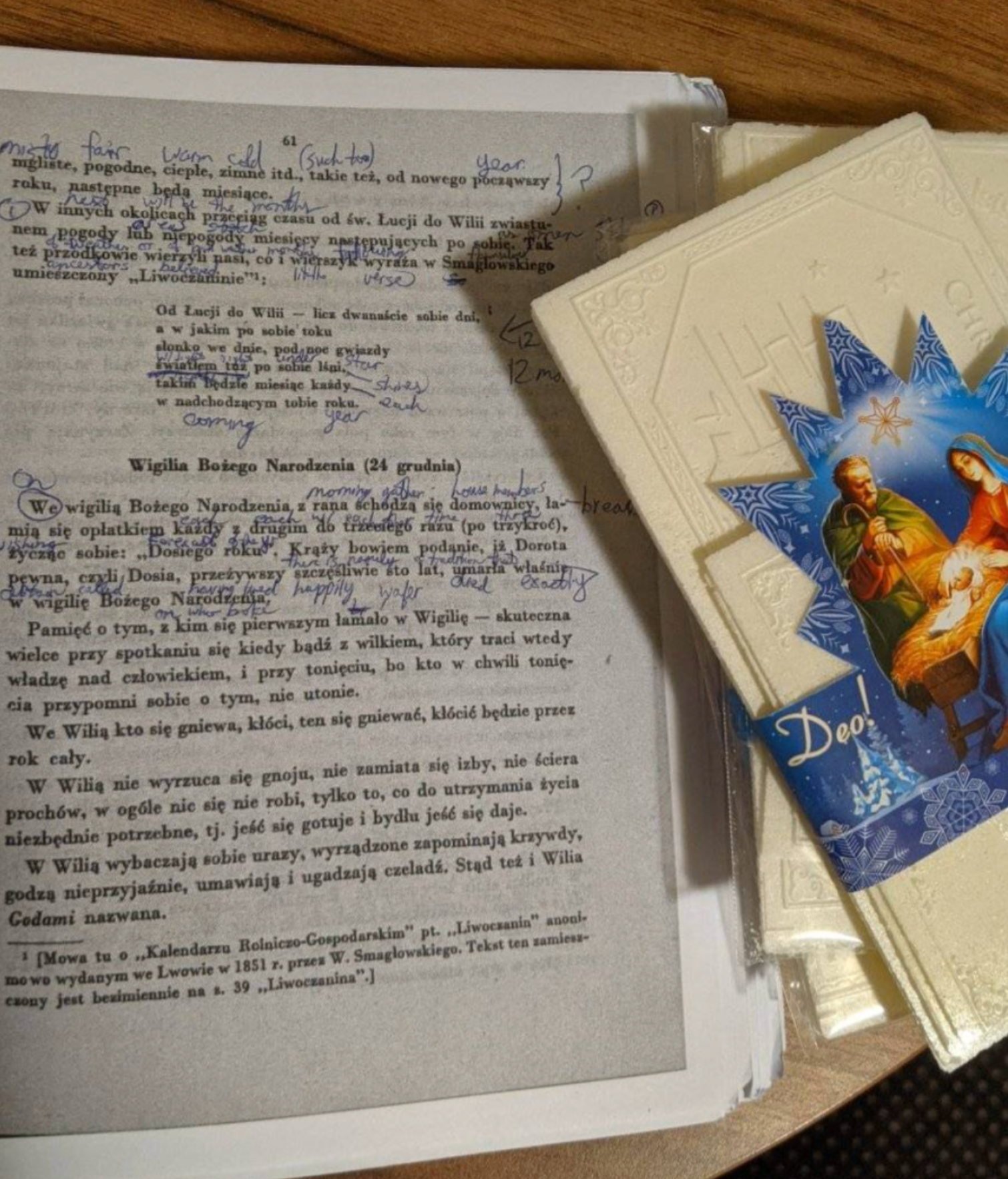
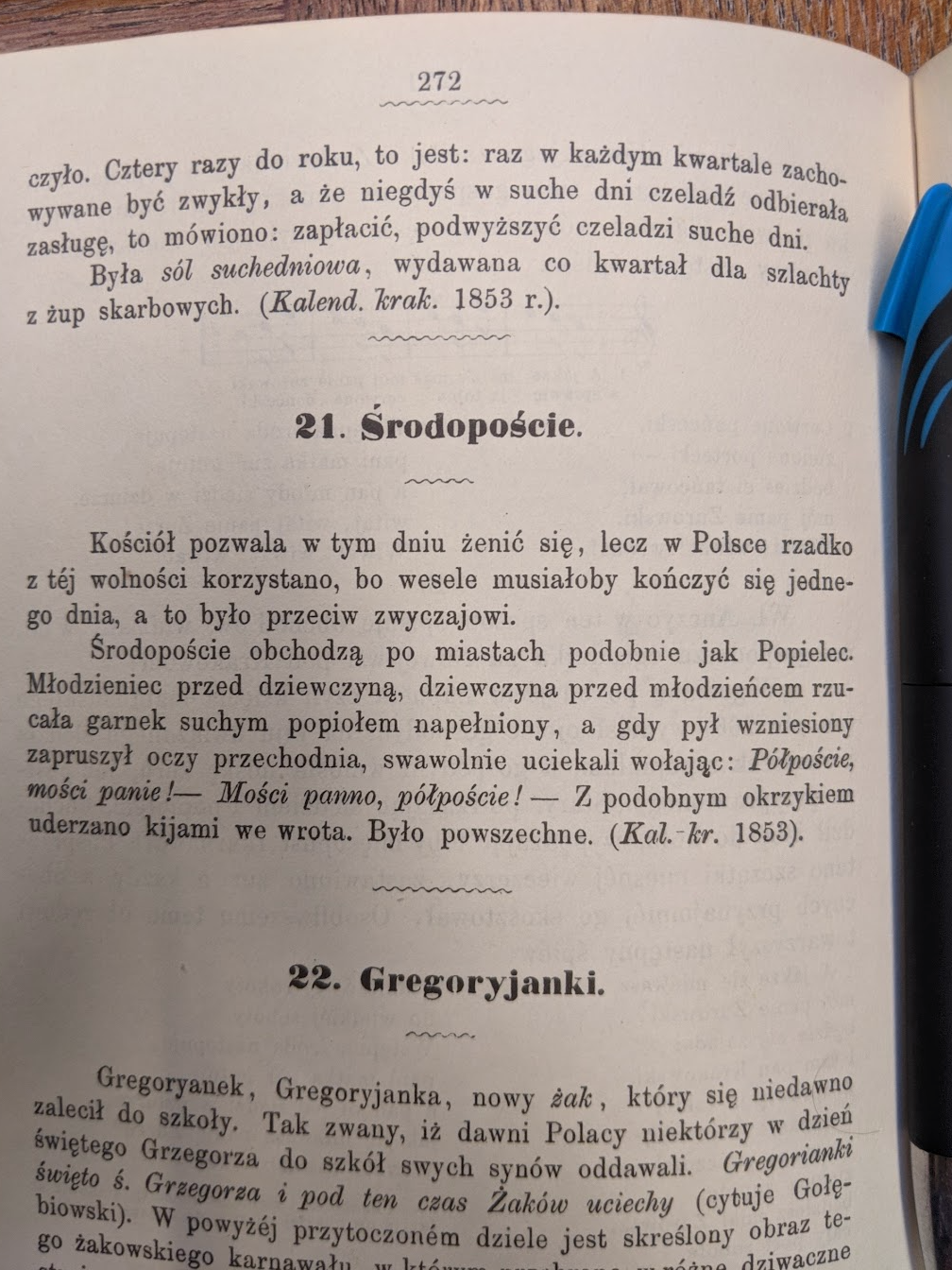
During November I began sustained work with the writings of Oskar Kolberg, especially the Tarnów-region volumes, while also studying the Partitions in Jagiellonian history courses. The pairing was decisive. Kolberg offered a record of village life gathered at the very moment when many future emigrants, my ancestors, were leaving.
This is the very world I wish to understand. The hardships, joys, and sorrows that my peasant ancestors left. And customs that faded with language.
I worked through the archaic language line by line, writing interlinear notes and extracting details of labor, feast days, hierarchy, repertoire, and seasonal life.
It is slow work, but very worth it.
• Primary source base: Kolberg’s Tarnów-region volumes
• Method: Line-by-line interlinear reading and extraction of social and musical detail
• Historical frame: Archive work integrated with formal study of the Partitions
• Public use: Findings began to inform public-facing posts for Nebraska Polonia audiences
• Research significance: Strengthened pre-emigration context for later diaspora comparison
• Method: Line-by-line interlinear reading and extraction of social and musical detail
• Historical frame: Archive work integrated with formal study of the Partitions
• Public use: Findings began to inform public-facing posts for Nebraska Polonia audiences
• Research significance: Strengthened pre-emigration context for later diaspora comparison
Early November - Diaspora Continuity: Festiwal Na Górale Nutę (Chicago)
At the beginning of November, I briefly crossed the Atlantic again. I flew from Poland to Chicago on invitation from Wojciech Dorula to attend Festiwal Na Górale Nutę, a major gathering of Górale music and dance in the Polish-American community.
The Górale, highlanders of southern Poland, are known for particularly strong musical, dance, and communal traditions. Chicago remains one of the most important diaspora centers where these traditions are still actively lived rather than merely remembered. Seeing this continuity outside Poland clarified something essential: emigration does not automatically sever tradition, but it does change the conditions under which it must survive.
What I was studying and practicing locally, language, workshops, parish rhythm, was mirrored in Chicago through community effort rather than geography alone. The trip reinforced the emerging direction of my work: not Poland versus diaspora, but the living exchange between them.
This experience fed directly back into the questions guiding my studies and fieldwork, confirming that ethnomusicology, genealogy, and reconnection must be held together if continuity is to be restored.
Local leaders and I met. Relationships were formed.
Of utmost importance, I was invited to join the Góralski ensemble Skalni.
A girl approached me, and said something to me in Polish.
"Przepraszam, moj polska nie najlepszy."
Shocked, she looked me in the eye.
She explained she saw me only weeks before at V Podhalańskie Spotkanie z Folklorem Tradycyjnym Karpat, and thought I was Polish.
I explained who I was. Another surreal moment. Speaking with someone across the ocean in America I had met recently in the Polish mountains.
As I left, I asked her if there was a place I could learn this tradition.
"Not really..."
Understanding, I nodded and turned away.
"Wait."
"Please join us, on next Monday. For the first recruit class. You can see how we practice."
I noted it in the calendar.
I started to note Podhale as a model of how tradition sustained could look, adjacent to my interest in the lost musicology of the Tarnów region, and began to become curious as to what structures make it hold so well. The practice was something I could not pass up.
Upon returning, I relayed these experiences to Prof. Jan Lencznarowicz, my good professor of history, who gave me his own insights based on his experiences with the Polonia worldwide. He has since become somewhat of a mentor.
• Setting: Festiwal Na Górale Nutę in Chicago
• Diaspora significance: Encounter with a living Góral tradition outside Poland
• Research effect: Clarified that emigration changes, but does not automatically sever, tradition
• Comparative value: Chicago and Poland began to read as linked fields
• Methodological result: Podhale emerged as a model of strong cultural transmission
• Diaspora significance: Encounter with a living Góral tradition outside Poland
• Research effect: Clarified that emigration changes, but does not automatically sever, tradition
• Comparative value: Chicago and Poland began to read as linked fields
• Methodological result: Podhale emerged as a model of strong cultural transmission
November 11 - Independence Day
On November 11, Poland’s Independence Day, I marked the day in modest form by playing Hej od Krakowa jadę and Mazurek Dąbrowskiego with friends after returning from an international flight.
• Date: November 11, Polish Independence Day
• Practice: Informal performance with friends
• Repertoire: Hej od Krakowa jadę; Mazurek Dąbrowskiego. Began to slowly, imperfectly, understand the patriotism our Polish history professor, Prof. Jan Lencznarowicz, had been elaborating on
• Meaning: Participation began to replace observation in everyday cultural life
• Practice: Informal performance with friends
• Repertoire: Hej od Krakowa jadę; Mazurek Dąbrowskiego. Began to slowly, imperfectly, understand the patriotism our Polish history professor, Prof. Jan Lencznarowicz, had been elaborating on
• Meaning: Participation began to replace observation in everyday cultural life
Oczepiny at Rydlówka
In November, I encountered oczepiny through active participation in a historically grounded reconstruction in Kraków.
Through my friends I made in Teatr Złoty Róg, working in conjunction with Muzeum Krakowa, I took part of a celebration at Rydlówka.
This is the old Bronowice house where the wedding of Lucjan Rydel and Jadwiga Mikołajczykówna took place, later becoming the basis for Stanisław Wyspiański’s renowned Wesele.
Today, the house is owned by Muzeum Krakowa.
Wyspiański had been present and observed the event closely enough to transform it into drama.
I was invited to take the role of the pan młody, place the cap on the girl during the rite, and deliver short lines in Polish.
A custom I had first encountered through reading and later through diaspora memory had to be entered as sequence, gesture, social position, and public action. The event also introduced me to Muzeum Krakowa figures and to a practice-oriented network where performance serves as a serious medium of historical and cultural transmission.
It deepened ties in a community that carries on tradition in a world so quickly changing.
Their hospitality was something of the old world, too! Gość w dom, jest Bóg w dom.
Between performances, of which there were perhaps 12, we feasted in side rooms. I was further imersed in Polish, and old folk music, played in both the performances for the tourists, and shred on the strings in the side rooms while we feasted and bonded.
• Setting: Rydlówka, original site of the Rydel wedding
• Historical frame: Reconstruction linked to the real wedding behind Wyspiański’s Wesele
• Partners: Teatr Złoty Róg and Muzeum Krakowa
• Role: Invited to act as pan młody
• Action: Performed the cap placement and spoke short lines in Polish
• Network gain: Introduced to Muzeum Krakowa figures and related cultural practitioners
• Methodological value: Reconstruction used as a bridge between scholarship, performance, and later diaspora comparison
• Historical frame: Reconstruction linked to the real wedding behind Wyspiański’s Wesele
• Partners: Teatr Złoty Róg and Muzeum Krakowa
• Role: Invited to act as pan młody
• Action: Performed the cap placement and spoke short lines in Polish
• Network gain: Introduced to Muzeum Krakowa figures and related cultural practitioners
• Methodological value: Reconstruction used as a bridge between scholarship, performance, and later diaspora comparison
XI. December: Ritual, Media, and Public Voice
Spirit Catholic Radio Interview
In December I joined Spirit Mornings on Spirit Catholic Radio in Nebraska for a live interview on memory, faith, and cultural loss across Poland and the American Midwest. The segment emerged from months of correspondence, preparation, revision, and technical clarification. I sent advance outlines, planned around production realities, and joined the program live from Poland.
Eager to share the music of the growing artistic networks I had been forging in Poland, I asked if I could play music I had encountered.
The station responded that they could not air previously recorded music by Polish musicians because of copyright concerns.
So I gathered a small group and made a new recording specifically for the interview.
Though I was only about a month into learning both Polish and violin, I reached out, organized the session, and recorded a brief version of Góra się z górom rozlywo with Jan Niezgoda and Monika Sobolewska. The song came from the Babia Góra region rather than my own Tarnów area, but it fit the segment’s themes of faith, distance, family, and what migration carries and leaves behind.
The station later published the interview online for replay and sharing. That transformed the appearance from a one-time conversation into a reusable public document of my growing project in motion.
• Outlet: Spirit Mornings, Spirit Catholic Radio Nebraska
• Date: December 9, 2025
• Format: Live radio interview with online replay afterward
• Preparation: Multi-week correspondence, outlines, clip planning, follow-up
• Production initiative: Organized a new recording when existing material could not be aired
• Collaborators: Jan Niezgoda; Monika Sobolewska
• Repertoire: Góra się z górom rozlywo, Babia Góra region
• Public-facing Result: Translated fieldwork into accessible language for a broad diaspora audience
• Date: December 9, 2025
• Format: Live radio interview with online replay afterward
• Preparation: Multi-week correspondence, outlines, clip planning, follow-up
• Production initiative: Organized a new recording when existing material could not be aired
• Collaborators: Jan Niezgoda; Monika Sobolewska
• Repertoire: Góra się z górom rozlywo, Babia Góra region
• Public-facing Result: Translated fieldwork into accessible language for a broad diaspora audience
Wigilia with Skalni
Skalni is a highlander dance ensemble whom I met in Chicago at the aforementioned Festiwal. Founded in 1952 by members of Akademia Medyczna, Politechnika Krakowska,Wyższa Szkoła Ekonomiczna, and theWyższa Szkoła Wychowania Fizycznego, the group carries on highlander traditions for those college students far away from their mountainous home.
Dr. Timothy Cooley, professor of ethnomusicology at UC Santa Barbara, whom I had met through reference of dr hab. Monika Golonka-Czajkowska, prof. UJ, told me this group was very important to such students in preserving their tradition while far from home.
I joined this group quite by chance, or, at this stage, at least the recruit group.
A girl noticed me from the workshop in Ludmierz. She approached me.
She was surprised I was not Polish, since I had not spoken much at the workshop.
She was even more surprised I was learning their language. I asked her kindly if there is anywhere I could learn this song and dance tradition. She invited me to join the newcomer group for Skalni.
On the third Wednesday of Advent, I arrived at Skalni expecting rehearsal and stepped instead into Wigilia. Permission was granted to stay. Prayer began. Opłatek circulated person to person. Then instruments emerged, circles formed, and the room became a living lesson in how continuity survives through repetition, correction, and song.
I had encountered Opłatek in the classroom at a UJ workshop just a few days before. Unfortunately, the little time we had did not allow the instructors to explain to us fully what it was.
Here, I began to understand. Many individuals, through the creaking open door that was Polish, wished me well.
I began to understand some, but still with a struggle.
I stayed mostly at the edge, listening. That was the right place. More than any explanation could have done, the evening showed what an unbroken transmission system feels like from the inside: exacting, collective, beautiful, and not arranged for outsiders. Song and music played powerfully through the night. I left without announcement, but with a sharper sense of what my own work lacked and what it would have to grow toward.
That night, I began to consider ways I could carry this culture home, to the old Polonia in Nebraska that had forgotten traditions, through action, and potential future institutional collaboration.
• Context: Wigilia gathering within an active folk ensemble
• Entry: Explicit permission requested and granted
• Ritual: Shared prayer; Gospel; opłatek exchange; spoken blessings
• Music: Informal circles, violin-led playing
• Entry: Explicit permission requested and granted
• Ritual: Shared prayer; Gospel; opłatek exchange; spoken blessings
• Music: Informal circles, violin-led playing
Skrzyszów Christmas and Kolędy
December also returned me to the ancestral region for Wigilia and related feast days. I was invited by my friends, Dominik and Dominika Nowak, per the standard Polish custom "gość w dom, Bóg w dom". Around the same time, I also joined kolędy-procession in Kraków, including violin playing.
• Christmas spent in ancestral-area village settings
• Invitation: Encounter with living holiday custom in family and parish context
• Musical role: Violin participation Muzeum Krakówa-led Kolędy procession in Kraków
• Research gain: Holiday life provided concrete context for earlier readings and field questions
• Invitation: Encounter with living holiday custom in family and parish context
• Musical role: Violin participation Muzeum Krakówa-led Kolędy procession in Kraków
• Research gain: Holiday life provided concrete context for earlier readings and field questions
XII. January: Fieldwork, First Semester Exams
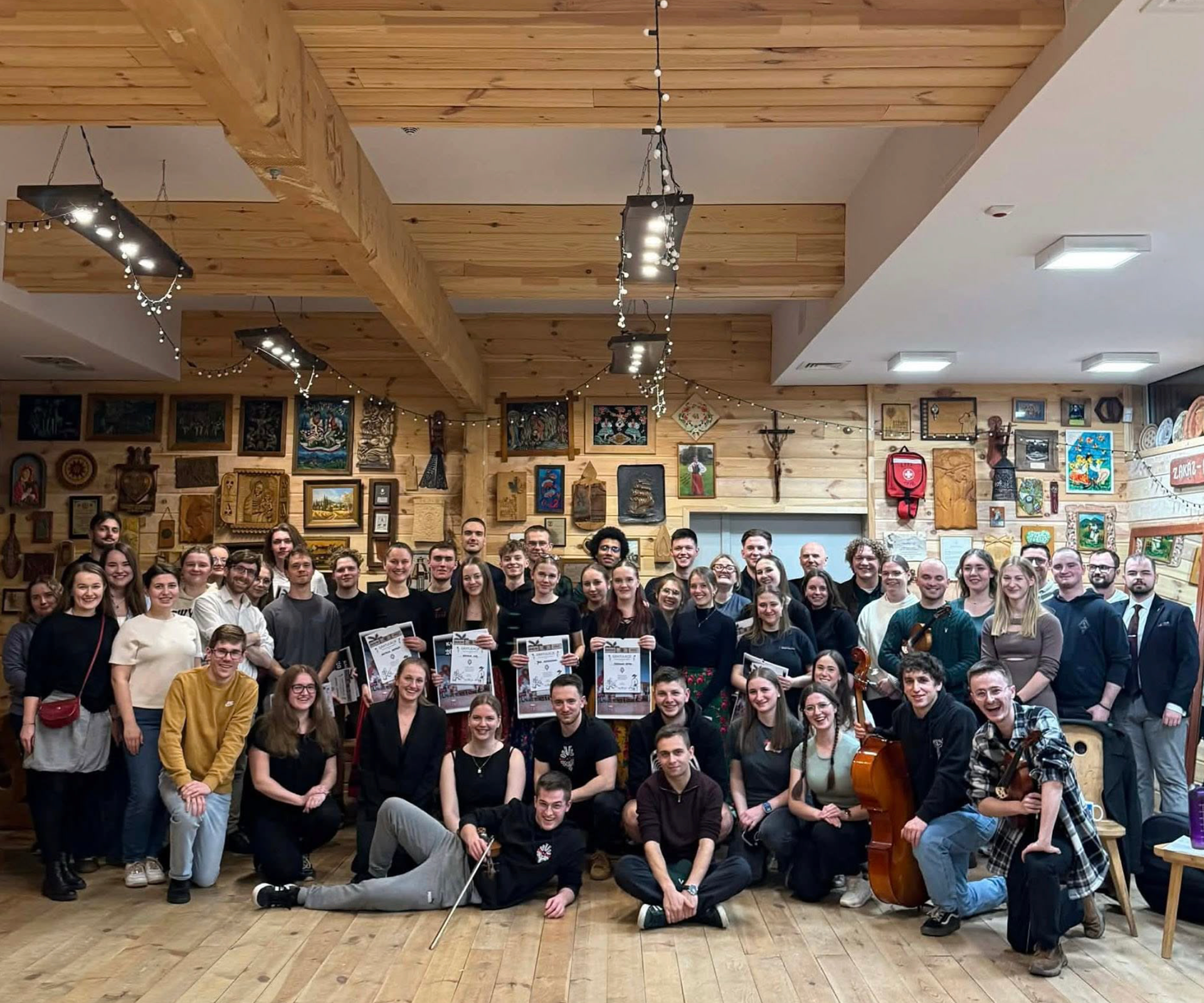
January brought a change of terrain rather than a break in the work. I returned to the United States not to pause the project, but to test what had been forming in Poland against the surviving fragments of old Polonia memory in Nebraska. At the same time, formal archive access and new regional collaborations began moving the work from enthusiasm into structure.
• Focus: Field verification, archive access, and comparative method
• Locations: Nebraska, Poland, Podhale, and Tarnów-region
• Result: My path gained clearer structure and stronger institutional footing
• Locations: Nebraska, Poland, Podhale, and Tarnów-region
• Result: My path gained clearer structure and stronger institutional footing
Nebraska Fieldwork
I returned to the United States not to pause the work, but to test it. Nebraska became the field. I moved through family homes, parish halls, and community spaces with a simple sequence: listen, record, compare. Wedding music, “house to church” melodies, variants of oczepiny, and older social memory surfaced in fragments. The material was partial, aging, and often vulnerable to disappearance, but it was still there.
What Poland had given me was a frame for hearing it. Without that formation, the fragments would have remained isolated. With it, they could begin to form a comparative body of evidence connecting diaspora memory to regional Polish practice.
• Nebraska "Old" Polonia, homes, parishes, legacy musicians, community institutions
• Method: Listen, record, compare, contextualize
• Material captured: Wedding repertoire, funeral and wedding memory, ritual variants, melodic fragments
• Interpretive key: Poland-side formation made diaspora material legible in new ways
• Project consequence: Poland and Nebraska were confirmed as two sides of one research field
• Method: Listen, record, compare, contextualize
• Material captured: Wedding repertoire, funeral and wedding memory, ritual variants, melodic fragments
• Interpretive key: Poland-side formation made diaspora material legible in new ways
• Project consequence: Poland and Nebraska were confirmed as two sides of one research field
Exams and Language Pressure
January also imposed academic challenges. After concentrated late-night study sessions, I passed the exams, with especially strong gains in listening and comprehension. The result was modest but important. Language progress could be measured. It was no longer only hoped for.
• Constraint: Intensive exam period under pressure
• Outcome: Exams passed successfully
• Measured gain: Listening and comprehension improved visibly
• Strategic value: Language progress became demonstrable, not aspirational
• Outcome: Exams passed successfully
• Measured gain: Listening and comprehension improved visibly
• Strategic value: Language progress became demonstrable, not aspirational
Family Meetings and Tree Research
The return period also included continued family meetings and tree work. This kept the project grounded. Archives and recordings remained crucial, but family remained the line through which the work retained its proper scale.
• Action: Continued contact with relatives alongside documentation work
• Methodological value: Prevented genealogy from collapsing into abstraction
• Result: Family remained the organizing center rather than a symbolic backdrop
• Methodological value: Prevented genealogy from collapsing into abstraction
• Result: Family remained the organizing center rather than a symbolic backdrop
IS PAN / Etnofon Research Access
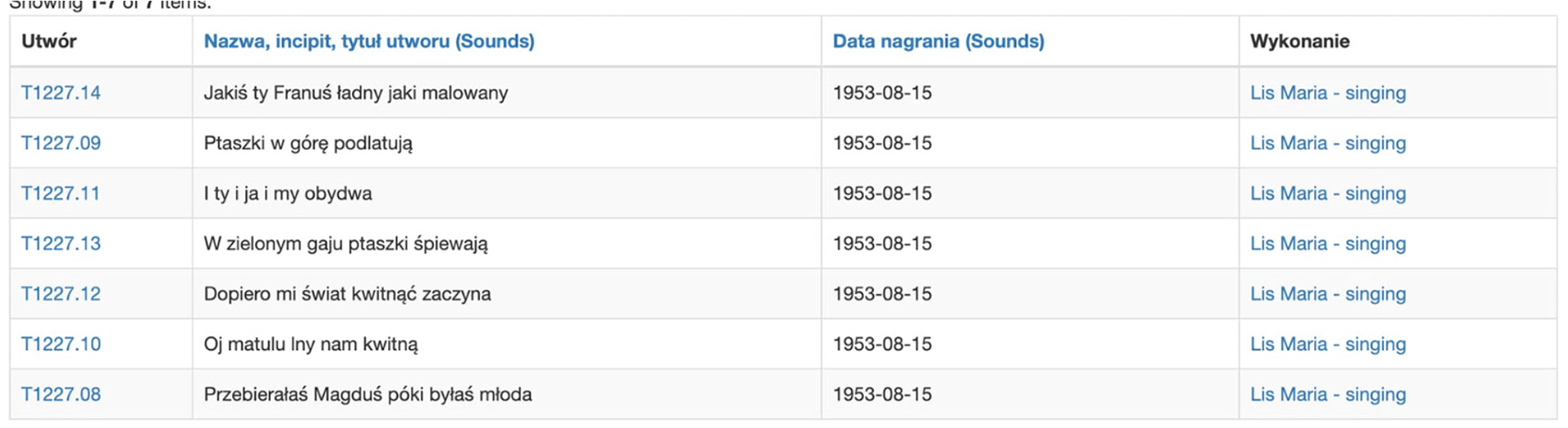
In January, after referral from the ethnography department, I contacted the phonographic collections of the Institute of Art of the Polish Academy of Sciences. I completed the paperwork, signed the required documents, and formalized researcher access. This shifted the work out of enthusiasm and into archive procedure.
The access mattered immediately. I began tracking recordings from Wola Rzędzińska and nearby Tarnów-region materials, and planning interviews connected to people who still remembered singers preserved in older recordings.
The opportunity is real, the pace is determined by my bettering language and opportunities.
• Institution: IS PAN / Etnofon phonographic collections
• Access level: Researcher access formally granted
• Process: NDA and archive paperwork completed and submitted
• Regional focus: Wola Rzędzińska and Tarnów-area materials
• Research gain: Transition from informal searching to structured archival procedure
• Constraint exposed: Polish remains the key limiting factor in follow-up and interpretation. It is of course, improving daily.
• Access level: Researcher access formally granted
• Process: NDA and archive paperwork completed and submitted
• Regional focus: Wola Rzędzińska and Tarnów-area materials
• Research gain: Transition from informal searching to structured archival procedure
• Constraint exposed: Polish remains the key limiting factor in follow-up and interpretation. It is of course, improving daily.
Zalasowianie and the Return of the Family Album
By January, the Tarnów-region line of work produced one of its clearest local responses. After earlier correspondence, I shared recordings from my family’s 1970s Nebraska album with people connected to Zalasowianie and received an unusually open reply. They listened seriously, compared the material to what they already knew, and recognized that at least some of it might be useful for understanding what had survived, shifted, or been reshaped by later polka influence.
Then I went to meet them. When I arrived, I was greeted not with explanation but with sound: they welcomed me by playing a song from the ancestral album itself. That moment was decisive. What had survived in diaspora form had returned to the home region as living sound. The meeting then moved quickly into practical discussion, including the possibility of rereleasing the original project in new recorded form under clearer research parameters, with closer comparison to local style, repertory memory, and regional knowledge.
• Primary contacts: Natalia Zabawa; Anna Wenc-Zabawa; Zalasowianie
• Action: Shared the family album and contextual notes
• Reception: Diaspora material taken seriously by regional practitioners
• Key moment: Welcomed with performance of a song from the ancestral album
• Forward outcome: Discussion opened around rerecording the project under strong research parameters
• Significance: Diaspora repertoire re-entered the home region as active source material, not only archive
• Action: Shared the family album and contextual notes
• Reception: Diaspora material taken seriously by regional practitioners
• Key moment: Welcomed with performance of a song from the ancestral album
• Forward outcome: Discussion opened around rerecording the project under strong research parameters
• Significance: Diaspora repertoire re-entered the home region as active source material, not only archive
Skalni Trial, Audition, and Entry
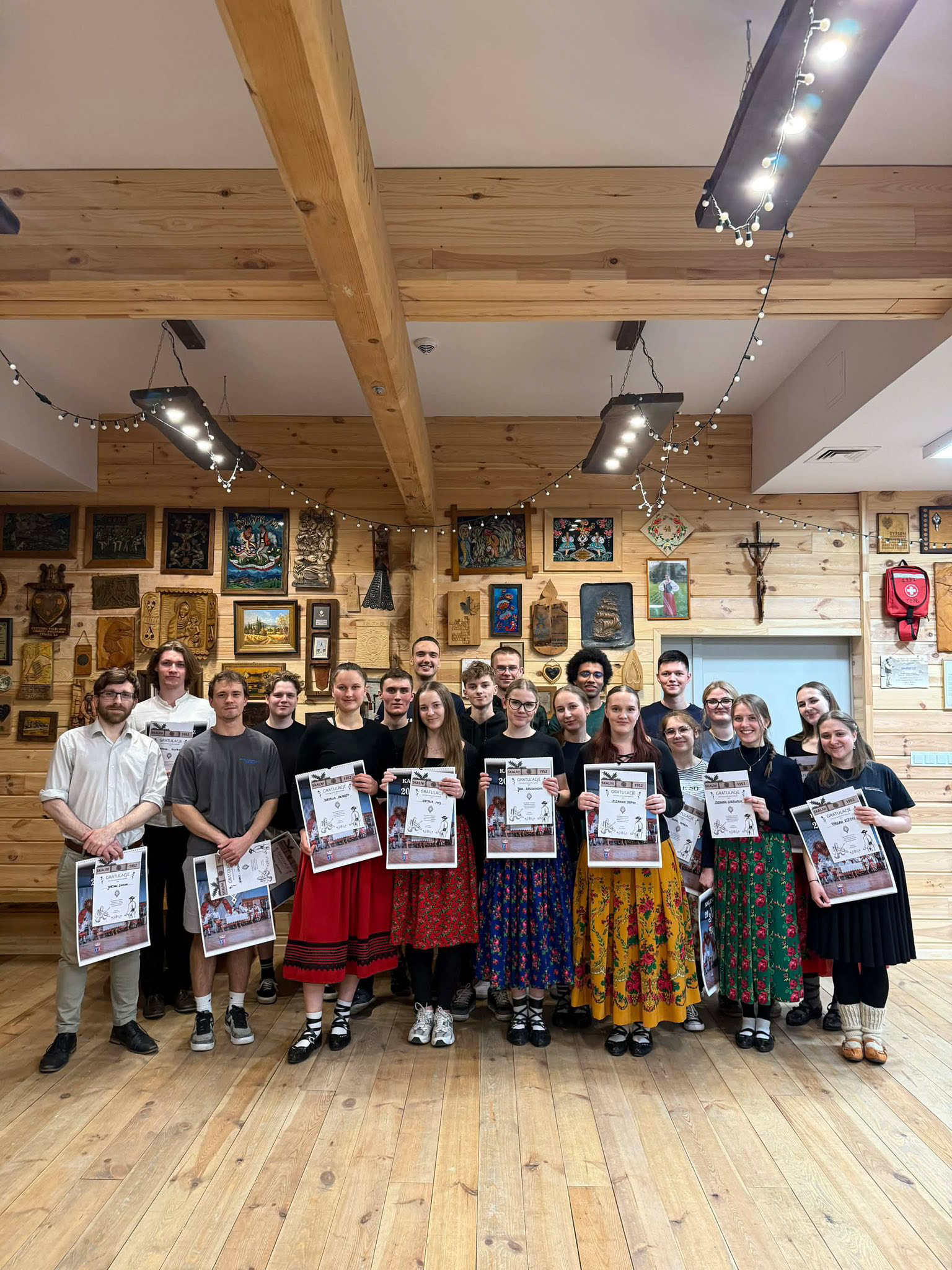
By January, the trial period around Skalni was over. If I wanted in, I had to earn it. Over the previous months, I had come to see Podhale as one of the few places where music and dance transmission still functioned with real internal strength. That made it important beyond regional interest. If I hoped to work seriously with Tarnów-region revival, diaspora comparison, and groups such as Zalasowianie, I needed to understand a living transmission system from within.
I rented a hall five times to practice, worked with Polish friends to drill the material, and closed part of the gap between language, body, and expectation. Then came the test. Józef recognized me from Chicago, asked about family in Poland, listened, and danced with me. I was accepted and continued into training camp. What I gained there was larger than repertoire. I gained an interior view of how tradition is corrected, normalized, and carried through disciplined collective form.
• Preparation: Private hall rental and focused drilling with Polish friends
• Evaluation: Evaluation through conversation and dance under leadership eye
• Result: Accepted into Skalni and continued into training camp
• Research value: Entry into an active transmission system from the inside
• Comparative importance: Podhale became a methodological laboratory for later Tarnów and diaspora work
• Evaluation: Evaluation through conversation and dance under leadership eye
• Result: Accepted into Skalni and continued into training camp
• Research value: Entry into an active transmission system from the inside
• Comparative importance: Podhale became a methodological laboratory for later Tarnów and diaspora work
XIII. February and March: Training and Language Growth
By February and March, my work had moved fully into sustained practice. Podhale emerged more clearly as my networks deepened there, and language pressure sharpened into one of the central practical growth points, but also limits on the work.
• Focus: Training, method, and linguistic realism
• Main gain: Clearer understanding of how strong transmission systems actually function
• Main limit: Polish language remains the key threshold to deeper access
• Main gain: Clearer understanding of how strong transmission systems actually function
• Main limit: Polish language remains the key threshold to deeper access
Skalni Training Camp and Research Method
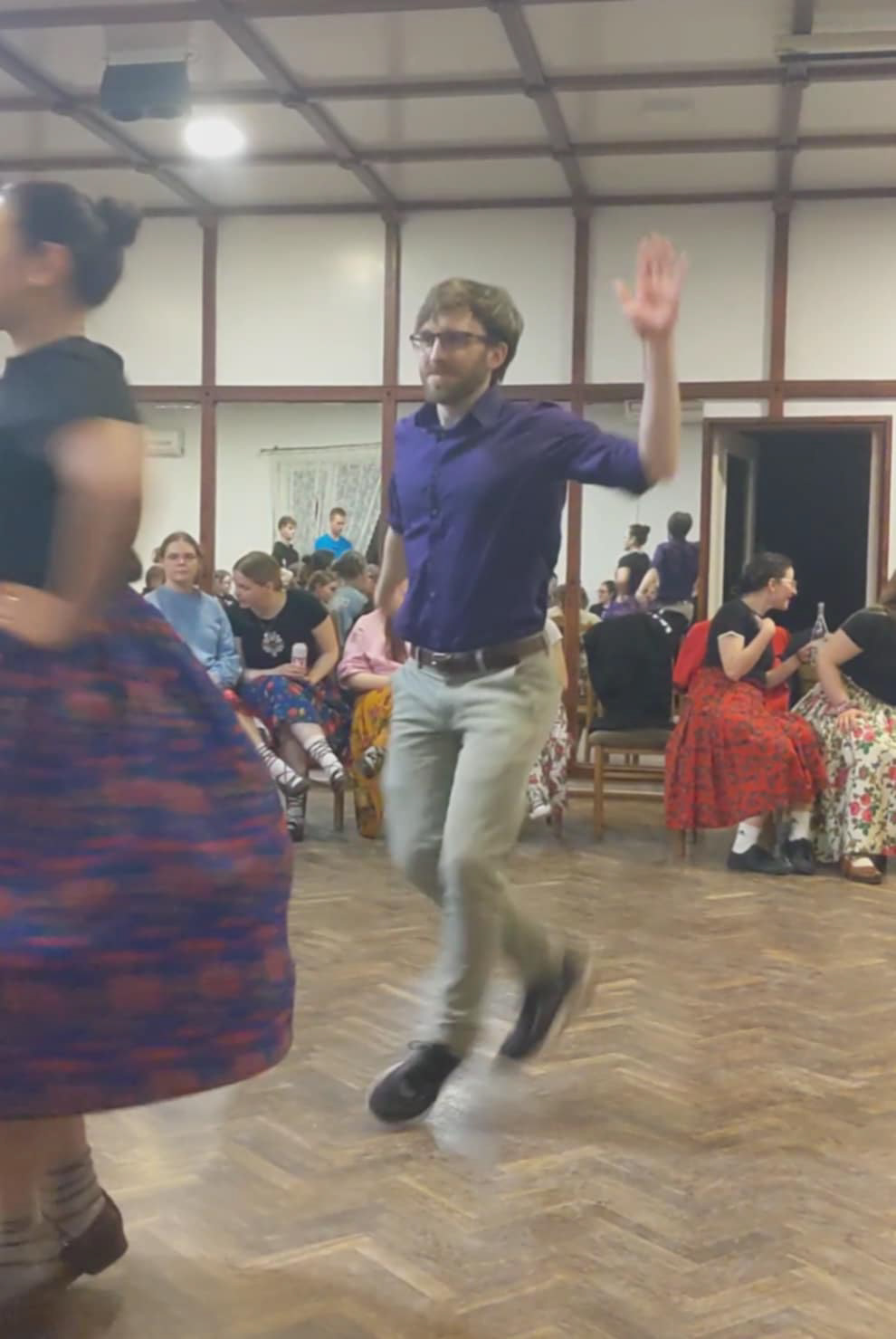
The training camp that followed acceptance into Skalni was formative. Long days, repeated correction, song circles, rapid dances, informal after-hours practice, and camp intensity all showed how tradition survives when a group still takes it seriously enough to rehearse it, demand it, and normalize it together. I joined to study that process from inside.
Podhale now stands in the project not only as a region of admiration, but as a living laboratory for transmission. It offers practical lessons for what restoration and group memory might someday look like elsewhere, including in diaspora communities that lost stronger forms much earlier.
• Setting: Skalni training camp and ongoing advanced practice
• Observed: Greeting customs, song circles, rapid dances, potańcówki
• Embodied milestone: Danced my first góralski within the group’s training context
• Research value: Direct exposure to a functioning transmission system
• Comparative use: Podhale serves as a model against which weaker transmission zones, such as my ancestral region of Tarnów / Wola Rzęńdzinska / Jadłowka-Wałki, as well as my ancestral region of Tarnov in Nebraska, can be read
• Long-term significance: Method, not only repertoire, is now being studied and absorbed
• Observed: Greeting customs, song circles, rapid dances, potańcówki
• Embodied milestone: Danced my first góralski within the group’s training context
• Research value: Direct exposure to a functioning transmission system
• Comparative use: Podhale serves as a model against which weaker transmission zones, such as my ancestral region of Tarnów / Wola Rzęńdzinska / Jadłowka-Wałki, as well as my ancestral region of Tarnov in Nebraska, can be read
• Long-term significance: Method, not only repertoire, is now being studied and absorbed
Language Growth as the Next Threshold
Polish is now central in determining the depth of the work ahead. Daily life in archives, rehearsals, village settings, and ordinary conversation has already shown how much becomes possible when even partial language ability is put to use in real situations. It has also clarified the next requirement. To move from promising access to deeper field competence, I have committed to two hours of Polish study each day. Stronger fluency will allow this work to expand beyond first contact and guided participation into fuller conversation, better interpretation, stronger trust, and more precise documentation.
This is not a side goal added to the project. It is the next threshold. Reaching B2 would make it possible to work more responsibly with older villagers, archival material, informal speech, humor, and the unspoken cultural logic that often disappears in translation. Language study is therefore not supplementary to the research. It is the condition for carrying it further.
• Present use: Polish already applied across archives, rehearsals, village contact, and everyday life
• Commitment: Daily study increased to two hours a day
• Next threshold: Stronger fluency will convert partial access into full
• Research value: Better Polish will open older speakers, informal trust, nuance, humor, and sharper interpretation
• Strategic direction: B2 is now the clearest practical step toward more serious ethnographic and archival work
• Commitment: Daily study increased to two hours a day
• Next threshold: Stronger fluency will convert partial access into full
• Research value: Better Polish will open older speakers, informal trust, nuance, humor, and sharper interpretation
• Strategic direction: B2 is now the clearest practical step toward more serious ethnographic and archival work
Cultural Amnesia Invite
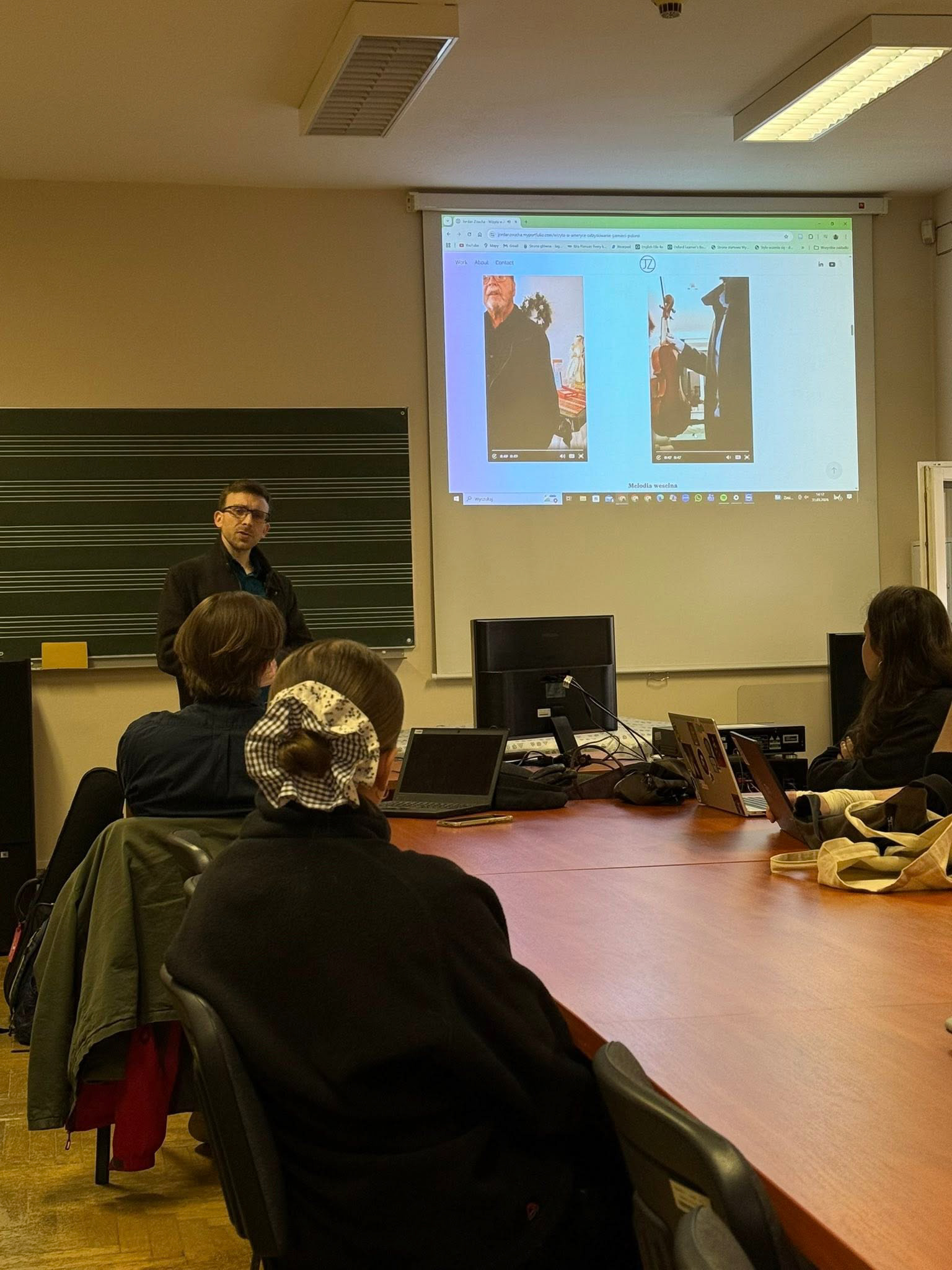
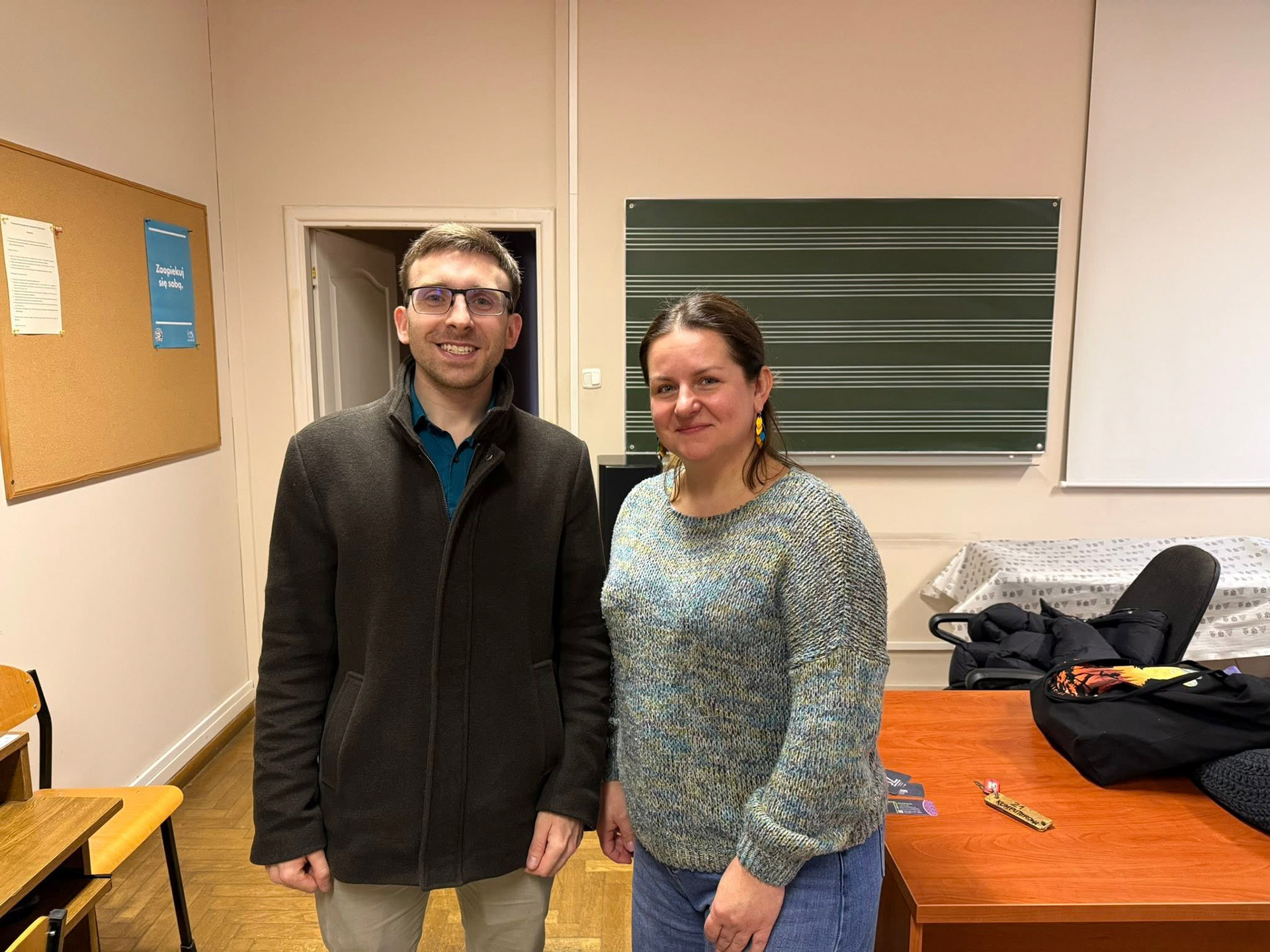
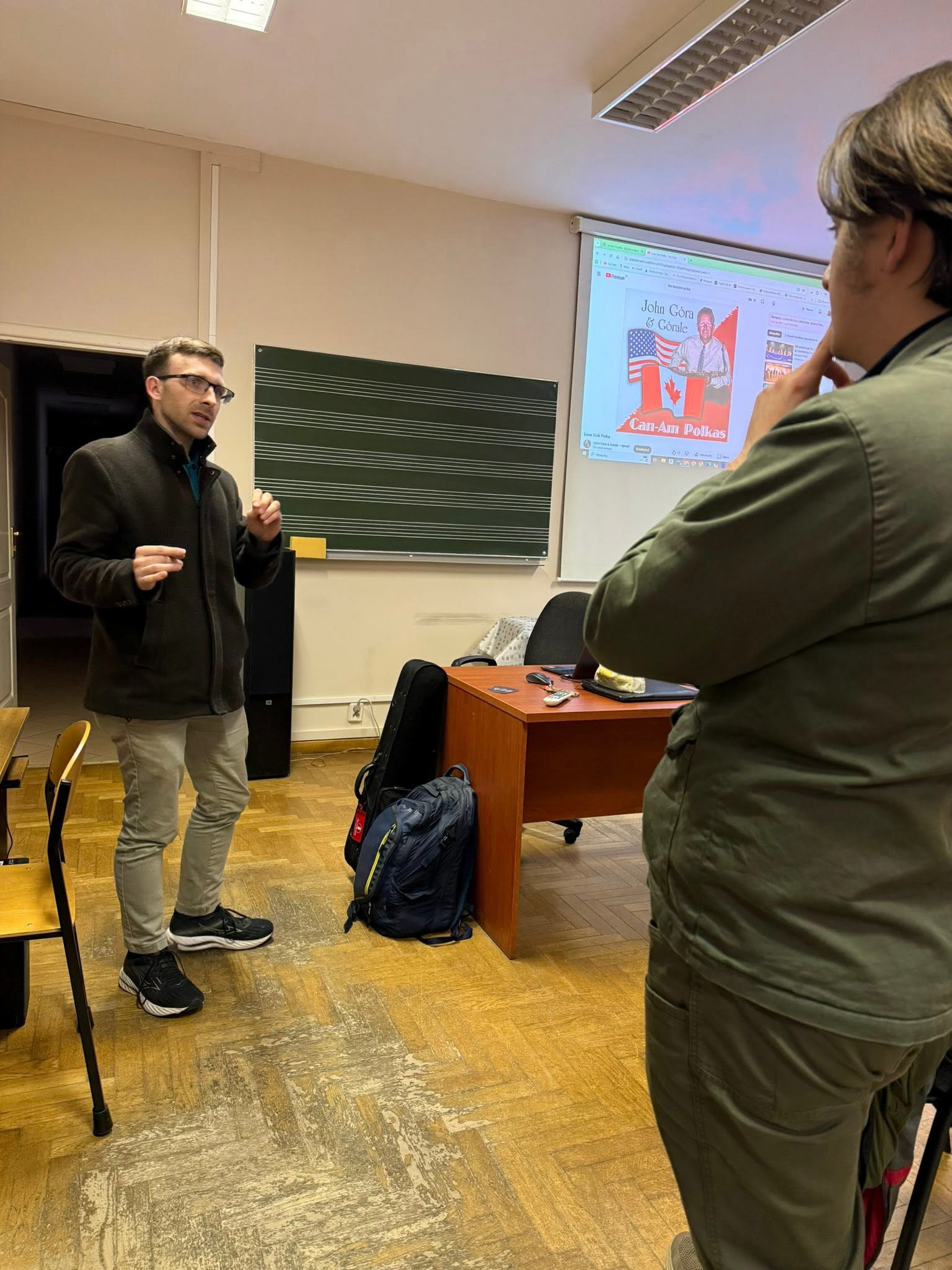
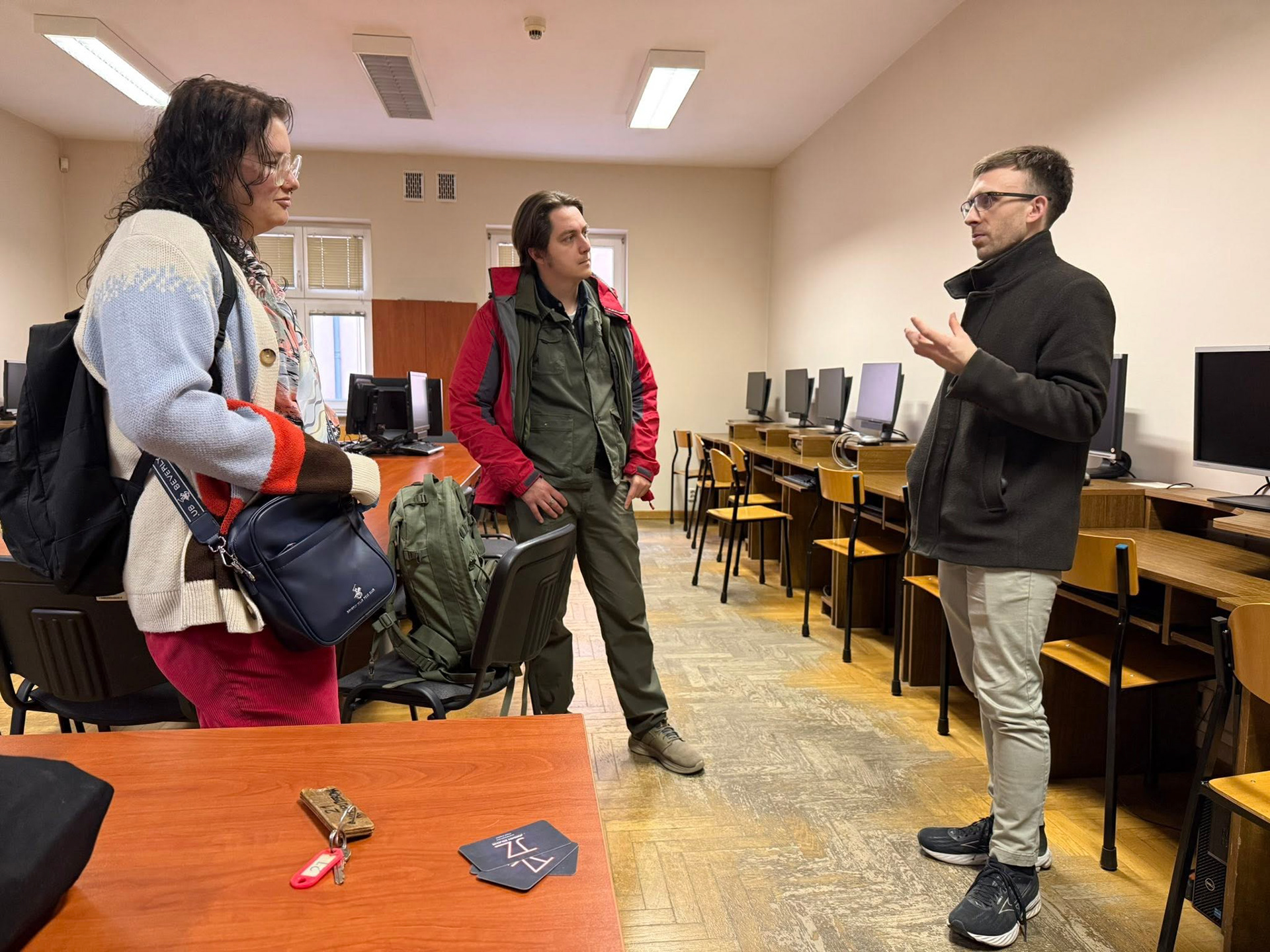
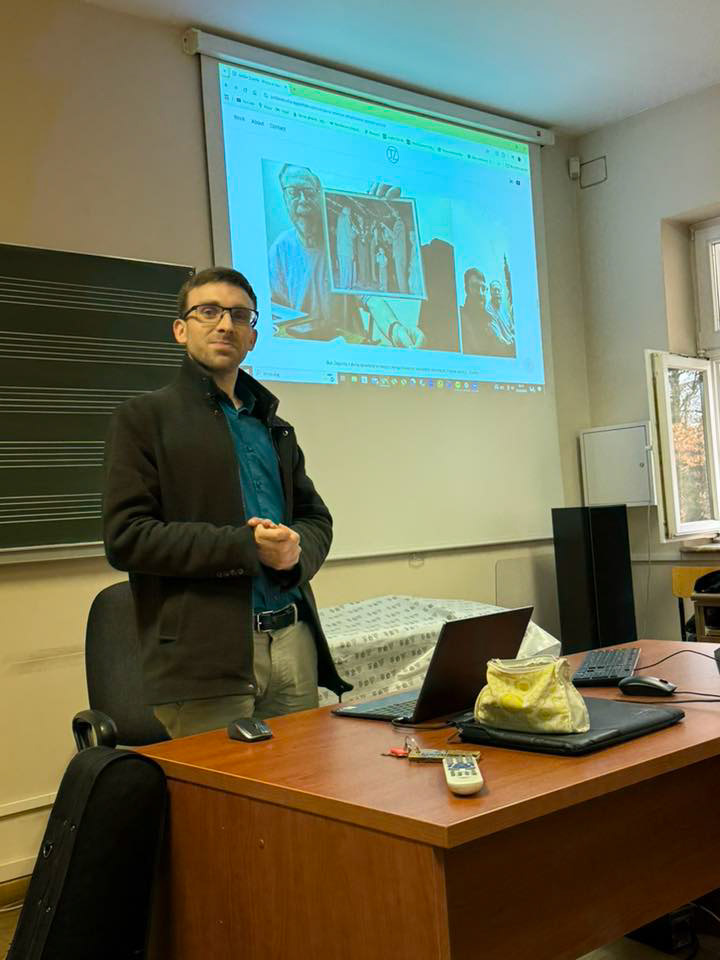
This visit formed a clear step in the public and educational dimension of the work. Invited to join an English-language class with musicology students, I presented a developing framework centered on cultural amnesia and the gradual loss of tradition within migrant communities. The aim was not only to explain, but to test ideas in dialogue, drawing on observations from work in the American Midwest among descendants of nineteenth-century Polish migration.
The discussion focused on three stages of forgetting: the loss of language, the weakening of lived practice, and the fragmentation of identity. At the same time, it turned toward the possibility of return, understood not as nostalgia but as disciplined re-engagement through language, fieldwork, music, and contact with living communities. Particular emphasis was placed on Polish as a necessary tool for serious research, and on music as a living archive capable of preserving structures of meaning across generations.
The meeting confirmed that these questions resonate beyond diaspora contexts and can open productive exchange in Polish academic settings. It also reinforced that teaching and public speaking are not separate from research, but part of the same process: refining language, testing ideas, and placing work into circulation.
• Context: Invited guest session, English-language class for musicology students
• Theme: Cultural amnesia, migration, and return
• Focus: Three stages of forgetting: language, location, and large-scale 20th century social changes
• Method: Field observation, musical example, discussion
• Key element: Music as a living archive of memory
• Outcome: Productive exchange; refinement through dialogue
• Direction: Continued integration of research, fieldwork, and public engagement
• Theme: Cultural amnesia, migration, and return
• Focus: Three stages of forgetting: language, location, and large-scale 20th century social changes
• Method: Field observation, musical example, discussion
• Key element: Music as a living archive of memory
• Outcome: Productive exchange; refinement through dialogue
• Direction: Continued integration of research, fieldwork, and public engagement
Institutional Partnership Horizon
As the network deepens, I have also begun thinking in institutional terms. If the right U.S.-side relationships can be built, there may be future possibilities for cultural promotion, exchange, teaching, and collaborative work involving Poland-based ensembles, diaspora institutions, and regional specialists. This remains early, but it is no longer imaginary.
• Scope: Poland-based ensembles, archives, and U.S. diaspora institutions
• Potential forms: Exchange, public teaching, collaborative recording, cultural promotion
• Current status: Exploratory, relational, and still developing
• Strategic value: Extends the project from personal return toward durable public structure
• Potential forms: Exchange, public teaching, collaborative recording, cultural promotion
• Current status: Exploratory, relational, and still developing
• Strategic value: Extends the project from personal return toward durable public structure
XIV. Public-Facing Social Media Outputs
Facebook and Instagram have become part of the working method. I use them to move material out of notebooks, archives, rehearsals, churches, and interviews into public circulation while the work is still alive. In practice, that means bilingual posts, short interpretive notes, event announcements, video excerpts, music previews, and visual documentation that make regional culture legible to descendants in the United States.
These platforms have also become a two-way channel. They do not only distribute finished thoughts. They generate response, memory, correction, and contact. Through public posts I have been able to prompt recollection, draw in local knowledge, test explanations, circulate repertoire, and keep a visible line open between the Tarnów region, Kraków, Chicago, and Nebraska. In that sense, social media has become one of the practical tools by which archival and field material begins moving back into living memory.
• Function: Facebook and Instagram used as bilingual public-facing dissemination tools within the research process
• Format: Field notes, short explainers, workshop and event announcements, video excerpts, music previews, and photo-based documentation
• Content areas: Dance transmission, liturgical and seasonal customs, family and diaspora memory, repertoire recovery, regional history, and ongoing fieldwork in Poland and Nebraska
• Audience bridge: Posts written to reach both Poles and the Polish diaspora, often in parallel English and Polish versions
• Examples: Explanatory posts on kolędy, opłatek, Roraty, krakowiak, radio outputs, and diaspora repertoire identification
• Research use: Public posts serve as a soft form of crowdsourcing, eliciting memories, identifications, reactions, and follow-up contacts
• Strategic value: Social media functions as an early dissemination channel that keeps the work visible, relational, and testable while larger projects are still developing
• Format: Field notes, short explainers, workshop and event announcements, video excerpts, music previews, and photo-based documentation
• Content areas: Dance transmission, liturgical and seasonal customs, family and diaspora memory, repertoire recovery, regional history, and ongoing fieldwork in Poland and Nebraska
• Audience bridge: Posts written to reach both Poles and the Polish diaspora, often in parallel English and Polish versions
• Examples: Explanatory posts on kolędy, opłatek, Roraty, krakowiak, radio outputs, and diaspora repertoire identification
• Research use: Public posts serve as a soft form of crowdsourcing, eliciting memories, identifications, reactions, and follow-up contacts
• Strategic value: Social media functions as an early dissemination channel that keeps the work visible, relational, and testable while larger projects are still developing
XV. Summary and Forward Direction
This work is not finished. What appears here is the first serious phase of a longer effort: the formation of language, method, archive access, regional contacts, musical practice, and public outputs across Poland and the American Midwest. It remains grounded in a fifth-generation return to places my family no longer knew how to name, but it is now moving beyond return alone. It is becoming a structured program of comparative work.
The immediate aim is to continue in Poland next semester and reach B2 fluency, so that language no longer sets the ceiling on research, collaboration, and interpretation. From there the direction is clear enough to name: further study in ethnography or ethnomusicology, deeper archive work, stronger field documentation, continued collaboration with living communities, and more disciplined comparison between Tarnów-region traditions, Podhale methods of transmission, and diaspora memory in Nebraska and the wider Midwest.
What began as a search for family has become a longer obligation. The task now is not simply to recover fragments, but to understand the world that formed them and place that knowledge back into circulation, where it can be heard, tested, shared, and carried forward.
• Status: Ongoing, early-stage, but already active across archive, field, performance, and public dissemination
• Immediate next step: Continue in Poland next semester
• Language target: B2 Polish
• Academic direction: Ethnography or ethnomusicology
• Research direction: Tarnów region, Podhale transmission, Nebraska and Midwest diaspora comparison
• Public direction: Further media, teaching, recording, and collaborative dissemination
• Long-term aim: Reconnect broken lines of memory through disciplined work at the source and across the Atlantic
• Immediate next step: Continue in Poland next semester
• Language target: B2 Polish
• Academic direction: Ethnography or ethnomusicology
• Research direction: Tarnów region, Podhale transmission, Nebraska and Midwest diaspora comparison
• Public direction: Further media, teaching, recording, and collaborative dissemination
• Long-term aim: Reconnect broken lines of memory through disciplined work at the source and across the Atlantic